
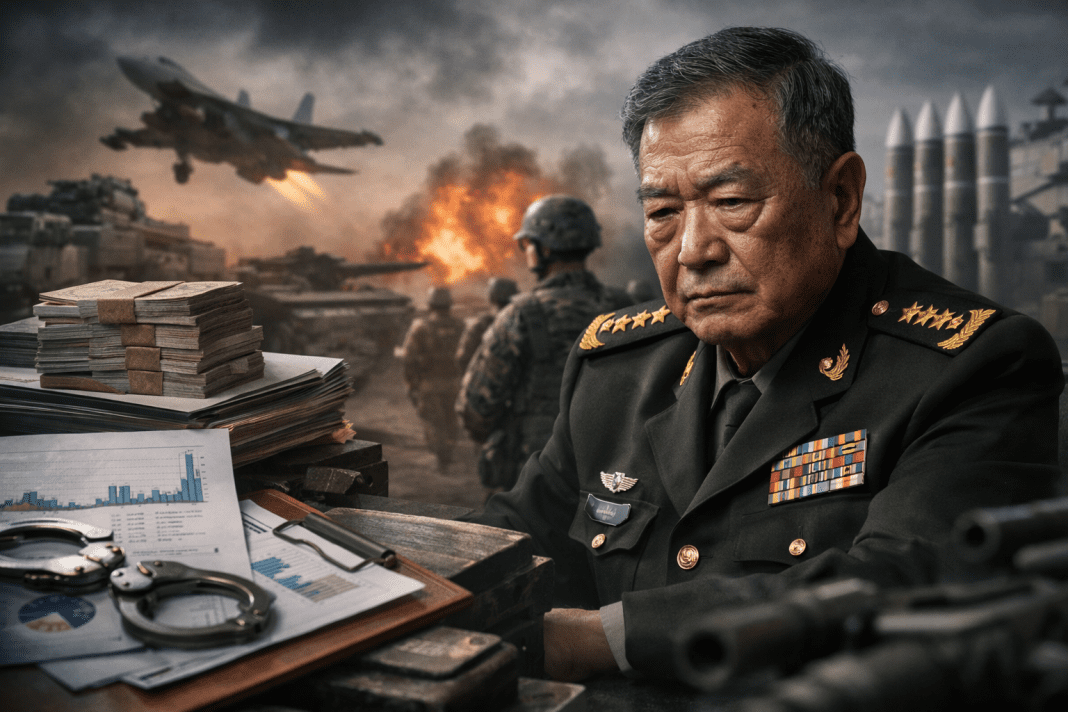

China’s official military newspaper, PLA Daily, has issued an unusually blunt warning about corruption inside the People’s Liberation Army (PLA), using the term “big rats” to describe officials accused of eating away at military funds and damaging combat readiness.
The phrase appeared in a commentary calling for strong action against corrupt practices linked to military spending. The article said such corruption weakens the PLA’s ability to fight and must be rooted out completely. While no individual was named, the timing of the commentary followed closely after the sudden removal of two of China’s most senior generals, including Zhang Youxia.
The term “big rat” is not commonly used in official military publications. It comes from the ancient Book of Songs and has long been understood in Chinese political language as a reference to greedy and corrupt officials who exploit state resources for personal gain. Observers noted that its use in a military context is rare and deliberate.
The commentary also stood out because it specifically mentioned tampering with military spending. Public accusations against PLA officers often focus on political disloyalty or moral failures, but direct references to budget misuse are far less common.
Zhang Youxia’s Roles Place Him at the Centre of Equipment Spending
Zhang Youxia was the first-ranked vice-chairman of the Central Military Commission (CMC), the body that controls China’s armed forces. His downfall was announced last weekend, along with the removal of Liu Zhenli, chief of the CMC Joint Staff Department. Chinese authorities have not released formal charges or details in either case.
According to Lyle Morris, a senior fellow at the Asia Society Policy Institute’s Centre for China Analysis, the “big rat” reference is likely aimed at Zhang. Morris said the language used in the PLA Daily article closely matches the seriousness of Zhang’s position and the nature of the accusations implied.
China conducts PLA patrols around Huangyan Island to safeguard sovereignty and monitor activity
China’s defence budget is the second largest in the world and has grown steadily over the past decade. A defence white paper published in 2019 divided the budget into three main categories: troop training, personnel living expenses, and equipment funding.
Equipment funding covers research, testing, procurement, and maintenance of weapons and military systems. This category has become the largest share of the budget, rising from 33.2 per cent in 2010 to 41 per cent in 2017. Equipment spending is also the area most closely linked to modernisation and combat capability.
Zhang’s career connects directly to this area. Before becoming vice-chairman of the CMC, he led the PLA’s Equipment Development Department from 2015 to 2017. He also oversaw its predecessor body from 2012. These years coincided with a major push to modernise China’s military hardware.
The same department has already been linked to corruption cases. Li Shangfu, who later succeeded Zhang in heading the equipment department and eventually became defence minister, was expelled from the Communist Party and the military in 2024. Authorities said Li had seriously damaged the political environment and professional standards in the military equipment sector.
Central Control, Combat Readiness, and Xi’s Chairman Responsibility System
From the DefTech Times perspective, the PLA Daily commentary reflects deeper institutional concerns rather than isolated misconduct. The article linked corruption directly to weakened combat readiness, a theme repeatedly stressed by China’s leadership.
Combat readiness depends on how effectively money is spent across training, personnel support, and equipment. The PLA Daily argued that corruption in budgeting directly harms real military capability, not just administrative integrity.
Historically, PLA commanders and regional units were allowed some freedom in deciding how to spend funds on weapons and supplies. According to Morris, this created space for regional power bases to form, sometimes operating with limited oversight from Beijing.
This background helps explain Xi Jinping’s emphasis on the chairman responsibility system. Under this system, Xi, as chairman of the CMC, holds final authority over all military matters, including major budget decisions. The system is meant to centralise control and reduce independent decision-making by senior commanders.
Another PLA Daily editorial stated that both Zhang Youxia and Liu Zhenli had “severely trampled on and undermined” this system. It also said their actions caused “grave damage” to the PLA’s combat abilities. Such language has not commonly appeared in past cases involving senior officers.
Alfred Wu, an associate professor at the National University of Singapore’s Lee Kuan Yew School of Public Policy, said Zhang may be facing both political and financial issues. Wu noted that undermining the chairman responsibility system is viewed as a serious political violation, particularly for someone holding a top CMC position.
A mainland analyst, speaking anonymously, said the references to “tampering with military spending” most likely relate to weapon procurement rather than training costs. Procurement involves the largest sums of money and has been the main focus of past anti-corruption investigations within the PLA.
So far, Chinese authorities have not disclosed how the alleged misconduct occurred or which decisions were involved. The case remains defined largely by official language, Zhang’s institutional roles, and the broader context of military reform and budget control.
From a defence and security reporting standpoint, the episode highlights how financial discipline, command authority, and combat capability are now being publicly linked within China’s military narrative in ways rarely seen before.