
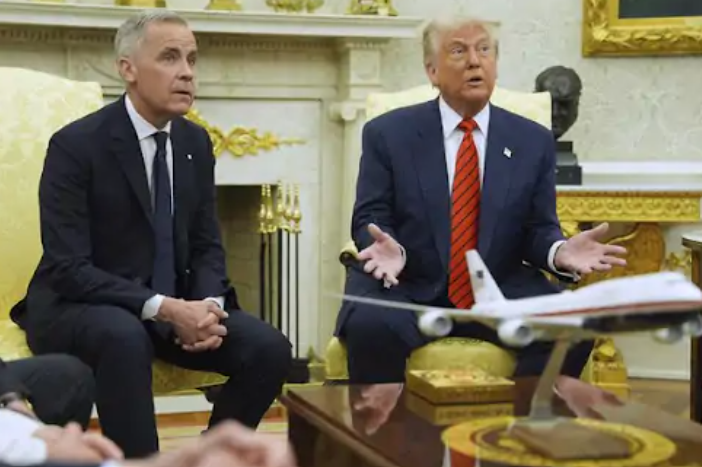

US President Donald Trump has publicly criticized Canada for rejecting his proposed “Golden Dome” missile defense project over Greenland, warning that the northern neighbor could face serious consequences for choosing closer ties with China.
Trump’s sharp remarks came on Truth Social, where he said, “Canada is against The Golden Dome being built over Greenland, even though The Golden Dome would protect Canada. Instead, they voted in favor of doing business with China, who will ‘eat them up’ within the first year!”
The controversy highlights rising tensions between Washington and Ottawa, with Trump emphasizing that the United States plays a crucial security role in protecting Canada.
Trump Criticizes Canadian Leadership
During his latest statements, Trump targeted Canadian Prime Minister Mark Carney, accusing him of not appreciating the support Canada receives from the United States.
Trump claims Greenland is vital for Golden Dome missile shield, but experts question the need
“Canada gets a lot of freebies from us, by the way. They should also be grateful, but they’re not. I saw your Prime Minister yesterday; he wasn’t so grateful. They should be grateful to us,” Trump said.
He further stressed the strategic importance of the “Golden Dome” missile defense system, claiming that it would not only safeguard Greenland but also provide protection for Canada.
“Canada lives because of the United States. Remember that, Mark, the next time you make your statements,” Trump added.
These comments come after Carney’s address at the 56th Annual Summit of the World Economic Forum in Davos, where he spoke about a “fading rules-based order” and warned against using tariffs as coercive tools—remarks that many interpreted as a subtle critique of Washington’s approach to Greenland.
Canada Moves Toward China
Amid Trump’s criticism, Canada has been actively strengthening its economic ties with China. On January 17, Prime Minister Carney announced a new trade agreement with Beijing aimed at opening markets for Canadian businesses and boosting exports for Canadian workers.
Carney said, “We’ve secured a new trade agreement with China—unlocking more than $7 billion in export markets for Canadian workers and businesses.”
The agreement includes a reduction in Chinese tariffs on Canadian canola seeds from 84% to roughly 15%. In return, Canada agreed to reduce its 100% tariff on Chinese electric vehicles, starting with an annual cap of 49,000 vehicles, which will grow to around 70,000 over five years.
JD Vance Warns of Rising Danger as China and Russia Eye Greenland
The Prime Minister emphasized that China has become a more predictable trading partner compared to the US in recent months. “Our relationship has progressed in recent months with China. It is more predictable, and you see results coming from that,” he said.
Analysts note that Canada faces significant tariffs from the United States, including a 50% levy on imported metals and a 25% tariff on non-US automobiles. The trade deal with China is seen as part of Canada’s effort to diversify trade partnerships in a more uncertain global economy.
Golden Dome Project Sparks Debate
The “Golden Dome” missile defense project proposed by Trump would have positioned advanced missile defense systems over Greenland. According to Trump, the system would serve as a shield, not only protecting the United States but also benefiting Canada.
Trump’s criticism of Canada suggests he believes the country is making a strategic mistake by siding economically with China rather than aligning with US-led security initiatives.
China views Greenland differently than Trump and moves to secure rare earths and Arctic trade
On Truth Social, Trump’s post framed the issue starkly: “Canada is against The Golden Dome being built over Greenland, even though The Golden Dome would protect Canada. Instead, they voted in favor of doing business with China, who will ‘eat them up’ within the first year!”
This dispute follows a series of diplomatic tensions over Greenland, trade tariffs, and security arrangements, which have placed Canada in a delicate position between the world’s two largest powers.