
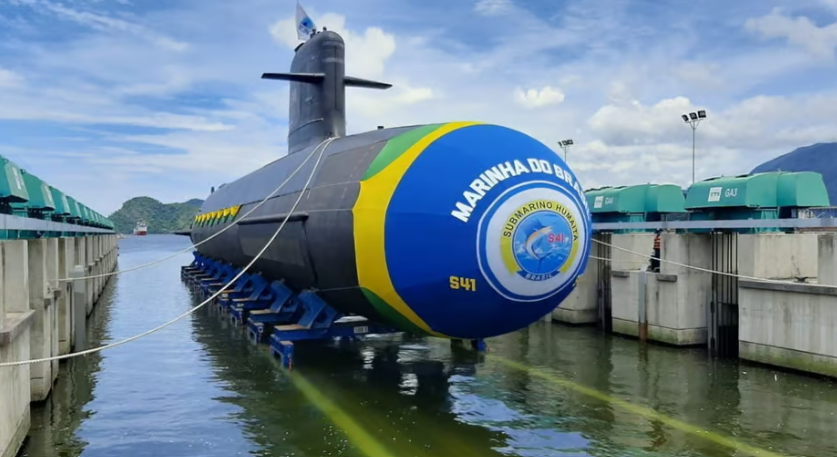

Brazil is stepping up efforts to strengthen its naval capabilities by expanding its nuclear submarine program. The move aims to improve response times, enhance maritime security, and ensure better protection of its vast Atlantic coastline and critical offshore assets.
A Major Shift in Naval Strategy of Brazil
Brazil is moving ahead with plans to expand its nuclear-powered submarine program from one vessel to three. This decision is aimed at strengthening the country’s ability to respond quickly to threats and maintain a constant presence across the vast South Atlantic waters.
The plan focuses on improving speed and readiness. At present, Brazil’s diesel-electric submarines can take up to 15 days to travel from one end of the coastline to another. With nuclear-powered submarines, that same journey could be completed in just three to four days. This sharp reduction in response time is seen as a key advantage in modern naval operations.
“A dangerous precedent for the world”: Brazil’s Lula pushes back against U.S. pressure on Venezuela
Brazil has a coastline that stretches over 8,000 kilometers. Protecting such a large area is a major challenge. The country also has important offshore resources, including oil fields, shipping routes, and mineral-rich zones. These areas, often referred to as the “Blue Amazon,” are critical to the nation’s economy and security.
To manage this, the navy is considering a three-submarine system. In this model, one submarine would always be on active patrol, one would be undergoing maintenance, and the third would be in training or preparing for deployment. This rotation ensures that there is always a submarine ready at sea, improving overall operational readiness.
Speed, Stealth, and Continuous Presence
Nuclear-powered submarines offer several advantages over traditional diesel-electric ones. One of the biggest benefits is speed. These submarines can travel faster and stay underwater for much longer periods without needing to surface.
Diesel-electric submarines must come up or use a snorkel to recharge their batteries. This makes them easier to detect. In contrast, nuclear submarines can remain submerged for extended periods, making them harder to find and track.
This ability to stay hidden is important for missions focused on “sea denial.” This means preventing other ships or forces from entering certain areas. Instead of direct confrontation, the goal is to create uncertainty for potential threats and protect important maritime zones.
The faster travel time also allows the navy to respond quickly to changing situations. Whether it is monitoring suspicious activity, protecting offshore assets, or securing shipping lanes, the improved mobility gives Brazil a stronger defensive posture.
The idea of having three submarines ensures that there is no gap in coverage. Even when one submarine is being repaired or upgraded, another can take its place. This continuous presence is considered essential for a country with such a large maritime area to protect.
Program Progress, Costs, and Challenges
Brazil’s nuclear submarine program has been in progress for decades and gained significant momentum after a major defense agreement in 2008. Since then, the country has invested around R$40 billion into building specialized infrastructure, advancing technology, and developing both conventional and nuclear submarine capabilities.
However, the program has faced repeated delays, mainly due to inconsistent funding. The original completion timeline has been pushed back several times, with the first nuclear-powered submarine now expected around 2037. To avoid further setbacks, an additional R$1 billion has been requested for 2026, highlighting the need for steady financial support in such large-scale defense projects.
A critical part of the program is the development of a domestically designed nuclear reactor. This reactor is currently being tested at a land-based facility in São Paulo to ensure its safety, efficiency, and reliability before it is installed into a submarine hull at a dedicated naval base.
Brazil is maintaining full control over its nuclear technology, including the fuel cycle, ensuring independence from foreign suppliers. The submarines will carry only conventional weapons, in line with international regulations, while the program continues to strengthen the country’s maritime defense capabilities.