
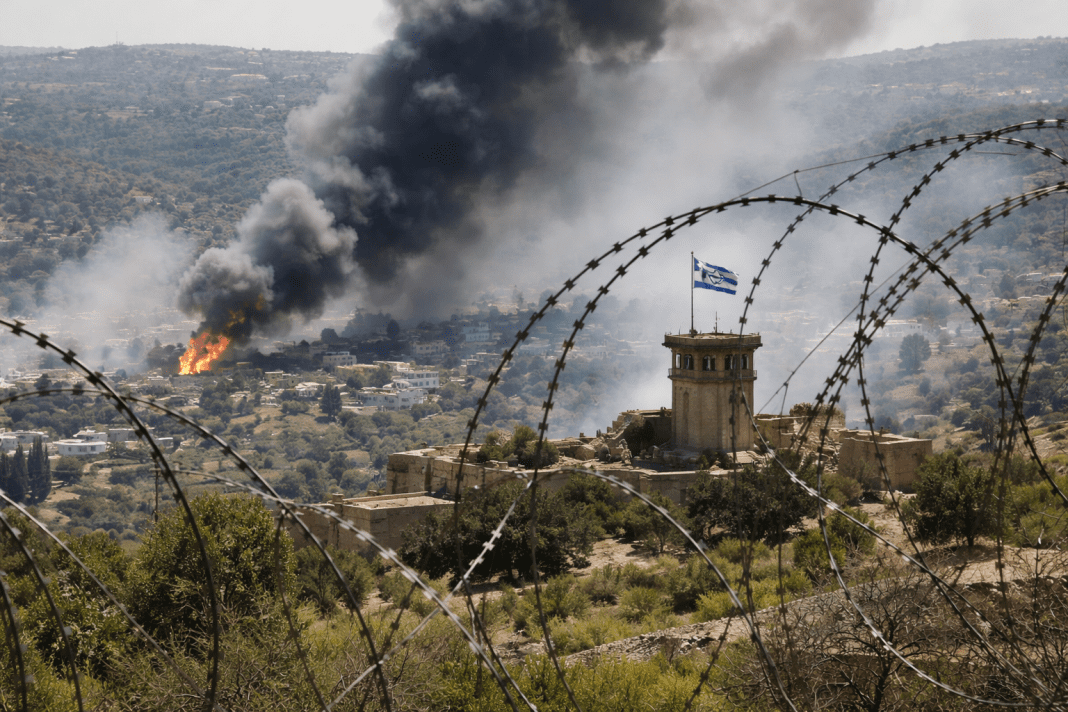

A fresh diplomatic push is gaining attention. Donald Trump said that talks between Israel and Lebanon are expected to take place tomorrow. His statement comes at a time when fighting is increasing. Clashes between the Israel Defense Forces (IDF) and Hezbollah are continuing along the northern border.
The announcement has raised hopes for a possible pause in the violence. However, military actions on the ground are still ongoing. There are no clear signs of the fighting slowing down. Diplomatic channels are now working urgently to bring both sides to the table.
Rising Tensions Along the Israel-Lebanon Border
Clashes between Israel Defense Forces (IDF) and Hezbollah fighters have intensified in recent days, especially near towns in southern Lebanon. Reports say Israeli airstrikes targeted several locations, including areas close to Nabatieh. During one such strike, an emergency response operation was hit, leading to the deaths of four paramedics and injuries to six others. The incident has raised serious concerns among humanitarian groups, as emergency workers are usually protected under international rules.
Is the ceasefire holding? Confusion grows as heavy strikes continue in Lebanon
The IDF says its actions are meant to stop Hezbollah from building stronger positions near the border. In response, Hezbollah has launched rocket attacks and other strikes, leading to a continuing cycle of retaliation. This back-and-forth fighting has made the situation more dangerous, with neither side stepping back.
Civilians on both sides of the border are facing fear and uncertainty. Many families have been forced to leave their homes, while others are staying in shelters as sirens and explosions continue. The conflict has also raised wider regional tensions, as Hezbollah is backed by Iran, adding another layer of complexity to the ongoing crisis.
Trump Announces Upcoming Talks
Amid the escalating situation, Donald Trump said that discussions between Israel and Lebanon are expected to begin soon. While full details of the meeting have not been officially confirmed, his statement has drawn attention to ongoing diplomatic efforts happening behind the scenes.
Trump described the expected talks as important and suggested they could help reduce tensions. His remarks come at a time when several countries and international groups are working to stop the conflict from spreading further across the region.
Israel strikes Zrariyeh bridge in Lebanon and launches new wave of airstrikes on Tehran
At the same time, the White House said diplomatic engagement is continuing on multiple fronts. Officials highlighted ongoing communication between regional players, including efforts by Pakistan, which is acting as a mediator in broader Middle East tensions. Karoline Leavitt, the White House Press Secretary, described these discussions as “productive and ongoing” and expressed hope for stability.
Meanwhile, Iran has also shown openness to diplomacy. Abbas Araghchi, Iran’s Foreign Minister, recently met with Pakistan’s army chief Asim Munir and repeated Tehran’s willingness to pursue peaceful solutions. These parallel diplomatic efforts show that multiple channels are being explored to ease tensions across the wider region.
Ongoing Conflict and Broader Regional Impact
Despite these diplomatic signals, the situation on the ground remains tense. Military actions have continued, with both sides showing no clear signs of stepping back. Clashes and strikes are still being reported, keeping the region on edge.
At sea, tensions are also increasing. Iran has warned that it could disrupt major maritime trade routes, including the Red Sea, the Persian Gulf, and the Gulf of Oman, if pressure from the United States continues. These waterways are critical for global shipping and energy supplies.
UN peacekeepers injured in southern Lebanon after Israeli shelling hits Indonesian base
The United States Central Command has confirmed that US forces are enforcing a naval blockade around Iranian ports. Officials said several vessels trying to leave have been turned back, effectively halting maritime trade. This has added another layer of tension, as any disruption in these routes could impact international trade and fuel supplies.
Meanwhile, the situation in southern Lebanon continues to raise concern. The recent strike near Nabatieh has highlighted the risks faced by civilians and emergency responders. International observers are closely watching developments, as both military activity and diplomatic efforts continue at the same time, showing how complex and fragile the situation remains.