

A single phrase has reignited one of the Western Hemisphere’s most complicated relationships.
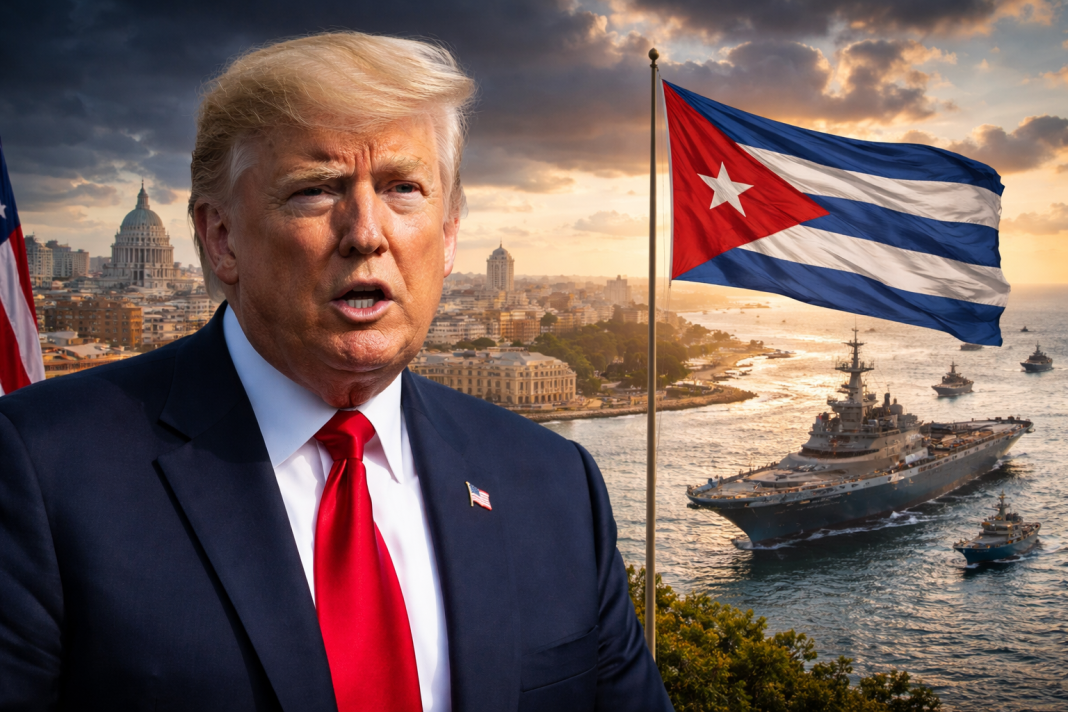
U.S. President Donald Trump suggested on Saturday that his administration is considering what he described as a “friendly takeover” of Cuba — a comment that has immediately stirred diplomatic circles, policy analysts, and governments across the region.
Speaking during a February 28, 2026 press briefing, Trump indicated the United States is exploring ways to bring Cuba closer into America’s economic and political orbit. He referenced the possibility of a structured transition or partnership but stopped short of outlining a detailed roadmap.
Even without specifics, the words landed heavily.
A Phrase That Echoes Through History
The relationship between Washington and Havana has never been simple. Decades of sanctions, frozen diplomacy, and ideological rivalry have shaped public memory on both sides of the Florida Straits.
Against that backdrop, the term “takeover” — even softened with the word “friendly” — carries historical weight.
For some observers, it signals bold ambition. For others, it raises alarms about sovereignty and political independence. In Latin America and the Caribbean, where history is deeply intertwined with questions of external influence, language matters.
Mexico trapped between Trump tariffs and Cuba blackout crisis as oil supplies face cutoff
So far, the Cuban government has not issued an official response. But silence, in moments like this, often reflects careful calculation rather than indifference.
Strategic Timing in a Tense Global Moment
The comment comes at a time when U.S. global engagement is highly visible. Washington is navigating diplomatic negotiations tied to Iran and maintaining a strategic military presence in key regions.
Meanwhile, global powers such as China and Russia have expanded economic and diplomatic relationships throughout Latin America.
In that wider context, Trump’s remark may reflect a broader effort to reinforce American influence in the Western Hemisphere. The Caribbean, long viewed as strategically important to U.S. national interests, is once again part of a larger geopolitical conversation.
Opportunity or Overreach?
Supporters of deeper U.S.–Cuba integration argue that dramatic change could unlock economic potential. They envision investment, infrastructure modernization, trade expansion, and new private-sector growth. After years of limited engagement, some see a moment for reset.
Critics, however, urge caution. They argue that describing cooperation as a “takeover” risks escalating tensions before dialogue even begins. Diplomatic language, they note, shapes perception — and perception shapes reaction.
Any real policy shift would require legislative coordination, formal negotiations, and agreement from Cuban leadership. Transforming rhetoric into action would be a complex, multi-layered process.
After winning the Nobel Peace Prize, Machado backs U.S.-led liberation of Cuba and Nicaragua
The Region Watches Closely
Across the Caribbean and Latin America, governments are watching carefully. Regional stability, trade relationships, and diplomatic balance could all be affected depending on how the situation unfolds.
For citizens in both countries, the moment feels uncertain. For older generations, it recalls decades of Cold War rivalry. For younger audiences, it raises questions about economic opportunity, sovereignty, and what a modern partnership might look like.
At this stage, no official framework has been released. There is no executive order, no signed agreement, no formal negotiation table announced.
Yet the impact of the statement is already visible. It has reopened debate, stirred speculation, and reminded the world how quickly geopolitical narratives can shift.
Whether Trump’s words mark the beginning of a major policy transformation or remain a striking headline will depend on what follows.
But one thing is certain: in international politics, a single phrase can echo far beyond the room in which it is spoken.