
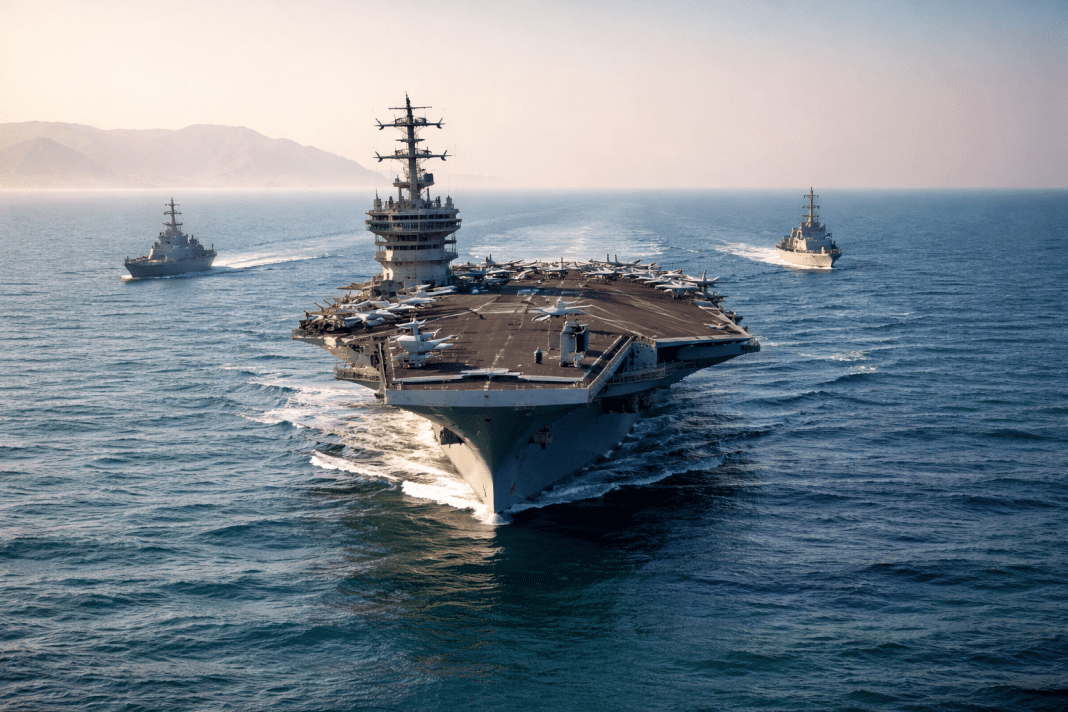

Tensions between the United States and Iran have sharply increased after the United States moved a large group of warships toward waters near Iran. The deployment includes a powerful aircraft carrier and several other military ships capable of carrying fighter planes, missiles, and thousands of troops. The move was described as a precaution, but it has sent a clear signal that the situation in the region is serious.
Rising Tensions in the Gulf
US officials said they sent the ships to show readiness and protect American interests in the region. They added that they hope no violence will occur. Still, the presence of such a large naval force has made many people around the world uneasy.
Iran reacted quickly to the military buildup. Senior officials said they have placed the country’s armed forces on high alert and warned that they would treat any attack, whether small or large, as a full-scale war and respond with strong force.
Global attention shifts north to Greenland — leaving Iran’s historic uprising in the shadows
This exchange of warnings and military movements has raised fears of a wider conflict. The waters near Iran are extremely important for global trade, especially for oil and gas shipments. Any disruption in this area could affect many countries far beyond the region.
The United States has said it is closely watching Iran’s actions, including its military activity and nuclear program. Iran, meanwhile, says it is acting only in self-defense and will not remain silent if it feels threatened.
The situation has become even more tense because of reports of unrest inside Iran. Protests have taken place in many cities in recent months, and human rights groups claim that thousands of people may have died during the crackdown. The authorities have not confirmed these numbers and have restricted internet and phone access, making independent checks difficult.
Because of this communication blackout, much of the information comes from outside sources, adding to uncertainty about events inside the country.
Inside Iran: Unrest and Strong Warnings
Inside Iran, the government is under heavy pressure due to ongoing protests that began months ago. These demonstrations were driven by public anger over living conditions and restrictions on daily life. While protests have slowed in some areas, the country remains under strict security control.
Security forces are present in many cities, and checkpoints and patrols have become more common. Many people are afraid to speak openly because of strict rules and the risk of punishment. Internet access remains limited, making it difficult for news, photos, and videos to reach the outside world.
There have also been reports about detained protesters and possible executions. The United States says it stopped some planned executions, but Iranian officials have strongly denied this and called the claims false. This dispute has added to tensions between the two countries.
Iranian leaders say they are closely watching the American military buildup and that their armed forces are ready for the worst-case situation. They say Iran does not want war, but it will not accept any attack, no matter how it is described. Officials have warned that they will treat even a limited strike as a full-scale war.
Meanwhile, daily life for ordinary people has become more difficult. With protests, security checks, and limited communication, many families are living in fear and uncertainty. The mix of internal unrest and external pressure has created a highly unstable situation.
The Military Buildup and Global Concerns
The deployment of a large American naval force to the region is a major development. An aircraft carrier strike group includes fighter jets, support ships, and advanced defense systems, making it one of the most powerful military forces in the world and a clear signal of strength.
Iran protests continue under Khamenei as US military aircraft movements draw attention
US officials say they made the move to protect their interests and warn against threats, though they hope it will not lead to fighting. Iran has responded by putting its forces on high alert and closely watching nearby waters, warning that it will not ignore any hostile action.
This standoff affects more than just the region. Many countries depend on these waters for oil and gas shipments, and even a short conflict could disrupt global trade and raise prices. Because of this, governments worldwide are watching closely as tensions remain high.