
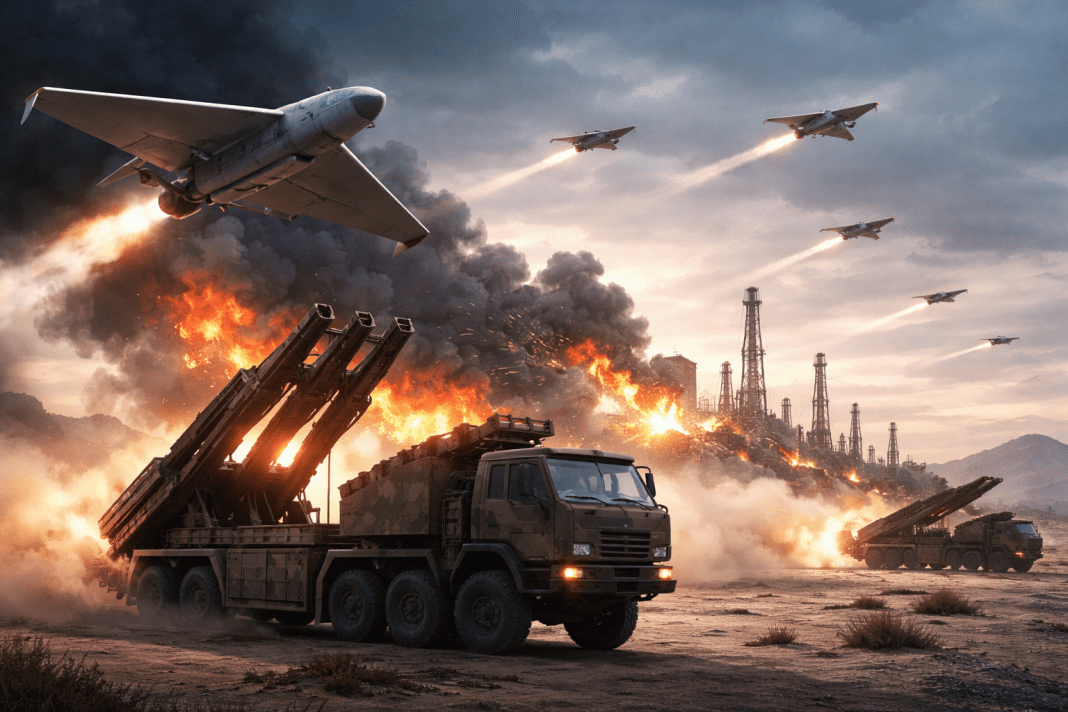

Tensions in the Gulf region have sharply increased after recent attacks on critical energy infrastructure. A major gas field, important for global energy supply, was targeted in a strike that raised concerns across markets and governments.
What stood out was the speed of the response. Within hours, counter-attacks were carried out against refinery targets in multiple Gulf countries. These strikes appeared planned and precise, hitting locations that had already been identified earlier.
This rapid retaliation has drawn attention. Reports suggest that military infrastructure had already suffered damage, yet the response was quick and coordinated. This has led to a closer look at how such operations are possible. Two key factors explain this capability: the widespread use of low-cost drones and a decentralised military structure that allows faster decision-making.
The Shahed Drone: Low Cost, High Impact Weapon
The Shahed-136 drone is central to these attacks. It is a simple unmanned aircraft designed to carry explosives and strike a target directly. Unlike advanced missiles, it is not very fast or highly sophisticated. However, its strength lies in how it is used.
One of its biggest advantages is cost. Each drone is inexpensive compared to traditional weapons. This allows large numbers to be produced and deployed. Instead of relying on a few high-cost systems, many drones can be launched at once.
These drones are also highly mobile. They do not require airbases or complex launch systems. They can be launched from trucks or mobile platforms, making them difficult to detect and destroy. Launch units can keep moving, reducing their exposure to counter-attacks.
Occupied Ukraine turns into Russia’s sanctions-proof economic lab backed by China and Iran
A key tactic is the use of saturation attacks. Large numbers of drones are launched together, overwhelming air defence systems. Even advanced systems struggle when faced with too many incoming targets at the same time.
There is also a strong cost imbalance. Defending against these drones often requires expensive interceptor missiles. These can cost far more than the drones themselves. Over time, this creates pressure on defence systems, as they must spend heavily to stop relatively cheap threats.
Another important point is that these drones are not used alone. They are often launched alongside other weapons, including missiles. This layered approach increases confusion and makes defence more difficult. Even when many drones are intercepted, some can still get through.
Drone Warfare and the Shift in Modern Conflict
The use of Shahed-type drones reflects a larger shift in how wars are fought. Low-cost, “good enough” weapons are becoming more important than highly advanced but expensive systems. These drones may not be perfect, but they are effective when used in large numbers.
This model is now influencing other countries as well. Even powerful militaries are developing similar low-cost drone systems. This shows that innovation in warfare is no longer limited to advanced nations. Simple and effective designs can spread quickly and shape global military strategies.
http://US shuts down alleged Iran-backed websites involved in hacking and repression
These drones have already been used in other conflicts, where they have caused damage by being deployed in large numbers over long periods. Their repeated use forces defenders to stay on constant alert. It also requires continuous use of air defence systems, which can lead to shortages of interceptor missiles over time.
This creates a new kind of pressure. Even successful defence becomes costly and difficult to sustain. As drone attacks continue, they can slowly weaken defensive capacity.
Mosaic Doctrine: Decentralised and Fast Response System
While drones explain how attacks are carried out, the speed of response is linked to how decisions are made. This is where the mosaic doctrine plays a key role.
This approach spreads authority across multiple levels instead of keeping it at the top. Smaller units are allowed to act independently based on pre-planned instructions. These instructions are prepared in advance for different situations.
When an event occurs, local units do not need to wait for orders. They already know what actions to take. This reduces delays and allows for immediate response. Even if communication systems are disrupted, operations can continue.
This decentralised structure also improves resilience. If leadership is affected or communication is limited, other units can still function. The system does not depend on a single command center.