
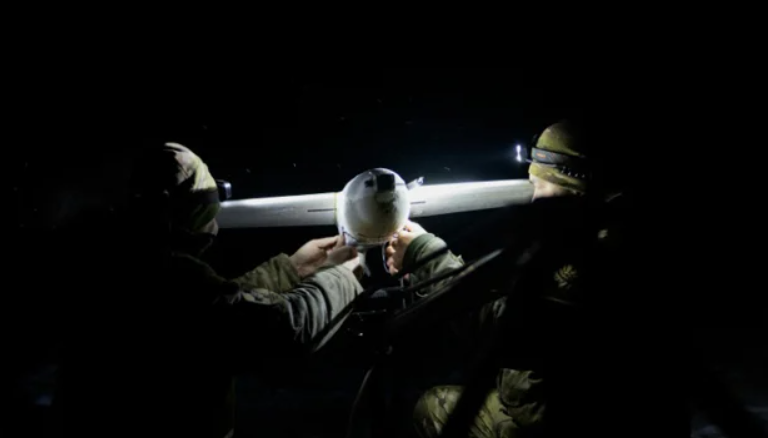

The war between Ukraine and Russia has entered its fifth year, with drones now dominating the battlefield. Once used mainly for recreation, these machines have become central to drone warfare, monitoring movements, guiding attacks, and reshaping modern combat through advanced technology.
The “Kill Zone” of Drone Warfare Changing Ground Combat
Large military vehicles once defined battlefield strength, with tanks and heavy artillery leading combat operations. However, drone surveillance has changed how armies move and survive, showing how drone warfare is reshaping traditional military tactics. Vast areas near the front line have turned into “kill zones,” sometimes stretching up to 20 kilometers, where drones constantly monitor activity from above.
Because drones provide continuous aerial visibility, large vehicles are easy to detect and quickly targeted. Slow-moving tanks and armored units can be identified within minutes and attacked soon after. As a result, soldiers now operate in smaller groups, moving quickly between covered positions while relying on camouflage and careful timing to avoid detection.
Massive firestorm erupts at Russia’s key Black Sea oil port after Ukrainian drone strike
Drones range from modified commercial devices to explosive-equipped aircraft, and they now account for a significant share of battlefield damage. Ground robots also support operations by delivering supplies and evacuating wounded troops from dangerous areas. Control of low-altitude airspace has become increasingly important, proving that success in drone warfare often depends on visibility and speed rather than heavy firepower.
Fiber Optics and Starlink Transform Drone Communication
Operating a drone requires a stable connection between the operator and the aircraft. At the start of the war, most drones relied on radio signals, but electronic warfare quickly created problems. Jamming systems could block or disrupt radio frequencies, causing drones to lose control or crash. Both sides began investing heavily in technologies designed to interfere with enemy communications, intensifying the technological race within drone warfare.
To counter jamming, new solutions were introduced. One major innovation is the use of fiber-optic controlled drones. These drones stay connected to operators through ultra-thin cables that unwind as they fly. Because commands travel through a physical cable instead of radio waves, they are far less vulnerable to electronic interference. In some frontline areas, leftover fiber-optic wires now cover fields and damaged streets like webs.
Poland’s Radosław Sikorski says Starlink is being used by Russia in Ukraine drone strikes
Another major development involves satellite internet connections. Some drones are equipped with Starlink terminals, allowing operators to control them over long distances while maintaining stable video feeds. Satellite links expanded drone range beyond traditional communication limits, but restrictions on certain terminals later disrupted operations for both sides.
During heavy fighting in regions such as Zaporizhzhia Oblast, reliable communication proved critical. The battle for secure drone signals has become a key technological contest, making communication control a central pillar of modern drone warfare.
Air Defense Reinvented as AI Enters the Battlefield
The widespread use of drones has forced armies to rethink air defense systems. Traditional defenses rely on advanced missiles designed to destroy aircraft or large threats, but these missiles can cost millions of dollars. Using such expensive weapons against cheap drones has created a major imbalance, further demonstrating how drone warfare is changing military economics.
To respond, new defensive methods have emerged. Electronic jamming is widely used to disrupt incoming drones by blocking their signals. Near front lines, roads are sometimes protected with nets to prevent drones from striking vehicles, while military trucks are equipped with metal cages and signal-blocking systems to reduce damage from aerial attacks.
Interceptor drones have also become an important innovation. Instead of firing costly missiles, these drones chase and destroy enemy drones in mid-air, creating a new type of aerial combat. Machine guns remain a last line of defense against low-flying targets, though technology now plays the central role.
Artificial intelligence is increasingly integrated into drones to improve navigation, target tracking, and flight stability. Some systems can guide drones during the final seconds before impact when signals weaken. Despite these advances, human operators remain essential, as AI continues to support rather than replace human control — a reminder that even in advanced drone warfare, human decision-making remains central.