
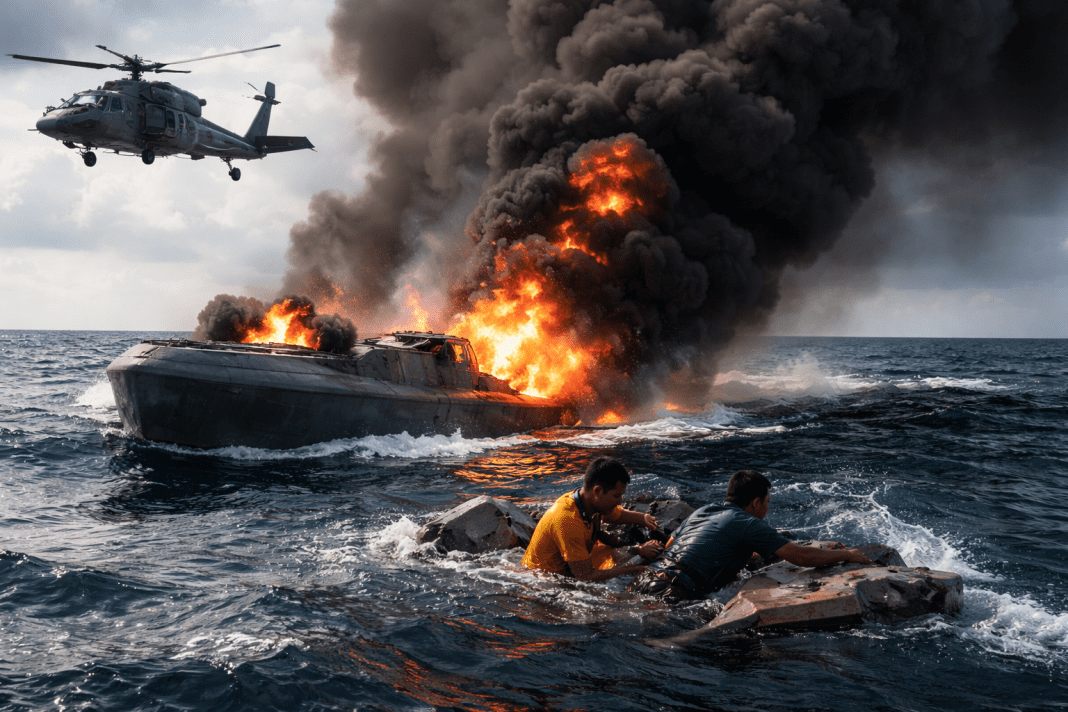

The U.S. military recently launched a powerful strike on a vessel in the Atlantic Ocean, claiming it was carrying large amounts of drugs from South America. The strike targeted a semisubmersible “narco-sub,” a type of vessel used by drug traffickers to move cocaine across the ocean with very low visibility. These boats are highly prized by drug traffickers because they are hard to detect and can carry massive loads of illegal drugs.
Deadly Strike on the High Seas Targets Drug Traffickers
The attack was sudden and intense. A special operations aircraft targeted the semisubmersible vessel with precision strikes, sending thick plumes of smoke into the sky. Inside the cramped boat, the crew scrambled desperately to escape through a small hatch, many struggling to get out as the vessel began to sink beneath them.
Amid the chaos, two men managed to jump into the turbulent waters and cling to floating debris, fighting the waves to stay alive. The rest of the crew was likely trapped inside when the vessel went under, highlighting the deadly nature of these strikes. The survivors were badly injured and exhausted from the ordeal, but their lives were spared by the timely intervention of U.S. forces.
The U.S. government described the individuals on board as “narco-terrorists,” a term used for drug traffickers accused of using drugs to inflict widespread harm. Officials said the strike was part of a broader effort to stop large shipments of drugs from reaching international markets. Yet this strike stands out because it left survivors, giving authorities an unusual opportunity to capture and question alleged traffickers directly at sea.
Survivors Repatriated Without Charges Against Drug Traffickers
U.S. forces flew the two survivors back to their home countries. One returned to Ecuador, and the other to Colombia. Both men had previously participated in the drug trade, and one had served time in the U.S. for cocaine trafficking before authorities deported him back to Ecuador.
Surprisingly, U.S. military officials did not provide local authorities with any evidence to hold the drug traffickers. They did not hand over drugs, phone records, GPS data, or videos. Without proof, local authorities released the men almost immediately.
7 Accused in $34M Drug Money Scheme Tied to Louisville Stores
Officials from both countries confirmed that no investigations or prosecutions were possible because the evidence no longer existed. The U.S. described the repatriation as “humanitarian,” meaning they returned the drug traffickers for care rather than legal action.
This approach has sparked debate. Some lawmakers argue that if the men were truly dangerous drug traffickers, releasing them contradicts the military’s actions. Critics say the U.S. could have collected evidence and brought them to court, as it has done in previous drug enforcement cases.
A Campaign That Avoids Legal Scrutiny
This strike is part of a wider U.S. military campaign in the Caribbean and eastern Pacific Oceans. Since September, at least 29 attacks on vessels suspected of carrying drugs have killed over 100 people. Unlike traditional law enforcement operations, which capture suspects and gather evidence, these strikes often destroy the boats and their cargo. By sinking vessels, authorities remove proof of alleged crimes, keeping cases out of court and limiting judicial scrutiny of their actions against drug traffickers.
The campaign targets different vessels, from fast-moving “go-fast” boats to semisubmersibles. While authorities highlight the risk of large-scale drug shipments, the destruction of evidence and the immediate release of survivors have raised questions about the approach. Traditional operations, such as those by the Coast Guard, focus on seizing drugs and detaining drug traffickers, helping prosecute cartel leaders.
Trump declares all-out war on drug cartels — ‘We’re just going to kill them’
Local authorities in Ecuador and Colombia reported that survivors returned from the strikes did not provide useful information about trafficking networks. One man disappeared after release, and both countries continue active anti-drug efforts, seizing hundreds of tons of cocaine this year. However, these high-seas strikes have not deterred local drug traffickers, who continue using known smuggling routes.
The Oct. 16 strike left survivors, demonstrating both the destructive power of the operation and the unusual decision by authorities to release potentially dangerous drug traffickers without charges. Local officials have expressed frustration at the lack of evidence, noting that prosecuting drug traffickers relies on careful collection and documentation of proof.