
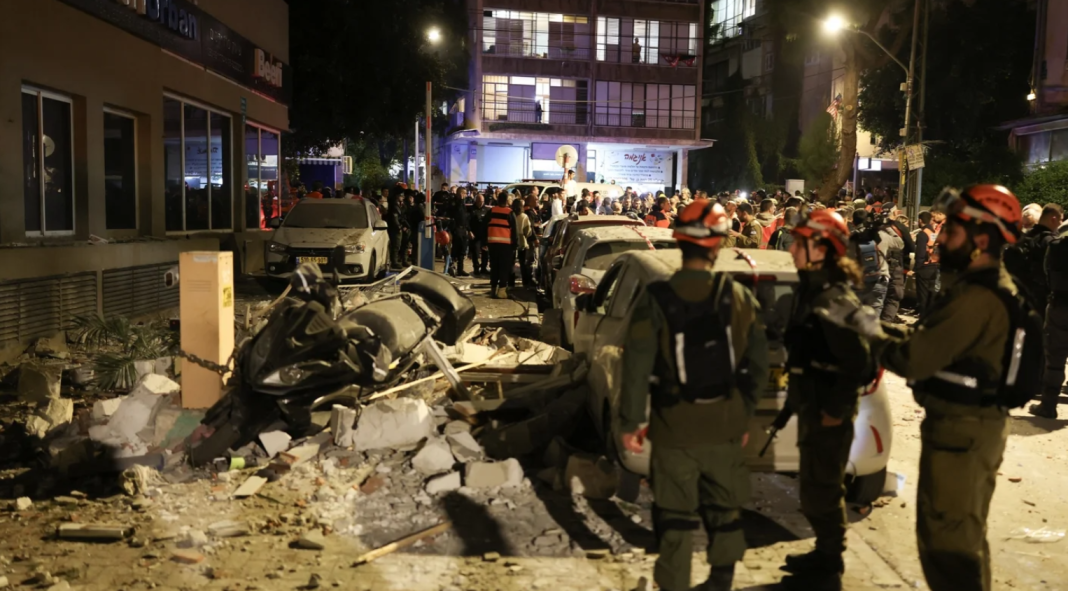

A major escalation has taken place in the ongoing conflict involving Iran and Tel Aviv, as Iranian forces launched a missile attack targeting the Israeli city. The strike reportedly involved advanced missiles, including the “Khorramshahr-4” and “Kedr,” both capable of carrying multiple warheads.
Missile Strike Hits Tel Aviv Amid Rising Conflict
According to official reports, at least two people were killed in the attack, raising the total number of deaths in Israel to 14 since the latest phase of the conflict began. Emergency services reacted quickly, transporting the injured to hospitals and securing the affected locations to prevent further harm. Rescue teams continued to monitor the situation closely as they worked through the impacted areas.
The missile strike was described by Tehran as a direct response to the killing of a senior security figure. Iranian authorities said the attack was part of a wider retaliation effort and made it clear that their military operations are still ongoing. This statement signaled that tensions remain high and actions could continue in the coming days.
Residents in Tel Aviv heard sirens and explosions as the missiles approached, forcing many to rush into bunkers for safety while air defense systems attempted to intercept the threats. Despite these efforts, some missiles managed to hit their targets, causing damage and casualties. The situation remains tense, with security forces on high alert and some schools and public places temporarily closed as a precaution.
Cluster Warheads Make Defense Difficult
One of the most concerning aspects of the attack was the reported use of cluster warheads. These types of weapons release multiple smaller explosive charges while still in the air. This spreads the impact over a wider area and makes it much harder for defense systems to stop them all.
Israeli officials stated that such weapons create serious challenges for interception systems. Even if some parts are destroyed mid-air, others can still fall and explode on the ground. This increases the risk to civilians and infrastructure.
Iran conducts missile strike on Israeli base in Tel Aviv raising security concerns
Cluster munitions are widely debated around the world because of their potential to cause harm beyond immediate targets. The smaller explosive pieces can land across large areas, increasing the chances of unintended damage.
During this attack, the use of such warheads meant that multiple explosions were reported across different parts of Tel Aviv. This added to the confusion and made rescue operations more complex.
Air defense systems were activated immediately after detecting the launches. However, the nature of cluster munitions reduced their overall effectiveness. Authorities are continuing to assess the full extent of the damage caused by the strike.
Strike Near Bushehr Raises Nuclear Safety Concerns
At the same time, Iran reported that a projectile landed near the Bushehr Nuclear Power Plant. Officials said there were no casualties and no damage to the facility, but the incident has raised serious concerns about the risks of military activity near nuclear infrastructure. Even without direct impact, such events increase fears about safety.
The International Atomic Energy Agency urged all sides to act with caution. It warned that any strike near a nuclear site could lead to dangerous consequences, even if no immediate damage is reported. The agency emphasized that restraint is critical in such sensitive situations.
Iran’s Bushehr nuclear facility remains safe after projectile hits plant premises
Nuclear facilities require strict safety measures, and even nearby explosions can pose risks. Experts say continued fighting in these areas increases the chances of accidents that could affect not just one country, but entire regions. The growing tensions are adding pressure to already fragile conditions.
Despite rising international concern, Iran has said it is not ready to consider a ceasefire. The broader conflict involving Israel and the United States continues to intensify, with missile alerts, airspace monitoring, and defensive operations active across the region as civilians face increasing uncertainty.