
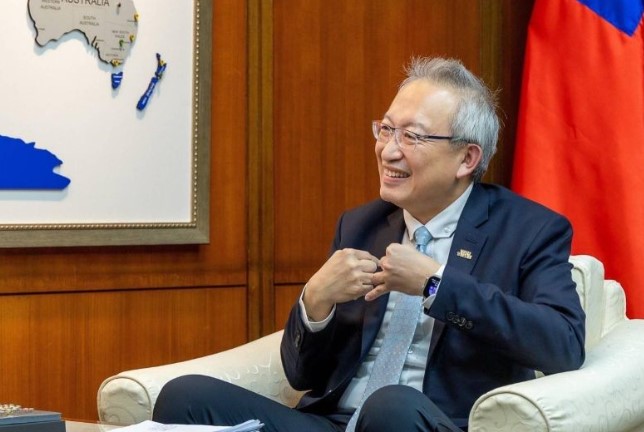

Taiwan’s Deputy Foreign Minister Francois Wu quietly visited Israel recently, sources say, in one of the island’s rare high-level trips to a country that does not officially recognise it. The visit highlights growing Taiwan-Israel ties amid global defence and security concerns.
Details of Wu’s meetings remain unclear, and it is unknown if Taiwan’s new T-Dome air defence system was discussed. Taiwan’s foreign ministry declined to confirm the trip but said both sides share democratic values and continue cooperation in trade, technology, and culture. Israel’s foreign ministry did not comment.
Francois Wu’s Rare Visit With Sensitive Timing
Francois Wu, one of Taiwan’s most prominent diplomats, previously served as Taipei’s de facto ambassador in Paris and is widely recognized for promoting Taiwan internationally. His last public trip was to the Berlin Security Conference on November 19, with the recently reported visit to Israel occurring just weeks later.
The secret nature of the trip underscores the delicate Taiwan-Israel relationship. Both sides maintain unofficial embassies, and Taiwan faces ongoing political pressure from Beijing, which considers the island part of China. Many countries avoid public actions that could be seen as recognising Taiwan as independent.
Despite these challenges, ties between Taiwan and Israel have quietly strengthened. Taiwan supported Israel after the October 2023 Hamas attacks and has hosted Israeli lawmakers in Taipei. Last year, Taiwan was briefly linked to Israel’s strike on Hezbollah in Lebanon, though both sides downplayed any impact on their relationship.
Defence Systems and Shared Security Concerns With Francois Wu
Taiwan’s interest in Israel is partly based on shared security challenges. Taiwan faces military pressure from China, which regularly sends warplanes and warships near the island. Similarly, Israel has long dealt with threats from neighbouring states and groups such as Iran and Hezbollah. Earlier this year, Israel and Iran traded missile and air strikes, with Israel’s defence systems intercepting many incoming threats.
Because of these similarities, Taiwan has been studying Israel’s defence technologies closely. Taiwan’s new T-Dome system, introduced by President Lai in October, is designed to create a fast and efficient “sensor-to-shooter” response that can destroy incoming missiles or drones. This multi-layer defence approach is inspired by Israel’s well-known systems like the Iron Dome, David’s Sling, Arrow, and the U.S.-made THAAD. Taiwan’s system integrates existing weapons such as the Patriot missile system, Taiwan-made Sky Bow missiles, and anti-aircraft guns.
TSMC reportedly asked to buy 49% of Intel to secure U.S. tariff cuts for Taiwan
Taiwan’s foreign minister, Lin Chia-lung, said last month that Taiwan and Israel learn from each other in defence and technology. He noted that just as Israel has the Iron Dome, Taiwan is developing its own version adapted to its needs.
Still, no information has confirmed whether the T-Dome system was discussed during Francois Wu’s secret visit. The sources declined to share what topics were covered.
Growing Exchanges Despite Diplomatic Limits
While Taiwan lacks formal diplomatic ties in the Middle East, it continues to maintain unofficial relationships. Taiwan and Israel operate de facto embassies in each other’s territory, allowing ongoing cooperation in trade, innovation, and culture. Exchanges between Taiwan and Israel have increased in recent months.
In September, six Israeli lawmakers visited Taipei and met President Lai. The following month, Deputy Minister Francois Wu met Yinon Aaroni, Director General of Israel’s Ministry of Welfare and Social Affairs, during his visit to Taiwan. These interactions show that despite political challenges, both sides are deepening cooperation.
China, which recognises a Palestinian state and has strong ties with the Palestinians, views Taiwan’s actions carefully. Taiwan, however, has stated it does not plan to recognise a Palestinian state, highlighting another point of difference between Beijing and Taipei on Middle East policy.
China warns of New Zealand naval patrol in Taiwan Strait citing regional risks
Taiwan’s growing interest in Israel reflects more than diplomacy. Both countries are democracies surrounded by larger and sometimes hostile neighbours. Both invest heavily in defence technology, and both look for partners who share similar values.
The latest secret visit by Francois Wu shows that, even without official ties, Taiwan and Israel are quietly building a relationship shaped by shared concerns, strategic interests, and an increasing level of trust.