
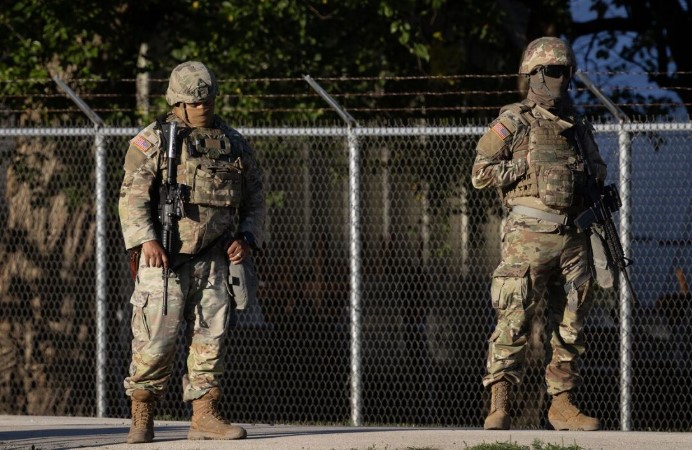

In a rare legal setback for President Donald Trump, the U.S. Supreme Court on Tuesday refused to allow him to send National Guard troops to the Chicago area. The ruling comes amid Trump’s growing use of the military in domestic cities, which critics say targets Democratic-led jurisdictions and aims to suppress dissent. The decision leaves in place lower court orders that temporarily halted troop deployments, marking a significant check on presidential authority in domestic military actions.
Supreme Court Leaves Lower Court Order in Place
The Supreme Court’s decision upheld a lower court ruling that blocked hundreds of National Guard troops from being deployed to Illinois. The Trump administration had requested that the Supreme Court allow the deployment to proceed while legal cases brought by Illinois officials and local leaders continued.
In a short, unsigned order, the Supreme Court noted, “At this preliminary stage, the Government has failed to identify a source of authority that would allow the military to execute the laws in Illinois.” The court emphasized that presidential control over National Guard troops likely applies only in “exceptional” circumstances, signaling the limits of executive power for domestic deployments.
Illinois court halts federal National Guard deployment citing lack of violence evidence
Three conservative justices—Samuel Alito, Clarence Thomas, and Neil Gorsuch—dissented from the ruling. White House spokeswoman Abigail Jackson said Trump remains committed to enforcing immigration laws and protecting federal personnel. She said, “Nothing in today’s ruling detracts from that core agenda.” On the other hand, Illinois Governor JB Pritzker praised the decision, calling it “an important step in curbing the Trump Administration’s consistent abuse of power.”
Trump Faces Supreme Court Setback
The ruling represents an unusual setback for Trump, whose administration has frequently prevailed at the Supreme Court on broad claims of presidential power since his return to office. The court, which currently has a 6-3 conservative majority, has often supported Trump’s expansive view of executive authority, making this decision particularly noteworthy.
The National Guard functions primarily as a state-based militia, under the authority of governors unless federalized by the president. Trump ordered troops to Chicago and Portland, following prior deployments to Los Angeles, Memphis, and Washington, D.C. The administration justified the moves as necessary to protect federal property and personnel at immigration enforcement facilities.
Legal firestorm erupts as judge says Trump cannot override Governors on National Guard orders
Supporters of Trump argue that Democratic-led cities experience lawlessness, violent protests, and crime, creating conditions that require military intervention. Critics, however, say these claims exaggerate the situation and serve as a pretext for sending troops. Federal judges reviewing the cases found that protests in Chicago and other cities were largely peaceful, manageable by local authorities, and far from the “war zone” scenarios described by Trump and his allies.
Legal Challenges and Court Findings
The legal battle over the Chicago deployment began after Illinois and Chicago sued, claiming the federalization of 300 Illinois National Guard troops, along with additional Texas National Guard units, was illegal. U.S. District Judge April Perry temporarily blocked the deployment, ruling that reports of violence at the Broadview immigration facility were unreliable. She noted that daily demonstrations, though persistent, did not constitute a rebellion or pose a threat to law enforcement. Perry warned that deploying troops would “only add fuel to the fire.”
A three-judge panel of the 7th U.S. Circuit Court of Appeals upheld Perry’s order, concluding that the president’s actions in Illinois were not justified. The Justice Department argued that local officials’ assessments of the protests were “implausibly rosy” and claimed federal personnel faced threats from protesters. Lawyers for Illinois and Chicago countered, noting that local authorities effectively handled protests and that federal operations at the Broadview facility were not hindered.
Armed woman bleeds in hospital after clash — National Guard storms into Chicago unrest
Legal experts also emphasized that historical interpretations of the law show that “regular forces” refers to active military personnel, such as members of the Army and Navy, rather than National Guard units. Judge Perry noted that the administration had not attempted to use regular forces before federalizing the National Guard, further undermining the federal government’s position.
Similar legal challenges have blocked deployments in Portland, Oregon, and previous National Guard actions in Los Angeles, Memphis, and Washington, D.C., drew criticism for apparent political motives. Experts say these cases highlight the limits on presidential authority to use domestic military forces, particularly when state governments oppose such measures. The Supreme Court’s ruling in Chicago reinforces these limits, underscoring that the federal government must respect state authority and legal boundaries when considering military interventions on domestic soil.