


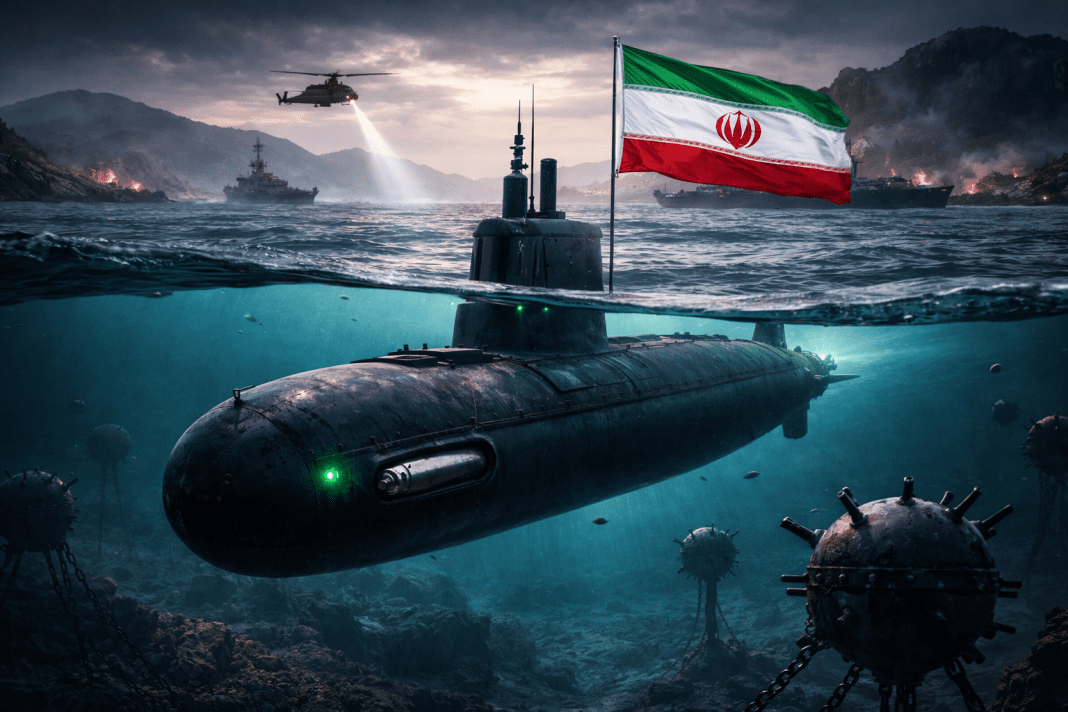


As tensions rise in the Strait of Hormuz, a narrow but critical artery for global oil trade, security concerns are increasingly shifting below the surface. While the United States has deployed air power and naval assets to secure shipping lanes, defence analysts say the most difficult threat to counter may be Iran’s fleet of small, hard-to-detect submarines operating in the region’s shallow waters.
The Strait, which connects the Persian Gulf to the Arabian Sea, carries a significant portion of the world’s crude oil shipments. Any disruption here has immediate global economic consequences, making it one of the most strategically sensitive maritime chokepoints.
A hidden challenge for US forces
In recent days, US President Donald Trump has called on allies to support efforts aimed at securing and reopening the Strait amid escalating tensions. The US military has deployed assets including A-10 attack aircraft and Apache helicopters to target Iranian speedboats and coastal infrastructure.
However, experts warn that air power alone may not be sufficient. Unlike surface vessels or fixed installations, Iran’s so-called “midget submarines” are specifically designed to evade detection and operate effectively in the Gulf’s shallow, murky waters.
These submarines are significantly smaller than conventional attack submarines, making them harder to track using traditional sonar systems. Their compact size and low acoustic signature allow them to remain concealed for extended periods.
The Ghadir-class advantage
At the centre of this capability is Iran’s Ghadir-class submarine fleet. Tehran is believed to operate up to 10 of these vessels, each roughly 29 metres long and weighing around 120 tonnes — a fraction of the size of standard submarines used by major naval powers.
British nuclear submarine HMS Anson moves into strike range of Iran amid widening Middle East war
Despite their size, Ghadir-class submarines are equipped with torpedoes and, crucially, the ability to deploy naval mines. Analysts say this mine-laying capability poses one of the most serious risks to maritime traffic in the Strait.
Even a limited number of mines can force shipping lanes to shut down temporarily, as clearing operations are complex, time-consuming, and hazardous. This creates a disproportionate impact compared to the relatively low cost and size of the submarines deploying them.
Geography as a force multiplier
Iran’s naval strategy is closely tied to its deep familiarity with the Gulf’s unique geography. The shallow waters, narrow passages, and high levels of maritime traffic create conditions that favour smaller, more agile vessels.
Over decades, Iranian naval forces have trained extensively in these conditions, refining tactics that maximise the effectiveness of their assets. This includes coordinated operations involving submarines, fast attack boats, and coastal missile systems.
The result is an asymmetric approach designed not necessarily to defeat a larger navy outright, but to complicate its operations and increase the cost of maintaining control over key waterways.
Beyond Ghadir: Expanding capabilities
In addition to its mini submarines, Iran operates larger platforms such as the Fateh-class submarine. These vessels, weighing around 600 tonnes, offer improved endurance and sensor capabilities, allowing them to operate in deeper waters while maintaining a relatively low profile.
The combination of smaller and mid-sized submarines provides Iran with a layered undersea capability. While Ghadir-class submarines are suited for stealth operations in confined waters, Fateh-class vessels can extend operational reach and provide additional flexibility.
Iran blocks 38 Indian vessels in Persian Gulf and accuses India of aiding US submarine attack
Strategic objective: Disruption, not destruction
According to defence analysts, Iran’s primary objective in the Strait of Hormuz is not necessarily to engage in direct confrontation with US naval forces. Instead, the focus is on disruption — particularly by targeting commercial shipping routes.
By laying mines or creating uncertainty about their presence, Iranian forces can effectively slow or halt maritime traffic. Even the perception of risk can lead shipping companies to reroute vessels, driving up costs and impacting global energy markets.
This strategy aligns with Iran’s broader approach to asymmetric warfare, where smaller, less expensive assets are used to counter technologically superior adversaries.
A fragile balance
As the situation evolves, the Strait of Hormuz remains a focal point of global concern. While military deployments by the United States and its allies aim to ensure freedom of navigation, the challenges posed by underwater threats highlight the complexity of securing such a vital corridor.
The presence of mini submarines underscores a key reality: in modern maritime conflict, the most significant dangers are not always the most visible. Beneath the surface, small, silent platforms have the potential to shape outcomes in ways that far exceed their size.
The Day Stealth Died: Iran Becomes First Country to Destroy F-35 Jets in Active Combat
For now, the balance in the Strait remains delicate — with global energy security closely tied to what happens in its narrow, contested waters.