
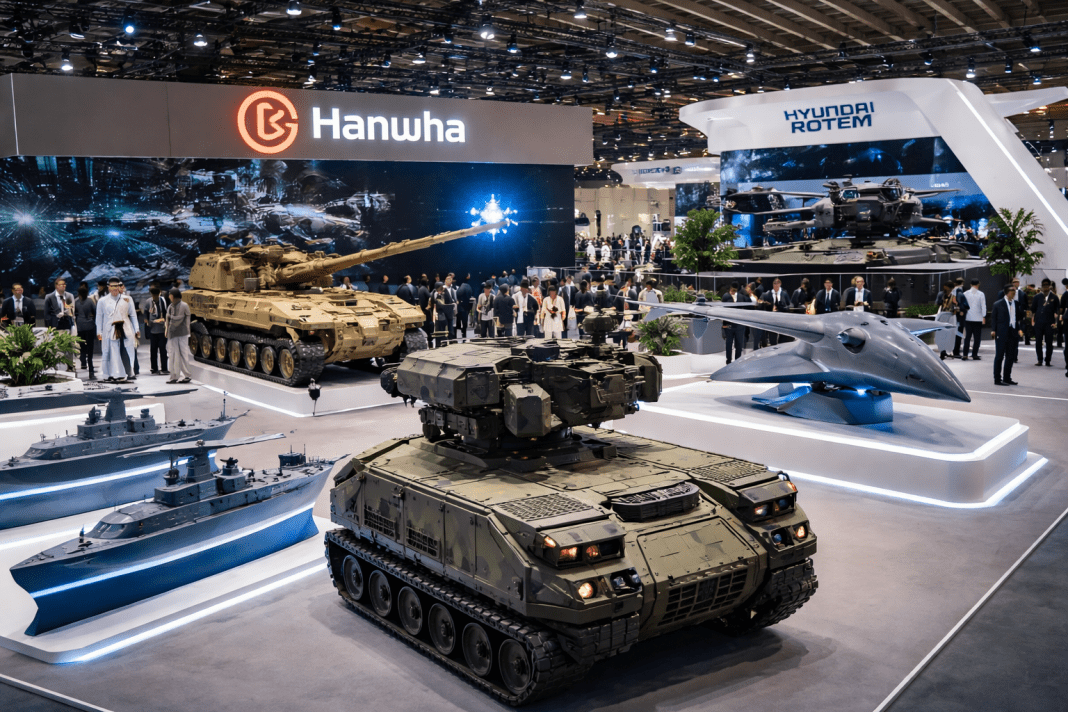

South Korea’s defense industry showcased its global ambitions this week in Riyadh. The country unveiled advanced land, sea, and air systems, including AI weapons. The display took place at one of the Middle East’s largest arms exhibitions. It highlighted both cutting-edge technology and the region’s push to modernize and diversify its military suppliers.
Hanwha Group Highlights AI Weapons and Armored Vehicles
Hanwha Group drew attention with a massive 677-square-meter booth shared by three of its affiliates: Hanwha Aerospace, Hanwha Systems, and Hanwha Ocean. The joint display emphasized the company’s strategy to provide integrated defense solutions spanning air, land, and sea, including advanced AI weapons that can autonomously detect and engage targets.
Hanwha Aerospace presented an artificial intelligence-powered laser-guided weapon that can detect and strike targets on its own. The company also showcased a version of its K9A1 self-propelled howitzer, customized for desert operations with a powerful 1,000-horsepower diesel engine. Alongside it, the Tigon armored vehicle, designed to operate in harsh desert conditions, drew significant attention from visitors. Hanwha Aerospace highlighted how its AI weapons could work seamlessly alongside traditional artillery to improve battlefield efficiency.
South Korea targets Canada’s $60 trillion submarine deal with sweeping industrial and energy offer
Hanwha Systems focused on advanced radar and air defense technology. Its multi-mission radar system is built to track increasingly sophisticated threats, including drones and crewed or unmanned aircraft. The display also featured a range of air defense tools, such as the Block-I laser-based air defense system. Several of these systems integrate AI weapons capabilities to automatically respond to incoming threats with high precision.
Meanwhile, Hanwha Ocean, the company’s shipbuilding branch, highlighted naval capabilities. Scale models of submarines and surface combatants were on display, including the 3,600-ton Jangbogo-III Batch-II submarine, which had been launched in October last year. These exhibits showcase South Korea’s ability to design and build advanced naval platforms for global clients, some of which are designed to carry AI weapons in the future.
Hyundai Rotem Debuts Unmanned Vehicles and Hydrogen Tech
Hyundai Rotem also participated in the exhibition, presenting a diverse range of land-based defense systems designed for modern combat. The company highlighted its ability to develop both traditional and cutting-edge unmanned platforms for complex battlefield scenarios.
A key highlight was the HR-Sherpa, a multipurpose unmanned ground vehicle equipped with counter-drone technology. The vehicle is built to detect, track, and neutralize unmanned aircraft, which are becoming an increasingly common threat in modern warfare. Its versatility allows it to operate in a variety of terrains and mission types.
The HR-Sherpa can also serve as a platform for AI weapons in combat scenarios, combining autonomous targeting with rapid response capabilities. This integration enhances operational efficiency and allows forces to engage threats with greater precision and reduced risk to personnel.
For the first time overseas, Hyundai Rotem unveiled its hydrogen fuel cell-powered unmanned mobility platform, Black Veil. By integrating AI weapons into this system, the company demonstrated its innovative approach to combining sustainable technology with advanced military capabilities. Black Veil reflects a growing trend toward autonomous, eco-friendly solutions that do not compromise on power or performance.
LIG Nex1 Presents Precision Missiles and Long-Range Defense
LIG Nex1, a prominent South Korean missile manufacturer, joined the exhibition with its lineup of advanced weapons. Among the products on display were the Cheongung surface-to-air missile and the L-SAM, a long-range air defense system capable of intercepting multiple aerial threats. While primarily missile-based, some of these systems can integrate with AI weapons for faster threat detection and targeting.
The company’s participation underscored South Korea’s expanding footprint in the global defense market. By showcasing both offensive and defensive capabilities, LIG Nex1 highlighted its role in providing precision-guided solutions for modern warfare.
The coordinated presence of these companies emphasizes South Korea’s aim to become a key player in international arms exports. The country is targeting regions that value advanced technology, fast delivery, and diversified defense solutions.
By bringing a wide array of land, sea, and air systems to one exhibition, including AI weapons, South Korea’s defense makers demonstrated both technical expertise and a growing ambition to compete on the global stage. From autonomous AI-guided systems to submarines and unmanned vehicles, the country’s display reflected the breadth of its military technology and its readiness to meet the demands of modern armed forces worldwide.