
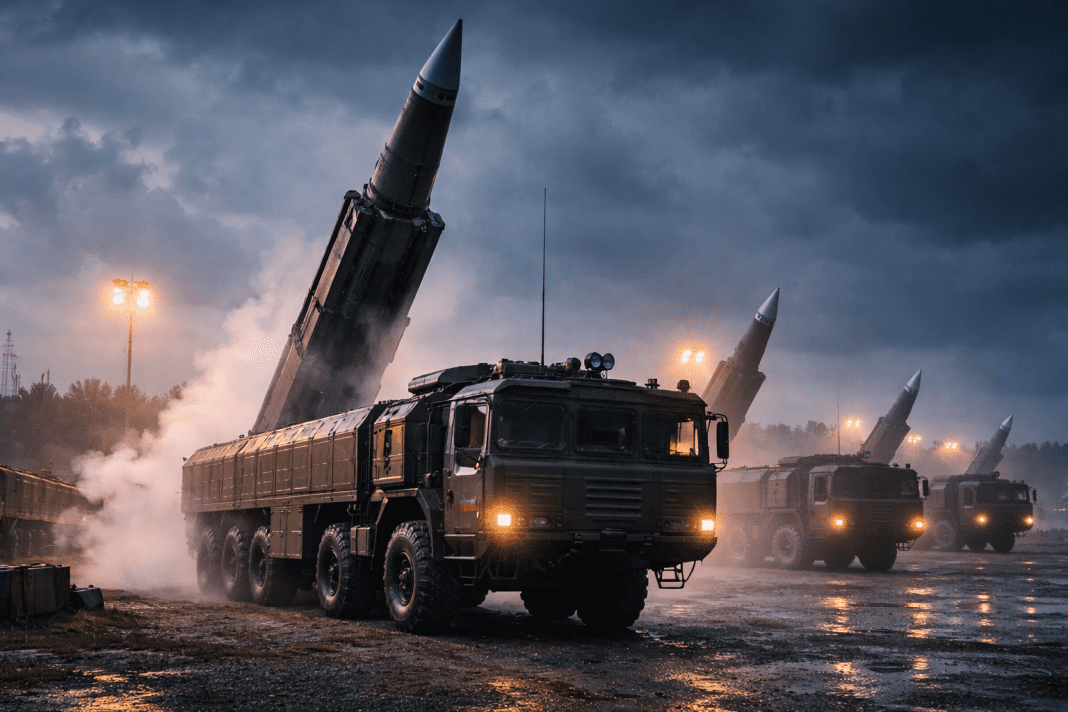

Leaked Russian production and financial documents indicate that Moscow has moved into serial production of a new extended-range Iskander ballistic missile, significantly expanding its ability to strike targets across Europe.
The missile, informally referred to as the “Iskander-1000,” reportedly has a range of up to 1,000 kilometres, placing multiple European capitals and critical NATO infrastructure within potential reach.
According to the leaked files, the new missile is a modernised version of the 9M723 ballistic missile, internally designated as the 9M723-2. The documents suggest that the system has progressed beyond testing and is now being manufactured at scale, despite wide-ranging Western sanctions on Russia’s defence industry.
The Iskander missile system is already one of Russia’s most heavily used weapons in the war against Ukraine. An extended-range variant would not only deepen the threat to Ukraine but also alter the strategic balance across Europe, particularly if deployed from Russia’s Kaliningrad exclave.
Russia fires Iskander missile at Kyiv government building in first direct strike since war began
What the Iskander-1000 means for Europe’s security landscape
The Iskander family, officially known as the 9K720 Iskander system, includes both ballistic and cruise missile variants. The Iskander-M, Russia’s primary domestic version, is a quasi-ballistic missile known for its high speed, manoeuvrability, and ability to evade air-defence systems. Speeds of over 2,000 metres per second leave defenders with very short reaction times.
The leaked documents indicate that the 9M723-2 retains these characteristics while extending its range to approximately 1,000 kilometres. From Kaliningrad alone, such a missile could potentially reach large parts of Germany, Poland, Scandinavia, the Baltic states, and key maritime choke points in Northern Europe. Cities such as Hamburg, Copenhagen, Stockholm’s southern approaches, and Oslo would fall within theoretical strike distance.
Military analysts warn that the missile’s ability to manoeuvre during flight and deploy countermeasures makes interception difficult even for advanced air-defence systems. Compounding the concern, Russian sources suggest that existing NATO early-warning systems may struggle to distinguish between standard Iskander launches and extended-range variants, forcing defenders to treat every launch as a potential long-range strike.
The strategic implication is clear: Europe’s rear areas, previously considered relatively safe, could become exposed in the event of escalation.
Evidence of serial production despite sanctions
The most alarming aspect of the leak is evidence that the Iskander-1000 is already in production. Financial records and procurement documents reportedly reference specific quantities of 9M723-2 missiles and components, a strong indicator of serial manufacturing rather than experimental development.
Additional documentation points to the production and testing of a new inertial guidance system designed specifically for the extended-range missile. Such systems are typically produced only once a weapon has cleared key development milestones.
Despite heavy sanctions on Russia’s defence sector, the documents also reveal continued reliance on foreign-made components. Western-origin electronics, microcontrollers, and power-management systems appear throughout the supply chain, often sourced indirectly through third countries. Ukrainian intelligence officials have stated that dozens of companies involved in the production chain are not currently sanctioned at all.
This highlights a persistent gap in sanctions enforcement and raises uncomfortable questions for European policymakers about how dual-use technologies continue to reach Russia’s weapons programs.
A broader geopolitical warning signal
Russia’s apparent ability to mass-produce an extended-range Iskander missile sends a broader geopolitical message. Beyond its battlefield utility, the weapon enhances Moscow’s leverage in strategic signalling, deterrence, and political pressure against NATO and the European Union.
Security officials also warn of proliferation risks. Russia has previously transferred missile and rocket technology to allied states, and analysts fear that advanced Iskander variants could eventually be shared with countries such as North Korea or Iran. Such transfers would further destabilise already volatile regions and complicate global non-proliferation efforts.
European experts argue that the response must go beyond condemnation. Strengthening sanctions enforcement, expanding export-control regimes, and improving missile-defence coordination are increasingly seen as urgent priorities rather than long-term policy goals.
As the war in Ukraine grinds on, the emergence of the Iskander-1000 underscores a stark reality: Russia is not merely sustaining its military-industrial base under sanctions, but adapting and expanding it. For Europe, the leaks are less a revelation than a warning — one that suggests the continent’s security environment is entering a more dangerous and unpredictable phase.