
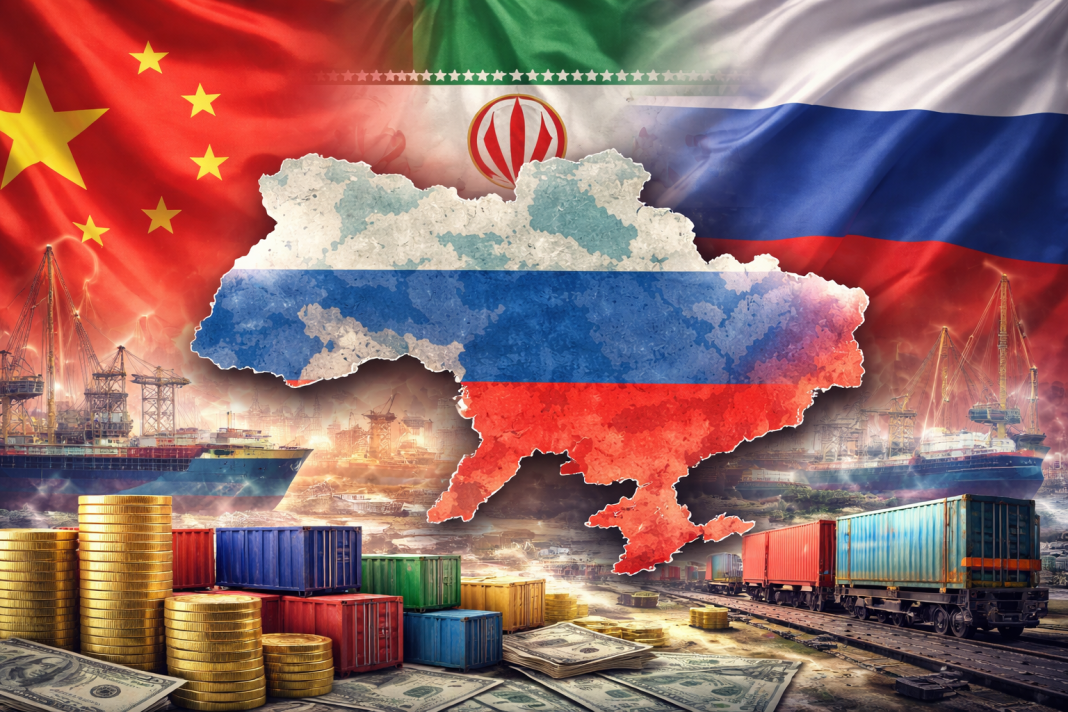

A new report has revealed how Russia is reshaping the economies of Ukrainian territories under its control. These regions include Crimea and parts of eastern and southern Ukraine that have remained occupied since 2014, with expansion during the full-scale invasion.
Sanctions from Western countries have limited Russia’s access to global trade, finance, and technology in these areas. As a result, Russia has started replacing these systems with alternative arrangements supported by a small group of partner countries.
The report describes this as a structured transition. Instead of relying on open international markets, economic activity is now routed through controlled channels. Trade, finance, and supply systems are being reorganized to function outside Western influence.
This has led to the emergence of a restricted economic model. It operates with fewer partners and depends on indirect methods to keep systems running under sanctions.
China Leads in Technology and Financial Integration
China plays the most significant role in supporting economic activity in the occupied territories. While it does not officially recognize these regions, its companies are involved through indirect business links.
Chinese firms are contributing to infrastructure, particularly in telecommunications. Mobile networks across several occupied areas now rely on Chinese equipment, with thousands of base stations installed to maintain services.
Business operations are often carried out through intermediary companies linked to Russia. This approach allows continued involvement without formal political commitments.
Financial systems are also shifting. The Chinese yuan is increasingly used alongside the Russian ruble, and banks in these regions are offering yuan-based services. This reflects a move away from Western currencies.
Digital payments have also expanded. Transactions using mobile platforms and cryptocurrencies are becoming more common, helping businesses operate without relying on global banking systems.
Seven Russian oil tankers originally bound for China make sudden U-turn toward India
Iran Expands Trade Through Non-Traditional Routes
Iran’s involvement focuses on trade and logistics. The report highlights its role in helping move goods out of the occupied territories through alternative channels.
Exports such as grain and coal, which face restrictions in global markets, are being redirected through these routes. These systems operate outside standard international frameworks, allowing trade to continue despite sanctions.
There are also early developments in direct economic ties. Certain agricultural and industrial products are being prepared for export to Iran. At the same time, Iranian companies have expressed interest in sectors like construction, agriculture, and manufacturing within these regions.
Although still developing, this cooperation provides practical support. It helps maintain supply chains and ensures that goods continue to move despite limited access to traditional markets.
http://European Union extends Russia sanctions until September after debate over sanctions list
North Korea Signals Support as Controlled Economy Takes Shape
North Korea’s role is limited but politically significant. It is one of the few countries that has openly supported Russia’s claims over the occupied territories.
The report notes activities such as delegation visits and participation in public events. While these actions do not contribute heavily to economic operations, they serve as signals of political alignment.
These interactions are used to show that the occupied regions are not entirely isolated. They also reflect cooperation among countries that share similar positions against Western influence.
At the same time, the report describes the overall economic structure in these territories as controlled and dependent. Key sectors such as finance, trade, and infrastructure now rely on a narrow group of external partners.
Economic activity continues, but it follows a system shaped by restrictions. Alternative currencies, indirect business operations, and limited trade networks define how these regions function under current conditions.