
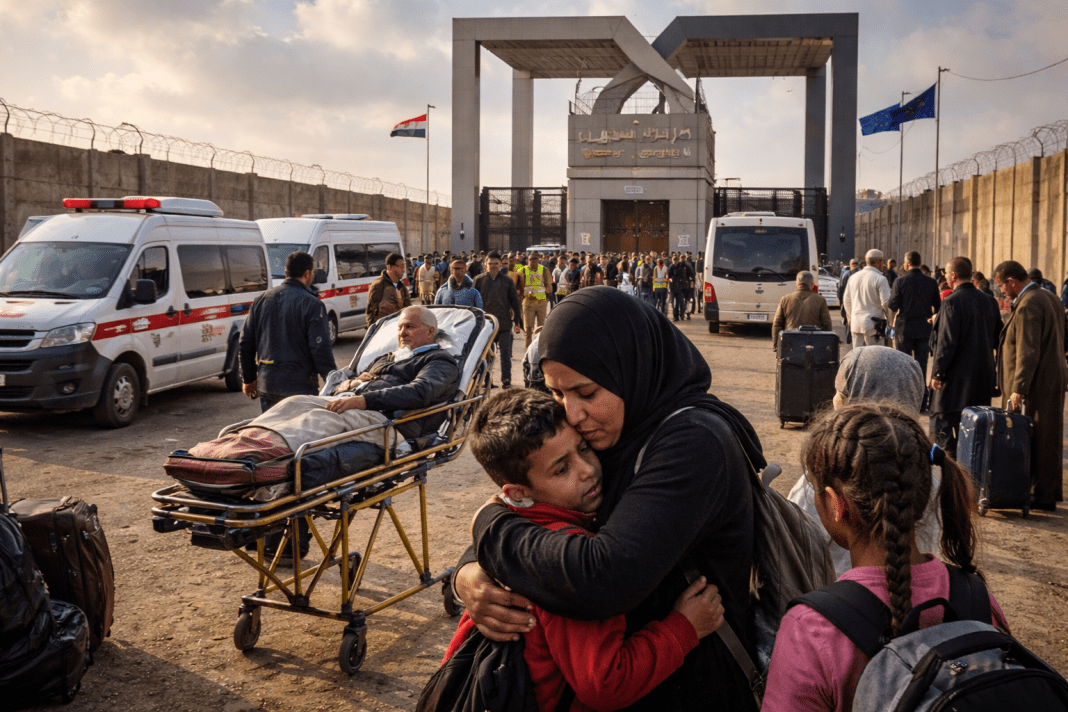

After many months of waiting, the Rafah border crossing between Gaza and Egypt reopened late Monday, allowing a small number of Palestinians to return home and a limited group of sick and injured patients to leave Gaza for medical care in Egypt. The reopening was part of the ongoing Israel-Hamas ceasefire and was widely seen as an important step, even though movement through the crossing remained very restricted.
Rafah Crossing Reopens After Months of Closure
Late at night, a bus carrying about a dozen Palestinians entered Gaza from Egypt. These returnees were people who had fled earlier in the war and were finally allowed to come back. Their arrival came hours after a small group of medical evacuees had crossed from Gaza into Egypt. Ambulances were seen waiting for long hours at the border before patients were finally transported across.
While officials had earlier suggested that around 50 people would be allowed to cross in each direction, the actual number fell far short. No commercial goods were permitted to pass through the crossing, making the reopening more symbolic than practical for now.
Before the war, Rafah was the main gateway for people entering and leaving Gaza. All other crossings are shared with Israel. The Rafah crossing had remained shut since May 2024, when Israeli forces took control of the area. Its closure severely limited travel and medical evacuations, adding to the suffering in the already devastated territory.
Medical Evacuations Offer Limited Relief
One of the main reasons for reopening the Rafah crossing is medical need. Gaza’s health system has been severely damaged by months of fighting, leaving thousands without proper care. Local officials estimate that about 20,000 people, including many children, need medical treatment outside Gaza.
Since the war began, over 10,000 patients have been evacuated, but after Israel seized the Rafah crossing last year, evacuations slowed dramatically. For much of that time, only around 17 patients per week were able to leave.
On Monday, ambulances queued for hours at the crossing before patients were allowed to cross. Egyptian authorities said about 150 hospitals across the country are ready to receive evacuees. The journey is long, as the crossing is nearly six hours from Cairo.
Beyond Gaza and Lebanon: Israel confronts a growing mental health emergency in its military
To support patients and their families, the Egyptian Red Crescent has prepared “safe spaces” on the border, providing temporary rest and basic care before they continue to hospitals.
Despite the reopening, major restrictions remain. Israel continues to ban patients from being sent to hospitals in the Israeli-occupied West Bank and east Jerusalem, which were previously key destinations for advanced care. This makes Egypt one of the few remaining options for Palestinians needing urgent medical treatment outside Gaza.
The reopening offers relief, but limited movement and strict controls mean many still face challenges accessing life-saving care.
Ongoing Violence and Tight Controls Around the Crossing
Even as the Rafah border crossing reopened, violence continued across Gaza, showing how fragile the ceasefire remains. Hospital officials reported that Israeli naval fire struck tents sheltering displaced families near the coast, killing a young child. Israel’s military said it was reviewing the incident. The same day, the military said it killed several Palestinians in northern Gaza who approached troops in a restricted area and posed an immediate threat.
Since the ceasefire began in October, Gaza’s health authorities report more than 520 Palestinians killed by Israeli fire, adding to over 71,800 deaths since the war began. International organizations generally consider these figures reliable, though they do not distinguish between civilians and fighters.
Under the ceasefire, Israel’s military still controls the area between Rafah and Gaza’s main population centers. Israel and Egypt vet people crossing the border, with European Union agents now supervising alongside a small Palestinian presence. Egypt has repeatedly stressed that the crossing must remain open for both entry and exit, to allow people to return home and leave safely.
Israel says it seized the crossing to prevent weapons smuggling by Hamas. While Rafah briefly reopened in early 2025 for medical evacuations, Monday’s reopening marks the first sustained movement in months. Only a small number of people crossed, but families hoped for reunions and patients for life-saving treatment.