
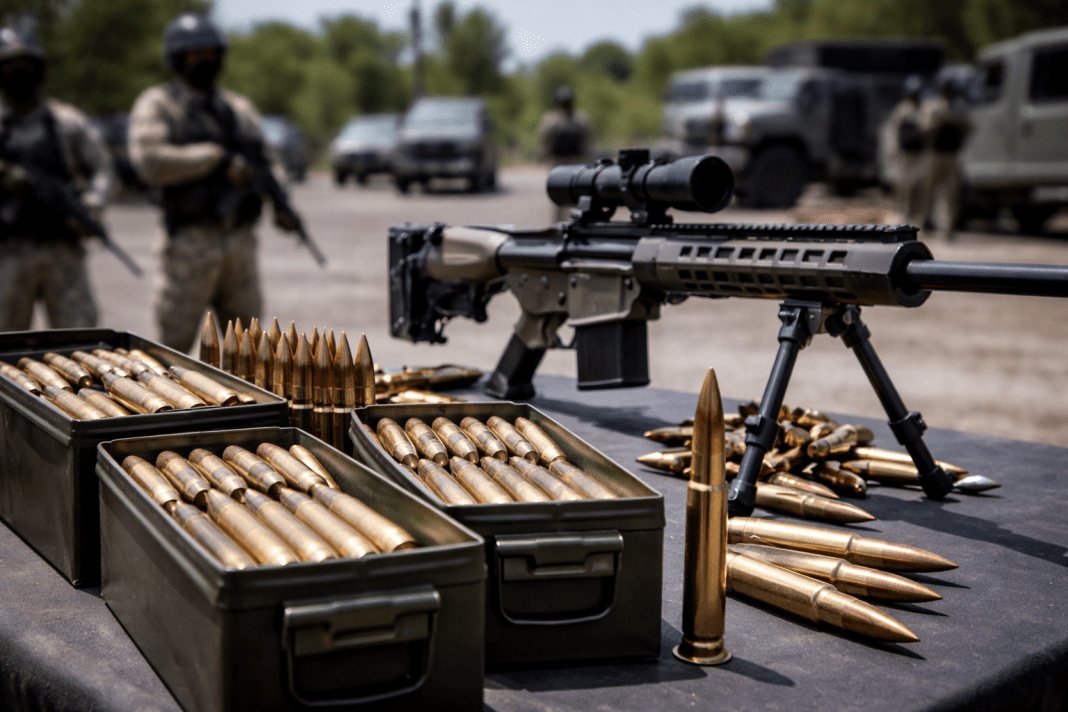

Almost half of the .50-caliber ammunition seized in Mexico over the past decade came from a U.S. Army–owned plant in Missouri, officials said. The ammunition was legally made in the United States. It was later trafficked into Mexico. The powerful rounds have been used by criminal groups in deadly attacks.
Massive Ammunition Seizures and a Clear Source
Mexican defense authorities say they have seized about 137,000 .50-caliber cartridges since 2012, with nearly 47 percent traced to ammunition produced at the Lake City facility in the United States. The U.S. government owns the plant, which produces more small-caliber ammunition for the U.S. military than any other facility. Under long-standing agreements, the plant has also supplied the civilian market for more than two decades by selling excess production after meeting military needs.
Seizure records show that gun shops in the southern United States legally sold many of the cartridges later recovered in Mexico. Traffickers then moved the ammunition across the border and delivered it to criminal organizations.
11 dead, 12 wounded after cartel gunmen attack football match in central Mexico
Mexican authorities say they recovered some cartridges marked with the initials “L.C.,” directly linking them to the Lake City plant. Investigators found these marked rounds after several major attacks, including assaults on police forces and government buildings that caused heavy casualties.
Mexican officials have repeatedly warned that the ongoing flow of weapons and ammunition from the United States has strengthened criminal groups, enabling them to carry out military-style attacks that threaten public safety and overwhelm local law enforcement.
Why .50-Caliber Weapons Are So Dangerous
The .50-caliber rifle is one of the most powerful firearms available. It is nearly five feet long, weighs about 30 pounds, and fires large, high-speed bullets. These rifles have limited practical use for everyday civilian activities. Even so, people in the United States can legally purchase both .50-caliber rifles and their ammunition, and federal law places few limits on how much ammunition a person may buy.
Mexican authorities say criminal groups have increasingly adopted these weapons. They have used them to shoot down helicopters, attack armored vehicles, assassinate officials, and carry out mass killings. Since the early 2000s, investigators have linked .50-caliber weapons to dozens of violent incidents across Mexico, causing more than a hundred deaths.
Cartel warfare fears rise after Parral killings — Mexico unleashes special operations troops
Official briefings show that attackers have used these rifles in several assaults on military and police helicopters, highlighting the serious threat they pose. Under the current administration, Mexican forces have seized about 18,000 firearms and traced roughly 78 percent of them back to the United States. Authorities say the seizures include more than 200 .50-caliber rifles.
While gun trafficking has drawn public attention, experts say far fewer people focus on ammunition smuggling. They estimate that traffickers move millions of rounds across the border each year, allowing criminal groups to remain heavily armed even after authorities seize weapons.
How US Military Production Reached Civilian Markets
The Lake City ammunition plant operates under long-standing contracts with the U.S. Army that require it to be capable of producing up to 1.6 billion rounds of ammunition each year when needed. In return, the companies that run the plant can use extra production capacity to sell ammunition to civilians, law enforcement agencies, and foreign buyers.
The U.S. Army says this arrangement helps save taxpayer money by keeping the plant active and efficient during periods of lower military demand. By allowing civilian sales, the facility can maintain its workforce and production readiness without relying only on military orders.
Mexico transfers 37 cartel members to US as pressure grows, bringing total transfers this year to 92
Investigative records show that this system has also allowed very powerful ammunition, including armor-piercing rounds, to reach civilian gun shops. Lawmakers previously targeted some of this ammunition as they sought to limit public access to military-grade rounds.
Once retailers sell the ammunition legally, buyers can purchase it in large quantities and traffickers can later smuggle it across the border. Mexican officials say this steady supply helps criminal groups quickly replace seized weapons and continue violent activities.