
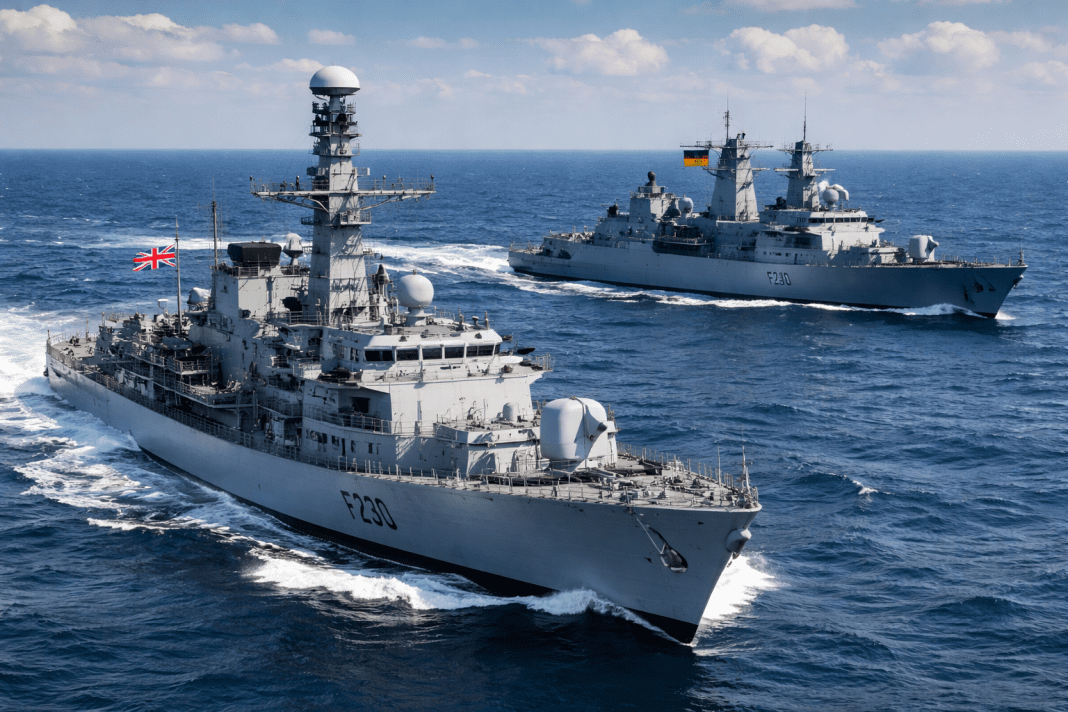

Britain’s naval readiness has come under question after Defence Secretary John Healey admitted uncertainty over available warships. This has raised concerns about the country’s ability to meet NATO commitments. The issue gained attention after the UK relied on support from Germany for an upcoming mission. This has highlighted growing pressure on the Royal Navy.
Confusion Over Number of Warships Raises Concerns
A surprising moment unfolded when UK Defence Secretary John Healey struggled to answer a simple question: how many warships does Britain actually have ready for action? After a pause, he stated that the UK has 17 frigates and destroyers, but defence experts quickly pointed out that this number can be misleading when referring to ships that are actually available for operations.
Military analyst Francis Tusa reacted strongly and said he was “flabbergasted” by the response. He explained that although the total fleet appears larger on paper, maintenance work and technical issues keep many ships from deploying, which significantly reduces the number of vessels available for immediate use.
Britain nuclear submarine base sees breach surge as UK MoD reviews security at HMNB Clyde
According to experts, the UK currently has only two Type 45 destroyers and around three Type 23 frigates available for immediate use, which is far lower than expected for a major naval power. The situation highlights a key challenge: not all warships are operational at the same time, as they require regular repairs, upgrades, and servicing, and some older ships, especially the Type 23 class, are facing serious maintenance problems.
Britain Forced to Borrow German Frigate for NATO Mission
The situation became more serious when the UK had to “borrow” a warship from Germany for an upcoming NATO operation. This rare move highlights how growing global security demands are increasing pressure on Britain’s naval forces while allies still expect the UK to meet its commitments.
The issue arose after the Royal Navy deployed HMS Dragon, a Type 45 destroyer, to the eastern Mediterranean due to rising tensions linked to the Iran situation. With one of its key warships sent to a high-risk region, the UK found itself short of available vessels to fulfil its NATO responsibilities, forcing it to look for support from allies.
Middle East on edge as UAE draws red line and US warships move closer to Iran
Defence Secretary John Healey confirmed that Germany stepped in to provide a frigate for the mission. Although the ship will operate under a German flag, British leadership will remain central to the mission. A Royal Navy commodore and his team will command operations onboard, ensuring that the UK still plays a leading operational role.
This unusual arrangement shows how stretched the UK’s naval resources have become. NATO missions depend on each member contributing ships, and any shortfall can disrupt planning. The idea of “borrowing” a warship has raised concerns, as it suggests that Britain may be struggling to maintain enough fully operational vessels despite its long-standing reputation as a major naval power.
Pressure Mounts Amid Global Tensions and Security Moves
The naval shortage comes at a time when global tensions are rising. The UK has increased its military focus on the Middle East and stepped up actions against Vladimir Putin and Russia’s so-called shadow fleet. These vessels are used to move oil and gas while avoiding international sanctions.
The shadow fleet includes hundreds of aging tankers that often change flags or ownership to escape detection. Prime Minister Keir Starmer has approved stronger measures, allowing British forces to board and seize suspicious ships passing through UK waters.
The UK is also working closely with the Joint Expeditionary Force, a group of northern European countries including Finland, Sweden, Norway, and the Netherlands. British forces have already helped track and intercept several suspected vessels alongside allies.
Britain unveils £500 million defence package with missiles for Ukraine
Despite these efforts, Defence Secretary John Healey admitted he is “not happy” with the Royal Navy’s current state. He said warships take years to build and pointed to past budget cuts and ageing vessels. Although an extra £300 million is being invested in shipbuilding, he stressed that rebuilding the fleet will take time.
The situation has sparked political debate, with opposition voices criticizing the government’s handling of defence resources. Concerns remain about whether the UK can meet its military commitments while managing growing global challenges.