
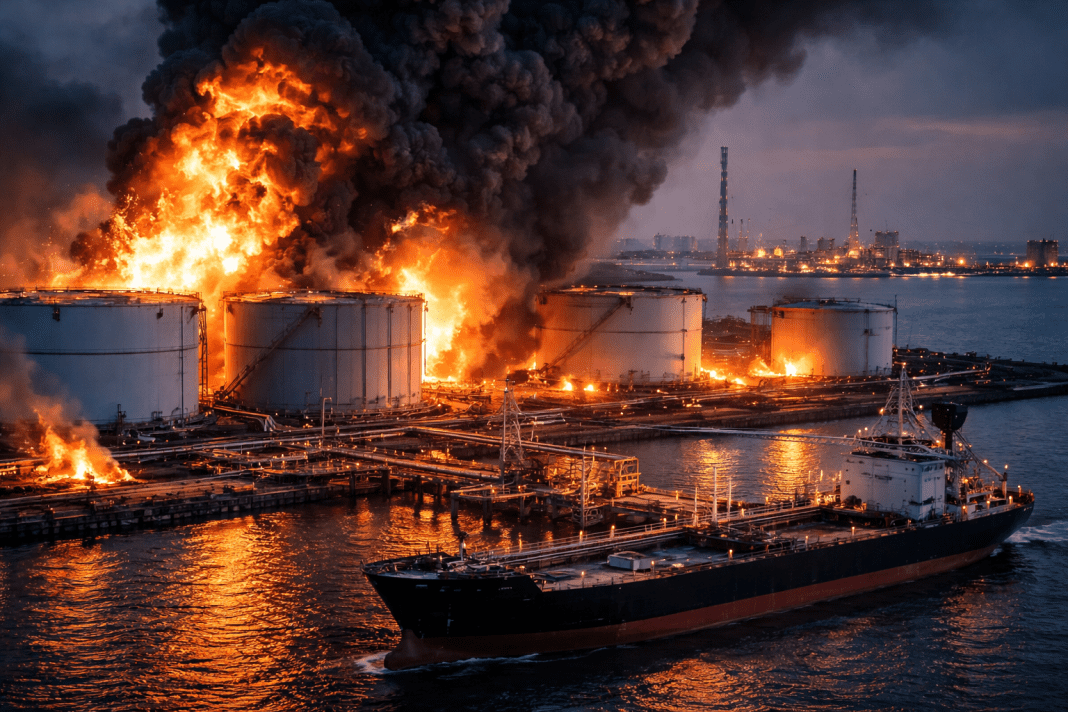

The United Arab Emirates’ Fujairah Port has become a major flashpoint in the escalating Iran-Israel conflict, as recent drone attacks have severely disrupted operations at one of the world’s most important oil hubs. The strikes have triggered fires at the oil terminal, forcing authorities to temporarily halt crude oil loading and raising concerns about the safety of global energy supplies.
These incidents come at a time when tensions in the Middle East are intensifying, with key energy routes becoming increasingly vulnerable. Fujairah, located outside the Strait of Hormuz, plays a crucial role in ensuring uninterrupted oil exports. The recent attacks highlight how energy infrastructure is increasingly being targeted to exert geopolitical pressure.
Drone Strikes and Fires Disrupt Fujairah Operations
The situation escalated after a drone strike hit Fujairah’s industrial zone, causing multiple fires. Emergency teams quickly responded to control the blaze, and authorities confirmed that no casualties were reported. However, the incident forced Abu Dhabi’s state oil company, ADNOC, to suspend crude oil loading operations temporarily.
Mojtaba Khamenei takes charge as oil prices hit $100 and U.S. denies Iranian hit on aircraft carrier
This attack marks the second disruption at the port in just a few days, indicating that even highly secured facilities are not immune to the conflict’s spillover. Oil shipments that had only recently resumed after an earlier strike were once again delayed. The repeated targeting of Fujairah underscores the vulnerability of key oil infrastructure in the region, showing how quickly conflicts in the Middle East can impact global energy flow.
Why Fujairah Port is Critical for Global Oil Supply
Fujairah is not just any port—it is a strategic hub for global oil exports. The terminal handles around 1 million barrels of oil per day, which accounts for roughly 1% of the world’s total oil demand. It is the main export point for the UAE’s Murban crude, making it essential not only for the country but also for international energy markets.
Any disruption at Fujairah can quickly affect global oil prices and create supply chain challenges. This explains why even short-term shutdowns at the port draw immediate international attention. The recent strikes demonstrate how vulnerable the global oil supply chain is to disruptions in the Middle East, a region already known for its geopolitical instability.
Donald Trump gives mixed signals on Iran war timeline as markets watch rising oil prices
One of Fujairah’s main advantages is its location on the Gulf of Oman, outside the Strait of Hormuz. The Strait is a narrow waterway that handles nearly one-fifth of the world’s oil supply and has often been a chokepoint for shipping. By bypassing this route, Fujairah allows oil exports to continue even if tensions in the Strait restrict movement. However, the recent drone attacks show that alternative routes are not completely safe, emphasizing the growing risks to global energy security.
Impact on UAE Oil Exports and Regional Energy Infrastructure
The attacks on Fujairah have already affected UAE oil output and export operations. ADNOC temporarily cut production and suspended certain activities to protect its personnel and infrastructure. The strikes also disrupted tanker movements, putting additional pressure on global oil markets.
Experts warn that repeated strikes reflect a broader trend in modern conflicts, where attackers directly target energy infrastructure. They use pipelines, oil terminals, and shipping routes as strategic leverage in regional conflicts because these actions can immediately affect economies around the world.
Russian oil revenues jump $1.3 billion as Strait of Hormuz crisis shifts global supply
The United Arab Emirates has responded by reassuring residents and businesses that major cities, including Dubai, remain secure and operational. Authorities are also working to strengthen protection at critical infrastructure sites to prevent further disruptions. Meanwhile, regional nations continue to monitor the situation closely, aware that attacks on strategic energy hubs like Fujairah could have ripple effects far beyond the Middle East.
The recent events at Fujairah demonstrate the immediate impact of the Iran-Israel conflict on vital energy infrastructure. As drone strikes continue to target the port, the UAE and global energy markets remain on high alert, highlighting just how connected local conflicts are to international oil supply chains.