
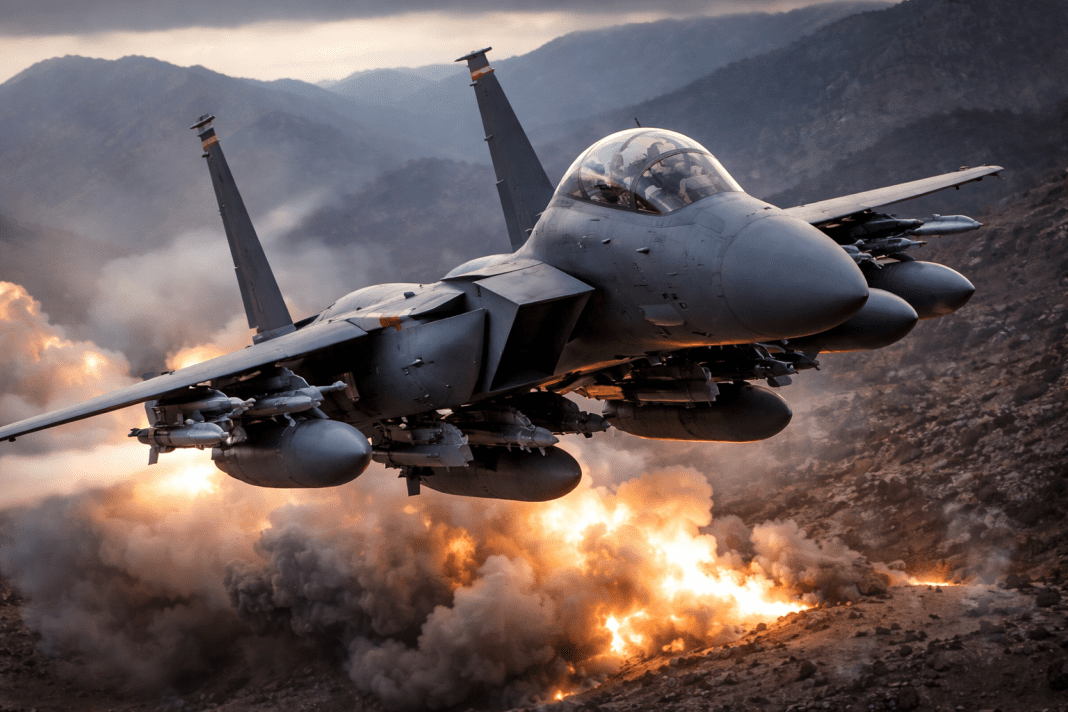

The downing of a F-15E Strike Eagle over Iranian territory has ignited a fresh wave of scrutiny over Washington’s reliance on a battle-proven but ageing aircraft in one of the most heavily defended airspaces in the world. At first glance, the question seems obvious: why deploy a jet rooted in 1970s design philosophy in a conflict defined by advanced radar systems, networked air defences, and electronic warfare? But the answer reveals a deeper strategic reality—modern warfare is not just about invisibility, but about volume, endurance, and adaptability.
Built for War, Not Just Survival
The Strike Eagle is an evolution of the F-15 Eagle, a jet originally conceived to dominate the skies during the Cold War. When McDonnell Douglas—later absorbed by Boeing—developed the F-15E, the goal was not merely to maintain air superiority, but to create a platform that could carry the fight deep into enemy territory.
Unlike stealth fighters that prioritise avoiding detection, the F-15E was designed to operate in contested environments with overwhelming force. It is engineered to strike hard, carry massive payloads, and return safely—often without needing escort aircraft. This design philosophy has allowed it to remain relevant across decades of shifting military doctrines.
From the sands of Operation Desert Storm to the rugged terrain of Operation Enduring Freedom and the urban battlefields of Operation Iraqi Freedom, the Strike Eagle has built a reputation as a dependable workhorse—less glamorous than stealth jets, but often more impactful in sustained combat.
The Day Stealth Died: Iran Becomes First Country to Destroy F-35 Jets in Active Combat
The “Bomb Truck” Advantage
One of the defining reasons the US continues to deploy the F-15E is its unmatched payload capacity. While stealth fighters such as the F-35 Lightning II are constrained by internal weapon bays to maintain low observability, the F-15E can carry an enormous external load of bombs, missiles, and targeting pods.
This allows a single aircraft to perform multiple strike roles in one mission—hitting hardened bunkers, infrastructure nodes, and mobile targets without needing multiple sorties. In a conflict like the Iran war, where time-sensitive targets and dispersed facilities are common, this capability becomes critical.
Its range is equally important. Equipped with conformal fuel tanks, the aircraft can travel deep into hostile territory without sacrificing payload. Combined with speeds exceeding Mach 2, it gives commanders the ability to strike quickly and from long distances—often before adversaries can reposition their assets.
Human Advantage in a Digital Battlefield
Another often overlooked strength of the F-15E is its two-person crew configuration. In an era where pilots are overwhelmed with data—from sensors, targeting systems, and electronic warfare inputs—the presence of a dedicated Weapon Systems Officer (WSO) provides a tactical edge.
While the pilot focuses on flying and threat evasion, the WSO manages targeting, radar systems, and countermeasures. This division of responsibilities is particularly valuable in complex strike environments like Iran, where threats can emerge simultaneously from ground-based missiles, radar systems, and interceptor aircraft.
Modern Upgrades, Old Limitations
Despite its age, the F-15E is far from obsolete. Continuous upgrades have significantly enhanced its capabilities. Advanced AESA radar systems provide long-range tracking and targeting, while modern electronic warfare suites improve survivability against radar-guided threats.
F-16 transfer to Ukraine stalls as Belgium waits for F-35 fighter jet arrivals
The emergence of the F-15EX Eagle II further underscores the platform’s continued relevance. Designed to carry next-generation and even hypersonic weapons, the F-15EX addresses one of the key limitations of stealth aircraft—the inability to carry large or bulky munitions internally.
However, no amount of upgrades can fully compensate for one fundamental disadvantage: visibility. Unlike stealth aircraft, the F-15E has a large radar cross-section, making it easier to detect and track.
The Iran Reality Check
This vulnerability came into sharp focus with the recent shootdown over southwestern Iran. The aircraft, reportedly engaged during a deep-strike mission, was targeted by advanced Iranian air defence systems. While both crew members survived, the incident has had a psychological and strategic impact far beyond the loss of a single jet.
Iran’s air defence network, believed to integrate radar systems, surface-to-air missiles, and electronic warfare capabilities, represents a new generation of layered defence. Against such systems, non-stealth aircraft face significantly higher risks—especially when operating without complete air dominance.
The rescue operation that followed, reportedly authorised by Donald Trump, highlighted the dangers involved. Recovering downed personnel in hostile territory requires extensive coordination, assets, and risk—turning a single aircraft loss into a broader operational challenge.
Firepower vs Stealth: A Strategic Trade-Off
The continued use of the F-15E reflects a deeper tension within modern air strategy. Stealth aircraft offer survivability but come with limitations in payload and mission endurance. Legacy platforms like the F-15E provide overwhelming firepower but at increased risk in contested environments.
Iran claims a second US F-35 stealth jet was shot down over its central region
In practice, militaries increasingly use a combination of both. Stealth jets may lead initial strikes to degrade enemy air defences, creating corridors through which non-stealth aircraft can operate more safely. Once those defences are weakened, platforms like the F-15E can deliver the heavy удар needed to sustain operations.
But the Iran conflict suggests that such strategies are not foolproof. Advanced air defence systems can recover quickly, relocate, and continue posing threats even after initial suppression.
Why the US Still Flies the F-15E
Ultimately, the answer to why the US continues to use the F-15E is straightforward: there is no perfect replacement. Each aircraft type brings its own strengths and compromises, and the Strike Eagle fills a niche that remains critical.
It is not just a relic of past wars, but a platform that bridges two eras—combining Cold War robustness with modern technological upgrades. In high-intensity conflicts where volume of fire and operational flexibility matter as much as stealth, the F-15E continues to prove its worth.
A Glimpse Into the Future
The recent shootdown is unlikely to end the use of the F-15E, but it will influence how it is deployed. Expect greater emphasis on electronic warfare support, coordinated operations with stealth aircraft, and possibly standoff weapons that allow strikes from safer distances.
As warfare evolves, the skies are becoming more contested, more complex, and less forgiving. The story of the F-15E Strike Eagle is no longer just about longevity—it is about adaptation under pressure.
In that sense, the aircraft’s continued presence over Iran is not an anachronism.