
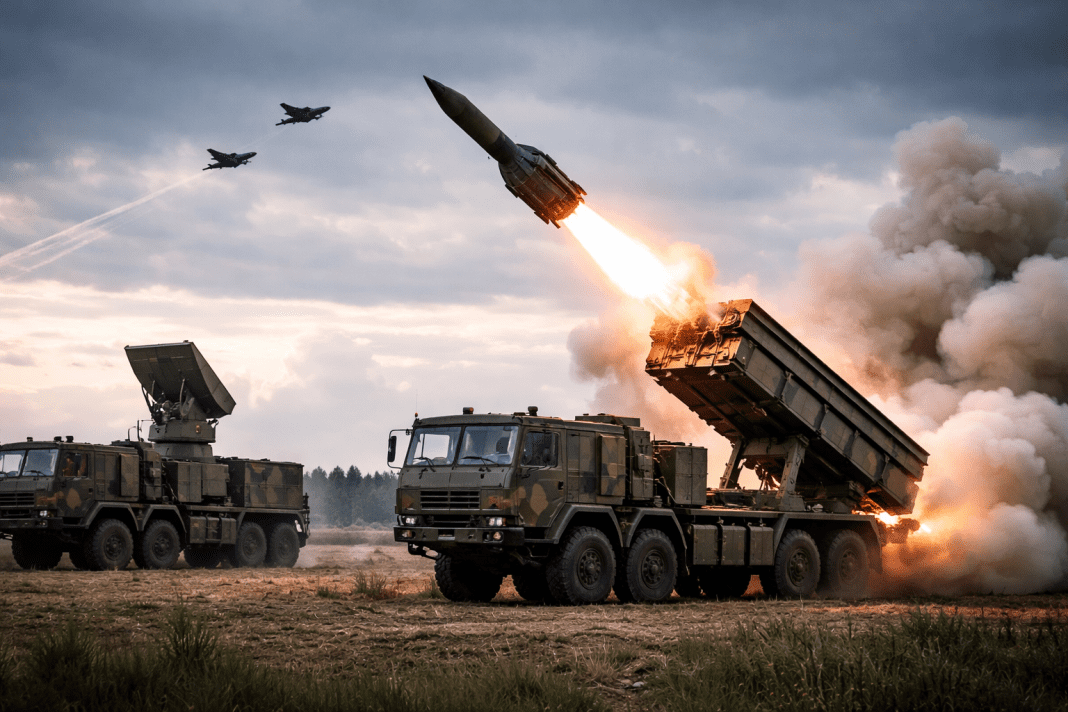

Europe’s main military weakness isn’t tanks or drones. It is ground-based deep-strike weapons that can reach far behind enemy lines. These weapons let Europe deter Russia and protect its allies. They also allow Europe to act independently. Deep-strike missiles could reshape the battlefield, much like drones have done in recent conflicts.
Why Deep-Strike Weapons Matter
Russia’s war in Ukraine has revealed a serious weakness in Europe’s defenses. Despite heavy losses, Russia continues to rebuild its army, produce more missiles, and expand drone operations, giving it the ability to strike far across Europe. European forces, on the other hand, cannot target Russia’s key bases, factories, or supply hubs, leaving the continent at a significant strategic disadvantage.
Deep-strike weapons are crucial to restoring balance. These missiles would allow Europe to threaten critical Russian targets without risking aircraft in heavily defended airspace. They don’t just level the playing field—they give Europe the ability to deter attacks, force Russia to spread its defenses thin, and influence the course of conflicts more effectively. With a credible deep-strike capability, Europe could act with greater confidence and independence.
Ukraine war transforms Europe’s security as NATO and Russia slide into prolonged power confrontation
Some propose buying US missiles like Tomahawks, but this comes with major drawbacks: limited production, high costs, long delivery times, and reliance on US priorities. Europe already possesses the industrial capacity, technology, and expertise to produce its own deep-strike weapons. The challenge is not the lack of tools—it is making rapid, large-scale decisions to act quickly, build numbers, and gain true strategic autonomy.
Current Efforts and Challenges
Europe has started programs to build deep-strike systems, like the ELSA project in 2024 and the British-German Trinity missile project. But these initiatives are moving too slowly and cost too much. ELSA struggles with competing national priorities and duplication, while Trinity is set to deliver refined systems only in the 2030s—long after Europe might need them.
Experts say Europe should focus on speed. Instead of waiting for a few high-cost missiles, countries should produce thousands of affordable systems. Just like drones changed modern warfare, a large number of missiles would force Russia to defend everywhere at all times. This approach would give Europe freedom to act and create escalation parity below the nuclear threshold.
United States says Russia shifts balance of power in Europe affecting NATO influence
To make this work, Europe must also improve its intelligence and guidance systems. Satellites, secure navigation networks, and real-time intelligence are essential. Missiles can only strike effectively if they know exactly where the target is. Without this technology, deep-strike weapons would be blunt tools. With it, they become precise instruments capable of striking critical enemy operations accurately.
Europe cannot rely solely on the United States. Strategic independence means acting on its own if US priorities change. Partnering with Ukraine could help. Ukraine has battlefield experience and could assist in shaping systems that are practical in real combat. Co-developing missiles with Ukraine could also speed production and ensure Europe can act independently while strengthening NATO’s overall defense.
Transforming Europe’s Military Power
The threat is immediate, and Europe’s gap in deep-strike capabilities is obvious. Current programs are moving too slowly to address rising risks. Europe has the industrial base, technology, and innovation to act fast—but it must prioritize large-scale, rapid production. Affordable, mass-produced missiles could strengthen Europe’s ability to deter Russia, defend Ukraine, and act independently.
Michel urges project-based security cooperation with Türkiye to strengthen Europe defense
Deep-strike weapons could become a true game-changer, much like drones have reshaped modern warfare. With thousands of missiles ready to target key enemy sites, Europe could force Russia to spread its defenses thin and limit its operational flexibility. This capability would give Europe far more influence over how conflicts unfold.
This isn’t about a few expensive missiles—it’s about creating massive capability and strategic autonomy. By focusing on speed, scale, and precision, Europe could transform its military power, secure its borders, and establish a stronger, independent defense posture for the continent.