
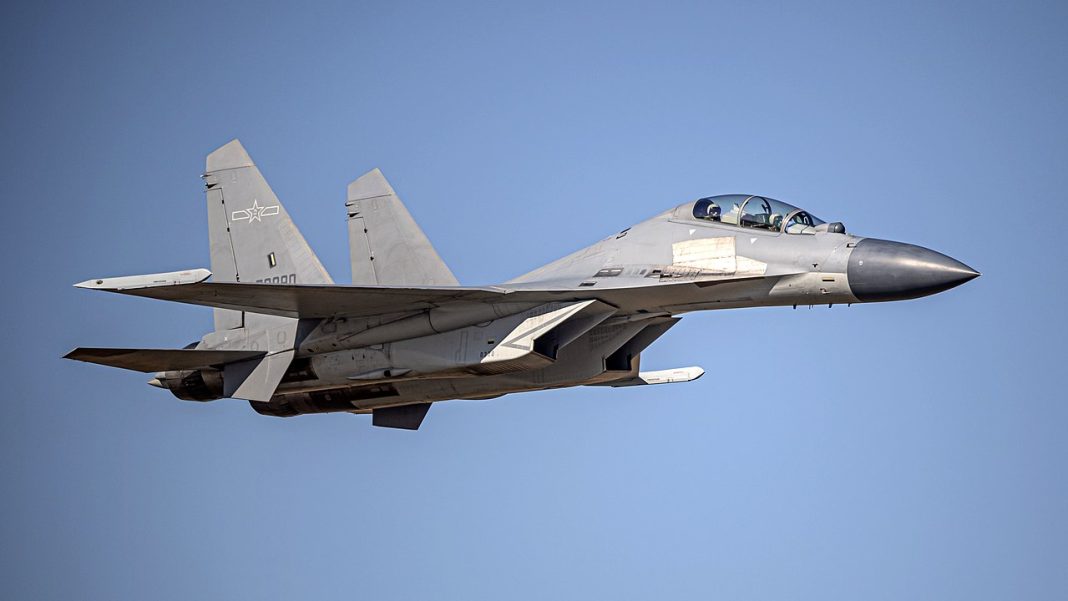

A military aircraft encounter over the Taiwan Strait drew attention after a fighter from the People’s Liberation Army Air Force carried out aggressive maneuvers near a Taiwanese jet. During the incident, a Chinese Shenyang J-16 fighter reportedly fired flares while flying close to a Taiwanese F-16 Fighting Falcon that had scrambled to intercept it.
Aerial Encounter Raises Tensions in Taiwan Strait
The confrontation took place during a Chinese military training exercise in the Taiwan Strait last December after a Chinese Shenyang J-16 crossed the unofficial median line separating mainland China and Taiwan. Taiwanese forces responded by scrambling F-16 Fighting Falcon aircraft to intercept and monitor the jet.
Although no combat occurred, the situation grew tense as the aircraft flew close to each other and the Chinese jet released flares. Pilots typically use flares as defensive tools to divert heat-seeking missiles, but releasing them near another aircraft can signal a warning or increase the risk during flight.
Chinese fighter fires flares near Taiwan jet in dangerous mid-air encounter during drills
The Chinese jet entered Taiwan’s Air Defense Identification Zone, a security buffer extending more than 100 miles from the coast. Taiwanese forces routinely intercept aircraft entering the zone to identify them. Close-range maneuvers like these draw attention because high-speed jets leave little margin for error, and pilots risk accidents even without firing weapons.
Rising Chinese ADIZ Incursions and Strategic Pressure
The incident reflects a broader pattern of increased military activity around Taiwan. Over recent years, flights by Chinese military aircraft into Taiwan’s ADIZ have grown sharply.
Research groups tracking aerial activity reported that incursions rose dramatically within a short period. Recorded flights increased from fewer than one thousand in one year to more than three thousand the following year, representing a significant jump in operational tempo.
These flights include fighters, bombers, surveillance aircraft, and electronic warfare platforms. Each entry into the ADIZ typically triggers monitoring actions from Taiwan’s air force, requiring pilots, aircraft, and radar systems to respond quickly.
China warns Europe not to admit Taiwanese politicians, citing diplomatic ‘red lines’
The median line of the Taiwan Strait has historically served as an informal dividing marker. While it has no legal status, it has long helped reduce misunderstandings by keeping military aircraft separated. Increased crossings of this line have added pressure to aerial patrols and interception missions.
The rising number of sorties also creates complicated military conditions. Frequent training flights can make it harder to distinguish between exercises and operational missions. In busy airspaces, repeated encounters between opposing aircraft increase the likelihood of close contact events like the one involving the J-16 and F-16.
Taiwan’s ADIZ functions mainly as a detection and reaction zone. Taiwan monitors aircraft entering its ADIZ carefully, even though it does not automatically consider them hostile. Pilots carry out intercept missions to identify aircraft, observe their behavior, and maintain security awareness.
Because modern fighter jets travel at hundreds of kilometers per hour, even small miscalculations in distance or timing can create dangerous situations. Regional observers closely watch aerial encounters to track these risks.
J-16 and F-16 Capabilities Compared
The encounter highlighted the technological comparison between the Chinese Shenyang J-16 and the F-16 Fighting Falcon, two advanced fighters from different generations. The F-16 first flew in the 1970s, but continuous upgrades have kept modern versions highly capable with improved avionics, advanced radar systems, and enhanced targeting sensors.
Both aircraft use Active Electronically Scanned Array (AESA) radar, which allows pilots to track multiple targets simultaneously and operate effectively in complex combat environments. Modern sensors also combine radar data with infrared detection systems, improving situational awareness during missions.
B-21 and F-47 fleets too small to strike deep inside China in Taiwan war, report warns
The J-16 is often described as a “4.5-generation” fighter because it combines traditional fighter performance with advanced electronics and electronic warfare capabilities. Derived from earlier Russian designs, it includes upgrades that improve communications, targeting, and survivability. A specialized variant carries jamming equipment designed to disrupt enemy radar and communications.
The J-16 can carry long-range air-to-air missiles, precision-guided weapons, and anti-ship munitions, while upgraded F-16s remain effective through modernization programs and service life extensions. The close encounter showed how aircraft from different eras can still perform at comparable operational levels using