
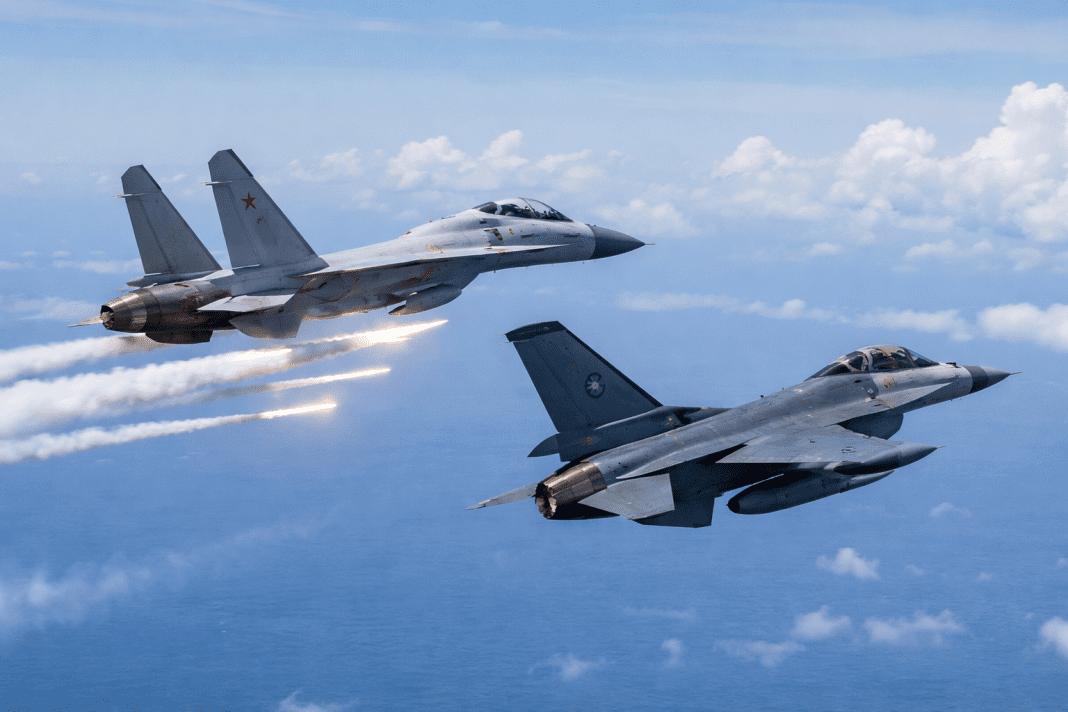

China has stepped up risky military activity near Taiwan. Fighter jets flew dangerously close to Taiwanese aircraft in nearby airspace during a late December exercise called “Justice Mission.” No weapons were fired. However, the aggressive and high-speed manoeuvres raised serious safety concerns.
Risky moves in close airspace
One of the most serious incidents involved a Chinese J-16 fighter releasing flares close to a Taiwanese F-16. Flares are meant to distract heat-seeking missiles, but when used nearby they can be dangerous and disorienting for pilots.
The incident happened as the Taiwanese jet responded to a Chinese aircraft nearing the median line of the Taiwan Strait, an informal boundary meant to reduce tension. At the same time, another encounter saw a Chinese J-16 fly very closely behind a Taiwanese F-16 in what appeared to be a firing position, a move widely seen as highly aggressive.
B-21 and F-47 fleets too small to strike deep inside China in Taiwan war, report warns
While some observers said the incidents were less severe than past radar-targeting cases, others argued that close-range flare firing is especially unsafe. Similar actions were reported in the South China Sea in December, suggesting the Taiwan encounters were part of a broader pattern of risky air behaviour.
Unusual tactics during military drills
A third incident during the exercise showed a different type of risky behaviour. In this case, a Chinese J-16 fighter flew directly underneath a Chinese H-6K bomber. This tactic, sometimes called “piggybacking,” is meant to hide the smaller jet from radar by using the larger aircraft as cover.
The manoeuvre was designed to make it harder for Taiwan’s radar systems to detect the fighter jet. However, when the aircraft were spotted, the Chinese fighter reportedly rolled its aircraft sideways to reveal missiles mounted under its body. This action appeared to be a show of force rather than a necessary flight move.
China warns Europe not to admit Taiwanese politicians, citing diplomatic ‘red lines’
Flying so close to another aircraft, especially underneath it, is dangerous even for highly trained pilots. Any sudden movement, turbulence, or miscalculation could cause the planes to collide. Military aviation experts consider such manoeuvres outside normal training behaviour.
The use of dramatic flight actions during a large military drill suggests an effort to demonstrate capability and confidence. However, it also increases the risk of accidents in already crowded and tense airspace around Taiwan.
Reports also noted that these actions were more extreme than what is normally expected from professional air forces. The manoeuvres went beyond standard intercept procedures and appeared designed to intimidate or send a strong message.
Growing pattern of unsafe air behaviour
In recent years, China’s military has reduced aggressive air intercepts involving US aircraft. However, risky actions have continued near the aircraft of US allies, especially around Taiwan. Defence reports say Chinese planes carried out several unsafe and operationally dangerous moves near allied aircraft over the past year, including sudden sharp manoeuvres and the release of flares or radar-disrupting materials close to other planes.
The December incidents near Taiwan match this wider pattern. These actions were widely seen as reckless and showed a higher willingness to take risks during military operations. Such behaviour raises the chances of misunderstandings, mid-air collisions, or rapid escalation in an already tense environment.
The timing of the incidents also drew attention. The military exercise took place soon after major leadership changes in China’s regional command responsible for Taiwan. Several senior posts had been vacant for some time, which may have affected command routines and decision-making.
A guard at the president’s office sold secrets for crypto, exposing Taiwan’s hidden spy war
Some analysts believe pilots may be under pressure to carry out more daring manoeuvres during exercises to show readiness and strength. This could explain the unusual tactics and close-range flying seen during the drill.
Despite concerns, no detailed official response addressed the encounters. Chinese officials said only that the exercise was successful and meant to protect national sovereignty. The incidents underline how crowded and tense the airspace around Taiwan has become, with little room for error.