
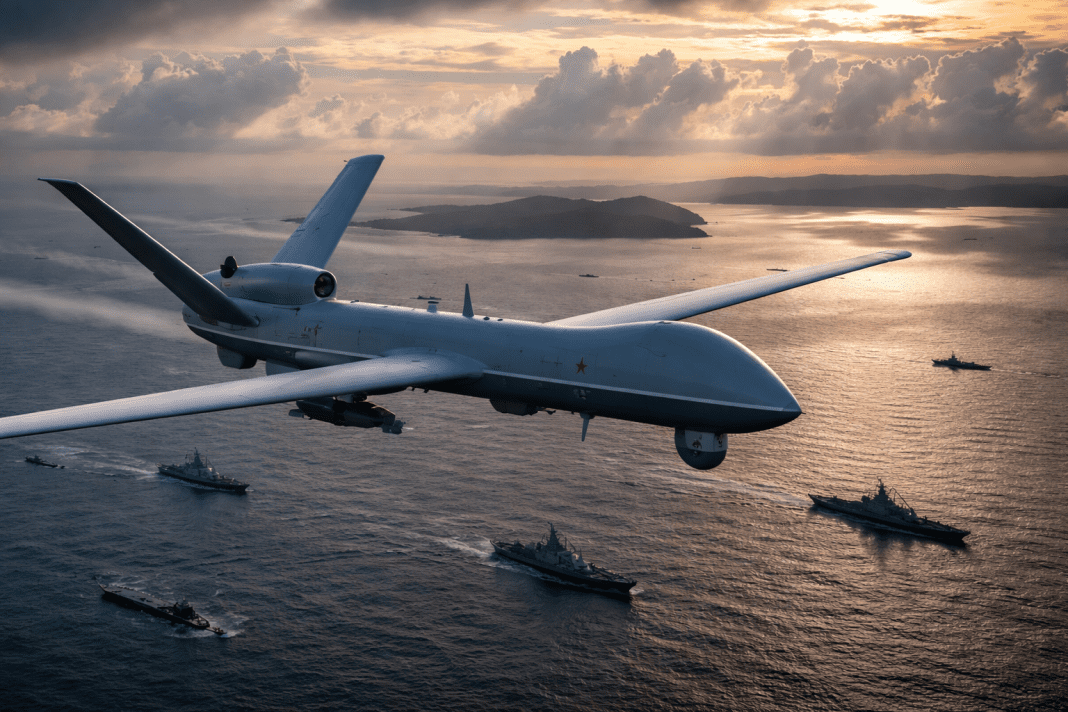

China has carried out new military activity in the South China Sea involving Drone Flights. A large drone flew repeated missions while disguising itself using false identification signals. These Drone Flights relied on electronic deception, causing tracking systems to misidentify the aircraft. Analysts call this an emerging “grey-zone” tactic amid rising tensions around Taiwan.
Masked Drone Flights And Digital Deception
Over recent months, a long-endurance Chinese drone conducted at least 23 recorded Drone Flights across the South China Sea and nearby areas while transmitting signals that made it appear to be different aircraft. Flight-tracking systems normally rely on transponders that broadcast coded data showing an aircraft’s identity, position, speed, and direction. Investigators found the drone repeatedly changed this digital identity during flights.
At different times, tracking platforms showed the aircraft as a cargo plane, fighter jet, passenger aircraft, and even a private executive jet. Some of the real planes being imitated were flying elsewhere at the same time, confirming intentional signal manipulation. The drone usually departed from Hainan province and flew routes toward waters near the Philippines, disputed islands, and Vietnam’s coastline.
China develops hypersonic missile components with steel alloys amid debate over aerospace materials
Its star- and hourglass-shaped flight patterns suggested surveillance missions, allowing repeated scanning of the same areas during the Drone Flights. Unlike most military drones that operate silently, this aircraft broadcast misleading signals. While unlikely to fool advanced military radar for long, the tactic could create confusion, slow responses, and complicate decision-making during tense situations.
Expanding Military Presence Across Strategic Waters
The South China Sea is one of the world’s most sensitive maritime regions. Several countries claim parts of the area, and it serves as a major global shipping route. Military ships, submarines, and aircraft from multiple nations operate there regularly, making it a closely watched strategic zone.
The drone flights covered areas known for heavy naval activity. Some routes passed near submarine operating zones south of Hainan, while others moved toward narrow sea passages connecting the South China Sea to the Pacific Ocean. These waterways are important for naval movement between regional seas and open oceans.
China warns Europe not to admit Taiwanese politicians, citing diplomatic ‘red lines’
Satellite images taken over several months showed large unmanned aircraft parked at airport facilities linked to the Drone Flights. Support buildings and runway expansion suggested continued operational use. The drones involved are designed for long missions and can carry surveillance equipment, communication systems, and sometimes precision weapons.
Analysts reviewing the flight data said the aircraft’s behavior matched surveillance operations rather than routine training. Repeated coverage of the same regions suggested detailed mapping and monitoring, while electronic deception during these Drone Flights showed testing of how tracking systems respond when aircraft identities suddenly change.
Flight Patterns Linked To Taiwan Scenario Concerns
Many of the drone routes extended toward areas around Taiwan, including key sea channels between Taiwan and the Philippines that serve as important access points for naval forces entering the Pacific Ocean. When analysts compared the flight paths with Taiwan’s geography, several routes passed near sensitive military and infrastructure locations, while others approached islands hosting foreign military bases.
The patterns raised questions about whether the flights were simulating conditions linked to a possible regional confrontation. In modern automated warfare, even brief confusion in tracking systems can slow responses and affect decision-making. Electronic masking may help conceal surveillance missions, create misleading information, or overwhelm monitoring systems with conflicting signals.
Undersea power shift as China overtakes U.S. in nuclear submarine launches
Flight-tracking companies noted that such coordinated signal manipulation is extremely rare. Earlier incidents usually involved accidental errors, but these missions showed repeated and structured identity changes during long operations. The drone sometimes switched identities several times within minutes before landing under a different aircraft registration, indicating advanced electronic control and careful planning.
The operations highlight how modern military activity increasingly combines physical movement with digital strategy. Aircraft can now manipulate data environments used by observers and analysts, while limited official explanations have left the purpose of the flights unclear despite their scale and technical sophistication.