
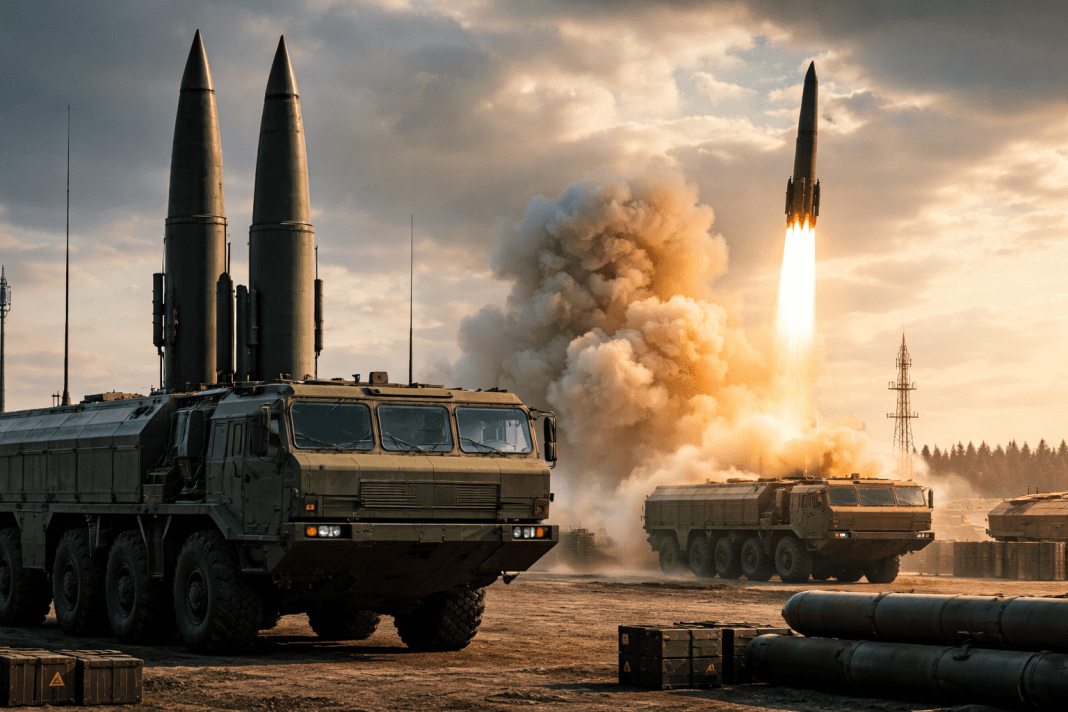

Russia has sharply increased its production of ballistic missiles used in the Iskander-M system. Reports say this rise was made possible by large imports from China. This development is outlined in a detailed assessment. The assessment focuses on growing cooperation between Russia and China. It highlights links between their industrial sectors. Special attention is given to industries connected to defense production.
How China Became a Key Supplier for Russia’s Missile Industry
Supply is at the core of the issue. Modern missiles are complex systems that require many materials, including chemicals, machinery, and electronic components. According to the report, China has become the main supplier of several critical items that Russia cannot easily produce on its own.
These supplies include rocket fuel chemicals, industrial machines used to shape metal parts, and electronic components that can serve both civilian and military purposes. Because these items are classified as dual-use goods, they can be traded for industrial needs but still support weapons production. This steady flow of materials has allowed Russian factories to operate more efficiently and increase missile output, easing earlier shortages.
Trade data highlights the growing economic link between the two countries. In 2024, trade between Russia and China reached about 250 billion dollars, up from roughly 190 billion dollars in 2022. This sharp rise shows how quickly business ties have expanded.
China’s role in Russia’s foreign trade has also grown significantly. In 2014, China accounted for just over 11 percent of Russia’s total trade. By 2024, that figure had risen to nearly 34 percent. As a result, around one-third of Russia’s foreign trade is now connected to China, making it Russia’s largest and most important trading partner.
Materials That Power Missile and Drone Production
Ammonium perchlorate is a key material highlighted in the report. It is an essential chemical used to produce solid rocket fuel for missiles, including those in the Iskander system. In 2024, China supplied about 70 percent of Russia’s imported ammonium perchlorate, tying Russia’s missile fuel production closely to Chinese exports. Without this material, large-scale production of solid-fuel missiles would be difficult.
The report also notes a sharp rise in other dual-use goods supplied by China, such as advanced machine tools, microprocessors, and industrial equipment. These items are critical for making precise missile parts and guidance systems, and Russia reportedly cannot produce enough of them domestically.
Chinese exports have also supported Russia’s drone production. Russia received drone bodies, lithium batteries, and fiber optic cables, which are used in fiber optic-controlled drones that can operate even when radio signals are disrupted. Lithium batteries extend flight time, while drone bodies house the components.
At the same time, China has become Russia’s largest oil buyer. In 2024, about 75 percent of China’s imported oil came from Russia, up from around 60–65 percent in 2022. This oil trade brings in significant revenue that supports Russia’s broader industrial activity.
Iskander Missile Output Rises Sharply
The effect of increased supplies can be seen clearly in missile production figures. Data comparing earlier years with recent numbers shows a sharp rise in the output of 9M723 missiles, which are used in the Iskander operational-tactical missile system.
At the beginning of 2023, total production stood at only 36 missiles. This low figure reflected shortages of materials, components, and manufacturing capacity. As supplies from China grew over time, these constraints were gradually reduced.
By late 2025, production levels had changed significantly. Monthly output had risen to about 50 missiles, while Russia’s stockpile was estimated at around 200 units. When these figures are compared, analysts concluded that overall production of 9M723 missiles had increased threefold.
This growth shows how access to foreign materials and components can directly influence weapons manufacturing. Missiles such as those in the Iskander system require precise engineering, stable fuel supplies, and advanced electronics. With steady access to these inputs, factories can operate at a much faster pace.
Russia fires Iskander missile at Kyiv government building in first direct strike since war began
China has rejected accusations that it supports Russia’s military efforts, calling them an attempt to shift responsibility for the conflict in Ukraine. China maintains that it does not provide direct military assistance and that its trade activities follow established rules.
However, the report focuses on trade patterns and supply chains rather than direct weapons transfers. By tracking chemicals, machinery, electronics, and industrial goods, the findings show how these imports have contributed to expanding Russia’s missile and drone production capacity.