
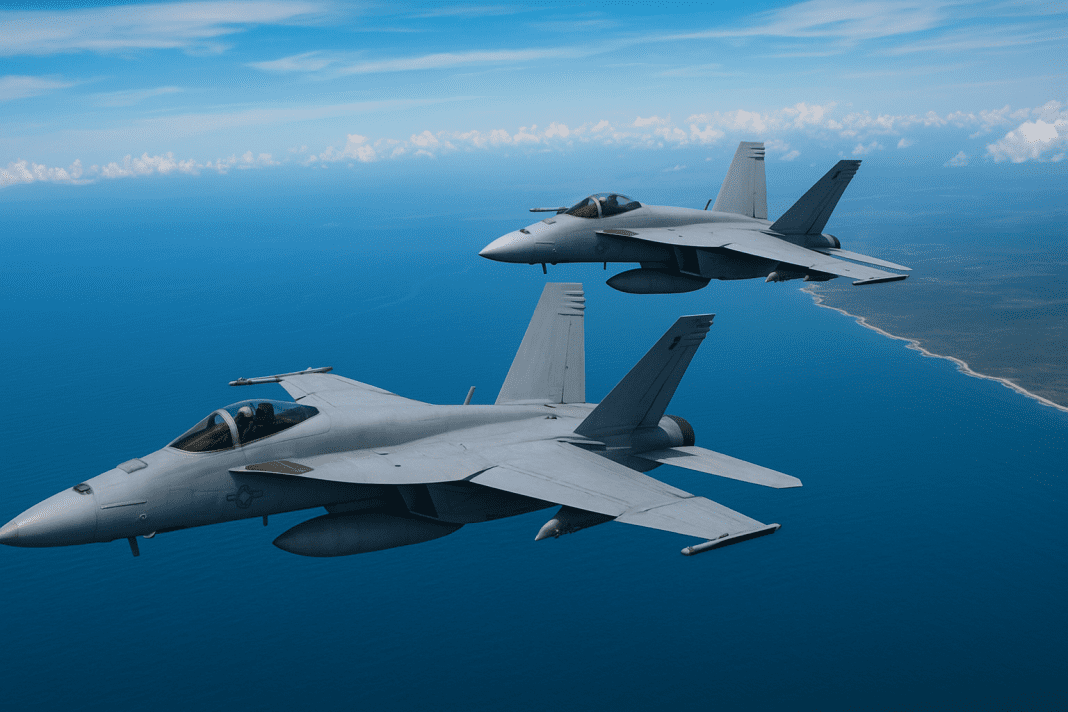

Two U.S. F-18 fighter jets entered Venezuelan airspace around noon on Tuesday, creating a dramatic moment that thousands of people followed online. The F-18 jets flew side by side and circled over the Gulf of Venezuela for nearly 40 minutes, performing a clear bow-tie pattern visible on popular flight-tracking websites. Many Venezuelans watched in real time as the jets moved deep into the country’s airspace.
Rising Tensions as F-18 Jets Cross Into Venezuelan Skies
The flyover happened less than 100 miles from Maracaibo, one of the largest cities in the nation. According to flight data, the F-18 jets maintained an altitude of about 25,000 feet before eventually turning north and exiting the area. Their path took them between two key regions for Venezuela’s energy sector — Zulia and Falcón.
The jets passed near Lake Maracaibo, a massive body of water known for its large oil reserves, holding several billion barrels of crude. The Gulf of Venezuela is also busy with fishing activity and oil tankers that travel to refineries on the coast. Despite Venezuela’s possession of Russian-built anti-aircraft defenses, including long-range missile systems, the F-18 jets flew through the area without interruption, which many observers considered a bold and deliberate show of strength.
U.S. Military Activity Expands as F-18 Flyover Raises Questions
The United States has increased its military presence in the Caribbean in recent months, adding more tension to its already difficult relationship with Venezuela. American officials say the current mission, called Operation Southern Spear, aims to stop drug trafficking in the region. This operation includes an estimated 15,000 to 16,000 U.S. troops positioned near Venezuelan waters.
The massive aircraft carrier USS Gerald R. Ford is also operating in the area. It is the largest carrier in the world and capable of launching dozens of F-18 Super Hornet fighters, raising the possibility that Tuesday’s aircraft may have taken off from the ship. The origin of the F-18 jets involved in the flyover has not yet been confirmed.
Venezuela has accused the U.S. of planning aggressive actions behind the cover of counter-narcotics operations. In reaction, Venezuela has activated its armed forces, called its civilian militia into action, and highlighted its multi-layered air-defense network. Analysts say the country’s defenses are among the most complex in Latin America, though they do not always function evenly due to limited resources and maintenance issues.
Just days before the F-18 flyover, Venezuelan authorities reported intercepting a “hostile” aircraft in Apure state. They said the aircraft had entered without a flight plan, had turned off its transponder, and was forced to land by Venezuelan fighter jets. With this incident happening so close to the U.S. flyover, people in the region are paying even more attention to military movements.
A Region on Alert as Activity Increases
The Gulf of Venezuela and the surrounding coastline are extremely important for the country. Zulia state borders Colombia, while Falcón contains the major refineries of Amuay and Cardón, which are vital for the nation’s fuel supply. These areas rely heavily on fishing, shipping, and oil transportation, making any unusual military activity especially noticeable.
Maracaibo, located close to the flight path of the F-18 jets, houses one of the main military air bases in western Venezuela. Just one day before the flyover, the air base hosted an event celebrating newly opened facilities. Local officials attended the ceremony, showing ongoing efforts to strengthen the region’s military infrastructure.
When the F-18 fighter jets appeared in the sky on Tuesday, they flew directly over waters used daily by fishermen, shipping vessels, and oil tankers. People in communities such as La Guajira and Coro tracked the jets online, trying to understand why foreign aircraft were performing such a long maneuver inside the country’s airspace.
Although there was no confrontation, the flyover has captured global attention. Military observers say actions like these are often used to send messages between countries, showing capability and readiness. With increased military activity already happening in the Caribbean, the presence of F-18 jets in Venezuelan skies has added another layer of tension to a region that many consider increasingly sensitive.
For now, neither nation has provided a detailed explanation for the mission. But the 40-minute presence of U.S. F-18 jets inside Venezuelan airspace has become one of the most widely discussed events in the region and has drawn major attention from international observers.