
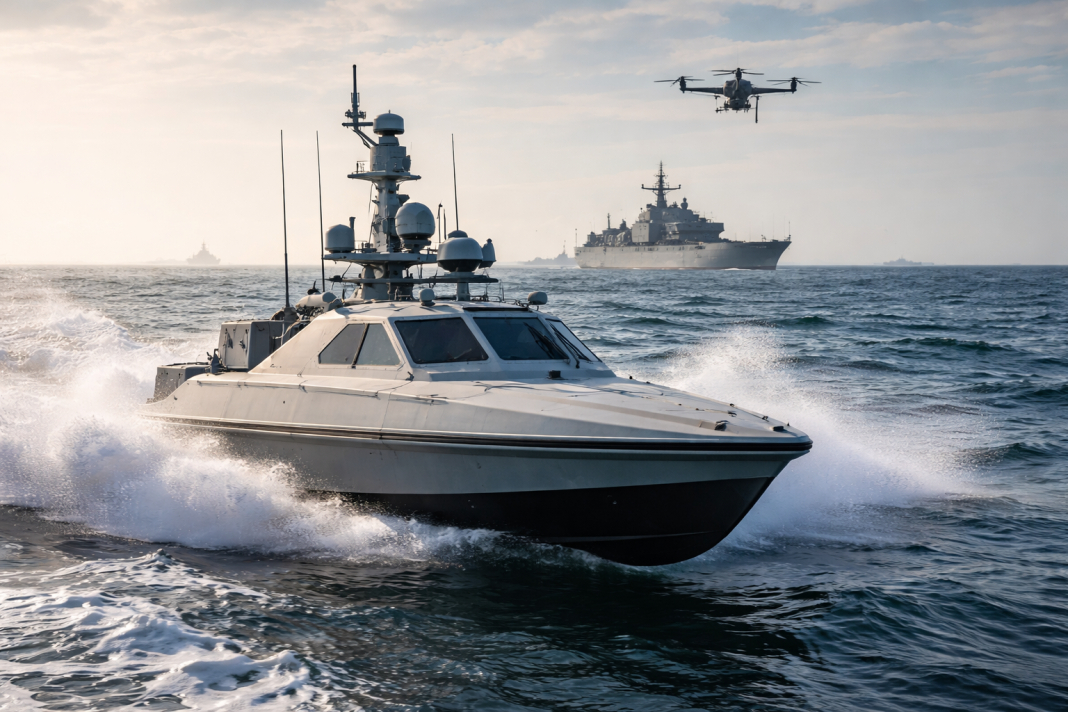

The United States has introduced unmanned drone boats in its operations against Iran, marking a key shift in modern naval warfare. These uncrewed vessels are enhancing surveillance at sea while reducing risks to personnel, highlighting the growing role of advanced technology in conflict zones.
A New Chapter in Naval Warfare
The United States has confirmed the use of unmanned drone boats in its ongoing operations against Iran, marking a key moment in modern naval warfare. This is the first time such vessels have been acknowledged in active conflict. Also known as uncrewed surface vessels, these boats are mainly used for surveillance and patrols in sensitive waters, showing how naval warfare is evolving.
Unlike traditional ships, these drone boats operate without any crew. They are remotely controlled or run on advanced automated systems, reducing risks to personnel. They can travel long distances and remain at sea for extended periods, highlighting a new direction in naval warfare.
Inside the lopsided naval battle between the USS Abraham Lincoln and Iran’s coastal defenses
The deployment is part of a broader effort by the United States and Israel to counter threats linked to Iran’s military activities, including missile and nuclear programs. Known as Global Autonomous Reconnaissance Craft (GARC), these vessels move quickly and gather critical data. They track ship movements, detect unusual activity, and provide real-time updates, improving awareness in tense maritime regions.
Rising Use of Sea Drones in Conflict Zones
In recent years, sea drones have become an important tool in modern warfare. Their growing use has been influenced by conflicts around the world, where such systems have proven to be both effective and cost-efficient.
One major example is the conflict involving Ukraine and Russia, where explosive drone boats were used to damage naval ships. These incidents showed how powerful and disruptive unmanned vessels can be, even against large and heavily armed fleets. As a result, many countries have started investing more in this technology.
Iran has also been linked to the use of sea drones. Reports indicate that drone boats have been used in attacks targeting oil tankers in the Gulf region. These incidents have raised concerns about the safety of vital shipping routes, which are crucial for global energy supplies.
US Navy halts maritime military escorts for commercial vessels in Strait of Hormuz
The introduction of US drone boats into this environment highlights how important these systems have become. They are not only used for gathering information but can also be adapted for different roles, including defensive and offensive missions. However, there has been no confirmation that the United States has used these vessels for direct attacks in the current operations.
The use of unmanned systems allows forces to respond quickly to threats without putting sailors in danger. It also provides continuous monitoring, which is difficult to achieve using traditional ships alone. This makes drone boats a valuable addition to naval operations, especially in regions where risks are constantly changing.
Challenges and Setbacks in Drone Boat Development
Despite their advantages, the development of unmanned drone boats has faced several challenges. The United States Navy has spent years working to build a reliable fleet as a cost-effective alternative to traditional ships and submarines, but progress has been slower than expected.
Technical issues, rising costs, and repeated delays have affected the program. Testing has also revealed safety concerns, with some drone boats failing to perform as planned. In one incident, a vessel collided with another boat during trials. In another case, a drone boat became inoperable during operations in the Middle East. These setbacks have raised questions about how dependable the technology is in high-pressure situations.
Even so, development continues. The Navy considers these vessels an “emerging capability,” meaning they are still being improved while already in use. They are part of a wider network of unmanned systems designed to boost surveillance and improve awareness in key maritime areas.
The use of drone boats also reflects a shift in military strategy. Instead of relying only on large and costly ships, there is growing focus on smaller, smarter, and more flexible systems. This approach aims to respond more effectively to modern threats while reducing risks to personnel.
Their deployment in operations against Iran shows how quickly new military technologies are moving from testing into real-world use.