
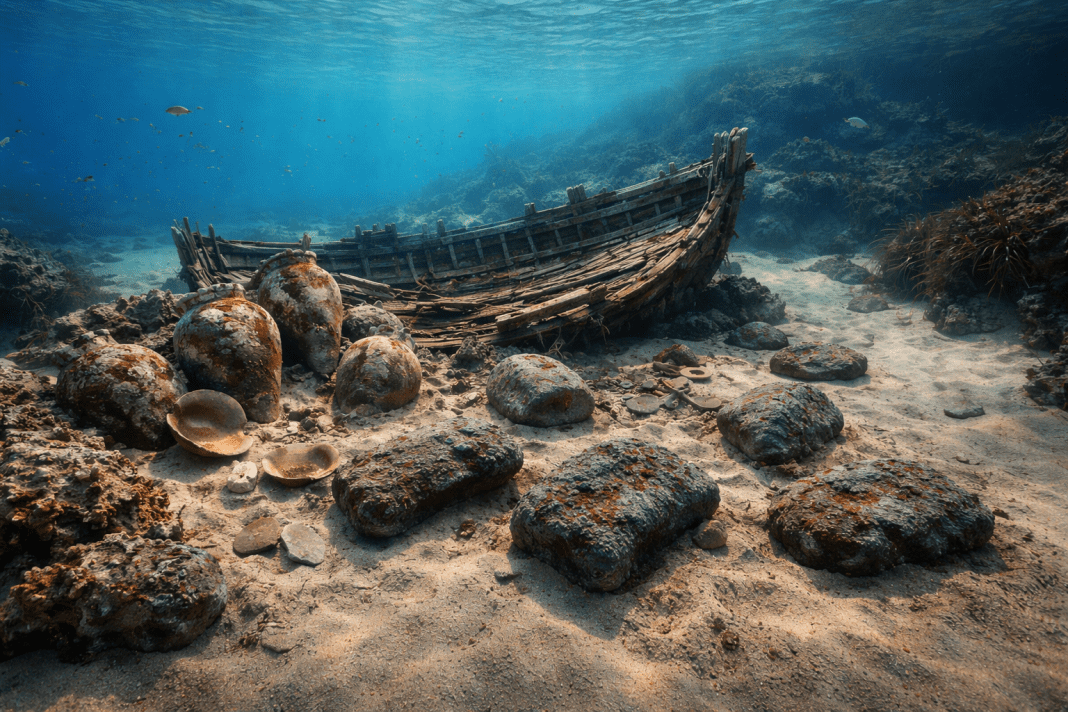

A 2,600-year-old shipwreck off northern Israel has revealed rare evidence about ancient iron trade. Found in a region once controlled by competing empires, the discovery provides new insight into how iron was produced, moved, and used during the Iron Age, and how it may have supported both trade and warfare.
Ancient Shipwreck Reveals a Forgotten Moment from a Turbulent Era
A discovery off the coast of northern Israel has drawn attention to a time when ancient kingdoms were constantly fighting for control of land and trade routes. More than 2,600 years ago, the Southern Levant was a region of conflict and shifting power. Major empires, including the declining Assyrian Empire, the rising Babylonian Empire, and ancient Egypt, competed for cities, farmland, and strategic coastal areas.
One important site was an ancient harbor near today’s Carmel Coast. It was once a busy trading point on the Mediterranean Sea. During the Iron Age, a ship sank close to the shoreline and was gradually buried by sand and seawater. Over time, it remained hidden for thousands of years.
Israel intensifies Beirut airstrikes and captures Hezbollah Radwan fighters in south
Later underwater archaeological work in the lagoon uncovered multiple shipwreck remains. Among them were heavy, stone-like objects that were not immediately identified. These unusual finds would later prove significant, offering important clues about ancient trade systems and the movement of goods across the Mediterranean during a period of intense political rivalry and warfare in the region.
Iron Blooms Found in Cargo Point to a Rare Form of Ancient Trade
Among the items recovered from a shipwreck seabed were unusual chunks of iron. These were not finished tools or weapons, but raw, partially processed metal known as “iron blooms.” They formed during early iron production when iron ore was heated with charcoal at very high temperatures, creating a spongy mass mixed with waste material.
Normally, ancient metalworkers would immediately reheat and hammer these blooms to remove impurities and turn them into usable iron bars. Because of this, experts once believed iron blooms were not transported over long distances or traded by sea in their unfinished form.
Iran launches sweeping spy crackdown, arrests dozens accused of passing military secrets to Israel
However, the shipwreck shows a different picture. The iron blooms appear to have been shipped as semi-finished cargo, with some pieces weighing between five and ten kilograms. This suggests that iron may have been traded as raw material between different regions for later processing.
The discovery also shows that ancient trade systems were more complex than previously thought. A protective layer may have preserved the iron during the sea journey. Nearby organic remains like seeds and burnt wood helped date the shipwreck to a period of major political change in the region.
New Understanding of Ancient Weapons, Trade Routes, and Warfare Supply Chains
The discovery of iron blooms in a shipwreck has changed how experts understand ancient supply systems during the Iron Age. Iron was one of the most important materials of that era. It was used to make weapons such as swords, daggers, arrowheads, and spear tips, along with farming tools like plows and cutting instruments that supported agriculture and daily life.
Producing iron was a difficult and highly skilled process. Unlike copper or bronze, iron required extremely high temperatures to extract and shape. Ancient furnaces mixed iron ore with charcoal, creating spongy, uneven masses of metal called iron blooms. These blooms still contained impurities and had to be reheated and hammered before becoming usable tools or weapons.
Israel strikes inside Syria, citing violence in Druze-majority region
Experts previously believed iron was fully processed near its production site, since transporting unfinished metal was considered risky and inefficient. However, the shipwreck evidence challenges this idea. It suggests that iron may have been traded in a semi-finished form, indicating that different regions could have specialized in different stages of production, from smelting raw ore to finishing weapons and tools.
The discovery also highlights the importance of coastal cities and sea trade routes during the Iron Age. Ports connected land and maritime networks, enabling long-distance trade. Other remains from the shipwreck, including pottery and balancing stones, show that ships carried mixed cargo. Together, these findings reveal that iron moved through complex trade systems that supported societies during periods of conflict, changing political control, and high demand for weapons and tools.