

A remark by senior Russian security official Dmitry Medvedev has put Greenland back in global focus. It has added strain to an already tense Arctic debate. He suggested Greenland’s residents could vote to join Russia. This could happen if the United States does not move quickly on its renewed interest in the island. The comment was framed as speculative and based on unverified information. Still, it has sparked discussion about power, security, and rivalry in the Arctic.
Greenland is a vast, ice-covered island with about 55,000 residents. It governs its own domestic affairs but remains part of Denmark, which handles defense and foreign policy. Once seen as remote, Greenland has gained importance because of its strategic location and what lies beneath its ice.
Medvedev’s remarks came as U.S. President Donald Trump revived his push for the United States to control Greenland, calling it critical for national security. While there is no serious process for Greenland to join Russia, the comment underscored how the island has become a focal point in wider geopolitical competition.
Greenland’s Strategic Importance Explained Simply
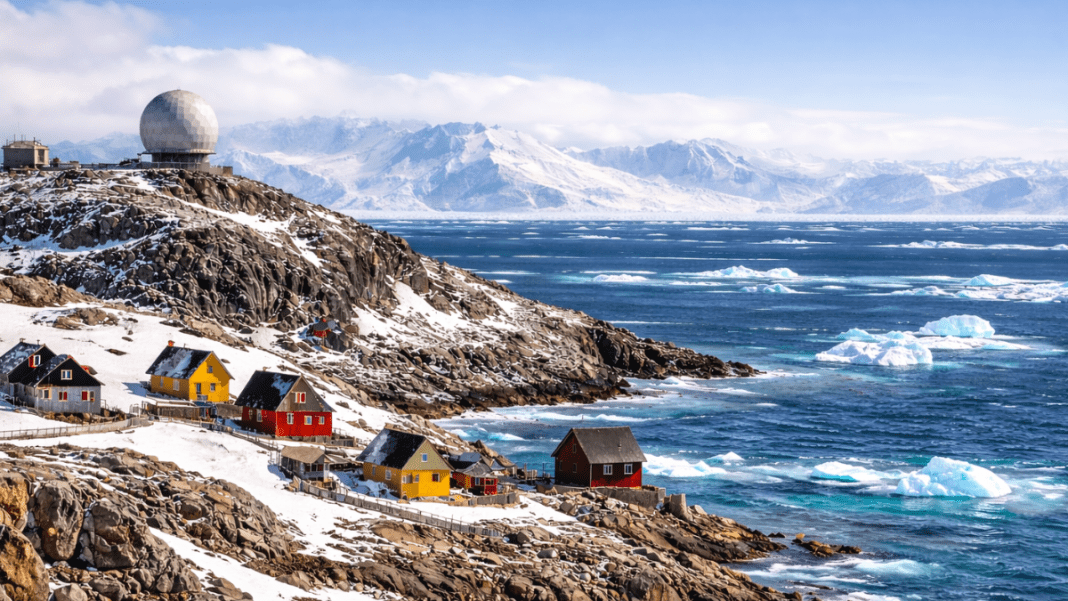
Greenland’s value is closely linked to geography. It lies between North America and Europe, making it a key point for monitoring air and sea movement across the North Atlantic. For decades, a major U.S. military and space surveillance facility has operated there. This site helps track missile threats and space activity, giving Greenland a role in global defense systems supported by Washington.
Beyond security, Greenland is believed to hold valuable natural resources. These include minerals and rare earth elements that are important for modern technologies such as smartphones, electric vehicles, and renewable energy systems. As climate change reduces ice coverage, accessing these resources may become easier.
Melting ice is also opening new Arctic shipping routes. These paths can shorten travel time between continents, making trade faster and cheaper. Because of this, many countries are paying closer attention to the Arctic, including the United States under Donald Trump, which has argued that Greenland’s location makes it essential for long-term defense planning.
This growing interest explains why Greenland has become part of global discussions. Control, influence, or even access to the island can shape military planning, trade routes, and resource supply chains.
Rising Tensions Among Major Powers
The recent statement by Dmitry Medvedev about a possible vote was widely interpreted as sarcastic rather than serious. It ended with a pointed line suggesting the United States would gain no new stars on its flag, underlining the mocking tone. Still, such language reflects real tensions between major powers as competition in the Arctic increases.
The relationship between Russia and Western nations has significantly worsened in recent years, particularly following the 2022 invasion of Ukraine. This conflict has disrupted collaboration in the Arctic, a region where countries previously cooperated on scientific research, safety, and environmental conservation. As a result, trust has eroded and military awareness has risen.
Germany warns Arctic security must be handled through NATO, not unilateral action
Russia does not claim Greenland as its territory. However, it considers the Arctic a region of national and strategic importance and closely watches developments there. Russian officials have previously said they are monitoring debates around Greenland, particularly as political and military attention grows following renewed interest from Donald Trump.
Denmark and Greenland have both firmly rejected the idea of any foreign takeover. Leaders have made it clear that Greenland is not for sale and that its people alone have the right to decide their future. These responses underline the legal reality that no outside power can simply claim the island.
Climate Change and a More Crowded Arctic Around Greenland
Climate change is a key reason the Arctic has become more contested. Warmer temperatures are reshaping the region, bringing new possibilities and new dangers. Longer ice-free seasons allow more ships to travel through Arctic waters, increasing traffic and competition.
At the same time, easier access raises fears about environmental damage and security incidents. Countries are strengthening their presence, watching each other closely, and planning for long-term influence in the region.
Russia issues arrest warrant for chess legend Garry Kasparov over alleged “terrorist” online
content
Greenland stands at the center of these changes. Its location, resources, and existing military infrastructure make it important to global powers. Statements like those made by Dmitry Medvedev, even when not meant literally, show how sensitive the issue has become amid renewed focus driven by Donald Trump’s push.
Today, Greenland remains a self-governing territory under Denmark, with its status protected by law and international agreements. The recent remarks do not change that reality, but they highlight how the Arctic, once distant from global politics, has become a focal point of international attention and strategic debate.