
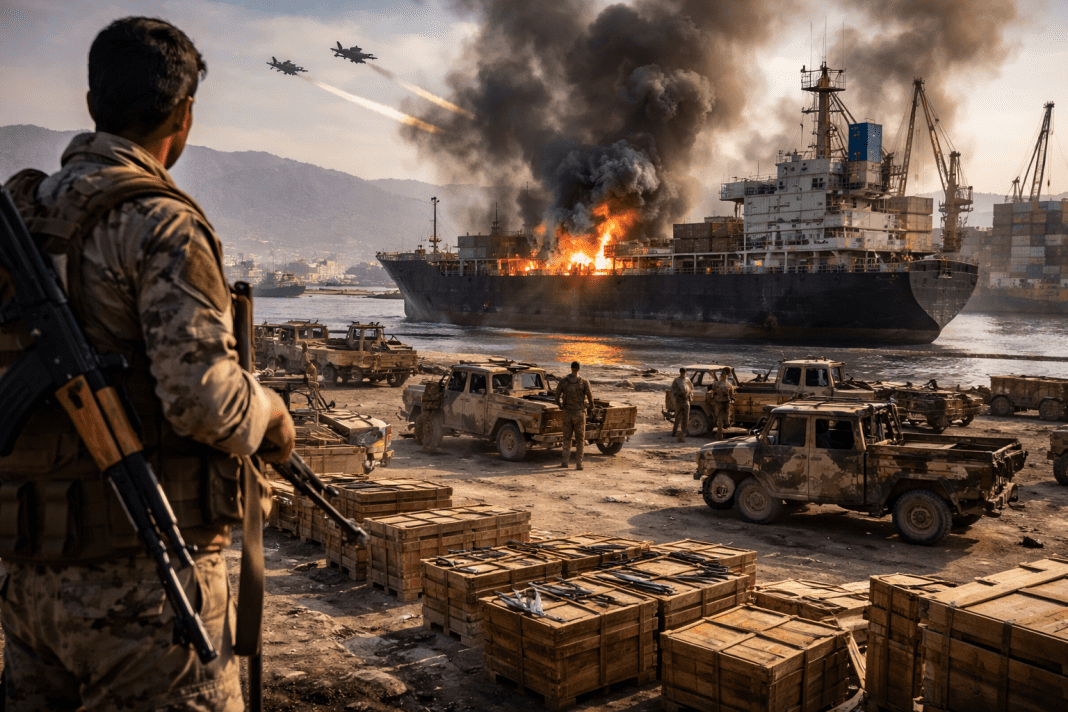

The Saudi-led coalition detected weapons and combat vehicles being unloaded from ships arriving from the United Arab Emirates and carried out limited air strikes in Yemen, raising tensions between former allies in the conflict. The coalition targeted only military equipment at the port of al-Mukalla, conducted the strikes under international humanitarian law, and reported no civilian harm.
Weapons Shipments and the Saudi-Led Coalition Response
According to the coalition, two ships reached the port after traveling from Fujairah, a port on the eastern coast of the UAE. Before unloading, the crews of the ships reportedly switched off their tracking systems. This situation raised alarm because authorities often view turning off tracking devices as an attempt to hide movements at sea.
Once the ships docked, they unloaded a large amount of weapons and combat vehicles, which authorities said were intended to support separatist forces in southern Yemen. The coalition warned that the arrival of such heavy military equipment posed a serious security risk and could sharply increase fighting on the ground.
Saudi Arabia deports over 13,000 in a week as immigration crackdown widens
In response, coalition aircraft carried out what officials described as a “limited military operation.” The strikes hit only the weapons and vehicles that the ships had unloaded at the port. Officials emphasized that the operation aimed to prevent further escalation and stop the spread of arms that could deepen divisions within the country.
The coalition also repeated that its strikes caused no collateral damage, meaning, according to their statement, that they did not harm civilian areas, buildings, or people. Officials highlighted these assurances to show compliance with international rules of war.
Rising Tensions Between Rival Allies
The incident comes at a sensitive time in Yemen’s long conflict. Several regional powers support the country’s internationally recognized government, but it does not act as a single united force. Instead, many groups with different goals make up the government, joining mainly because they oppose the Iran-backed Houthi movement that controls much of northern Yemen.
In recent weeks, a UAE-backed separatist group in the south has made rapid gains. This group aims to restore South Yemen as an independent state, separate from the north. Its fighters have taken control of wide areas, pushing out other government-aligned forces and their allies.
These advances have caused tension between Saudi Arabia and the UAE, which have both played key roles in the coalition supporting Yemen’s government. While they were once closely aligned, they now back different factions within the same political system.
The Saudi-led coalition has warned that it will stand by Yemen’s government in any military confrontation with the separatists. It has also repeatedly called on the separatist forces to withdraw peacefully from provinces they seized recently. These calls suggest a preference for negotiation, even as military pressure increases.
Protests, Military Build-Up, and Growing Fears
The situation in Yemen remains tense as southern separatist forces continue to hold their positions despite recent air strikes blamed on Saudi Arabia. These forces, seeking to restore South Yemen as an independent state, have refused to retreat and warned that pressure will not force them to give up territory.
Supporters of southern independence have been gathering regularly in cities like Aden, waving flags of the former South Yemen and calling on leaders to formally declare independence. Many demonstrations happen weekly, with the largest rallies taking place on Fridays, and footage shows South Yemen flags alongside UAE flags, highlighting the group’s ties to Abu Dhabi.
Netanyahu launches quiet campaign to stop U.S. F-35 jets reaching Saudi Arabia and Turkey
At the same time, Saudi-backed forces have stationed thousands of fighters near Yemen’s northern border, close to areas that separatists recently captured. While commanders have not ordered them to advance, their presence raises concerns of a potential wider clash between rival factions.
Yemen’s conflict, ongoing since 2014 when Houthi forces seized the capital Sanaa, has caused one of the world’s worst humanitarian crises. The recent strikes on weapons shipments from the UAE underline how fragile the balance of power has become, with internal divisions and the flow of arms keeping the country trapped in ongoing conflict.