
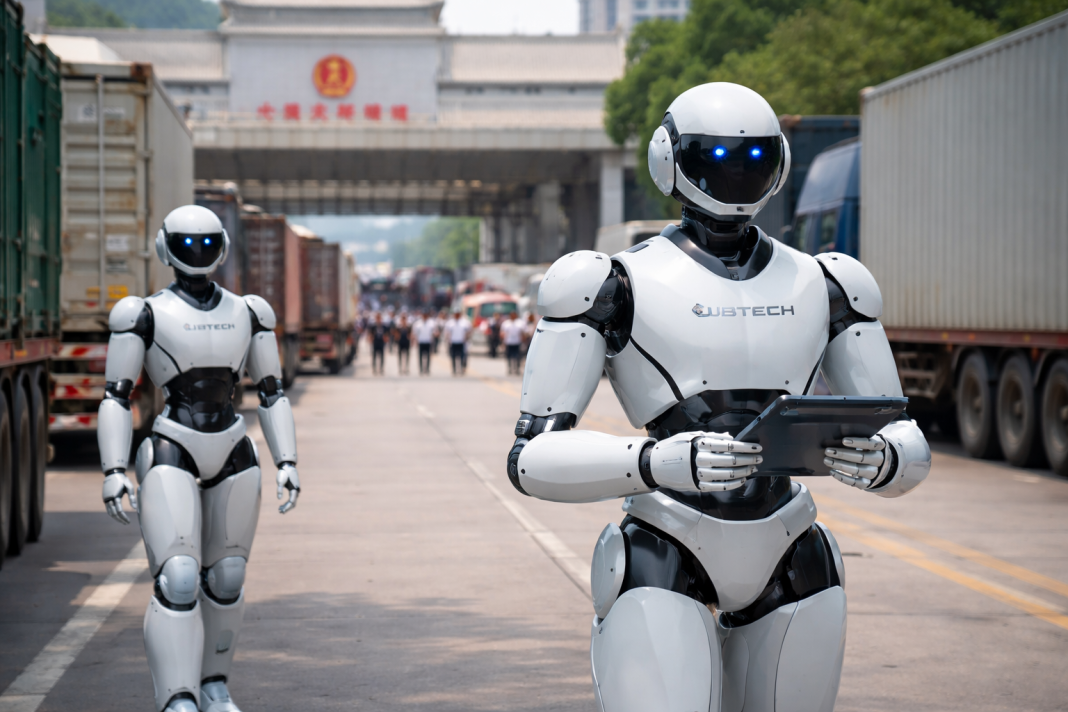

China is preparing to deploy humanoid robots at a busy border crossing with Vietnam. This marks a striking new chapter in the use of robotics in public spaces. Shenzhen-based UBTECH Robotics has won a $37 million contract. The company will send its Walker S2 machines to Fangchenggang, a coastal city in Guangxi province near the Vietnamese border. The rollout is expected to begin this month.
Advanced Walker S2 Robots Ready for Real-World Challenges
UBTECH Robotics specializes in full-size humanoid robots for industrial and public service applications. Its engineers focus on “embodied intelligence,” a type of artificial intelligence designed to control a robot body so it can navigate messy, real-world environments. The border crossing presents a complex challenge because of tight schedules, constant traffic, and the need for continuous inspections.
The Walker S2 units are adult-sized humanoid robots with jointed legs, arms, and a torso that let them move in spaces built for humans. The robots replace their own batteries autonomously, allowing them to operate for long periods with minimal downtime. Their movement relies on cameras, depth sensors, and force feedback in their joints, helping them stay balanced and avoid collisions in busy areas.
Chinese Government Warns of Bubble Risks in Humanoid Robots Sector Amid Rapid Growth
Robots in Action at the Border
At the Fangchenggang crossing, Walker S2 robots will assist border staff in multiple ways. Some robots will guide passenger queues, direct vehicles, and answer simple questions from travelers. Others will patrol corridors and waiting areas, monitoring for blocked exits or unusual crowd patterns that may require human intervention.
The robots will also support cargo operations. They can move between cargo lanes, check container IDs, confirm seals, and relay status updates to dispatch centers. Beyond the border itself, the Walker S2 units are trained to work in industrial facilities, walking structured routes through steel, copper, and aluminum yards to perform inspections.
Robotic Rovers: The Astonishing Mechanics of Space Exploration and Beyond
The Fangchenggang deployment is one of several large-scale projects for UBTECH this year. The company has previously supplied robots to factories and data centers in other provinces, with 2025 orders for the Walker S2 series totaling around $157 billion. Despite these orders, the company is still working to achieve sustainable profit.
How Humanoid Robots Are Trained and Monitored
Beijing has established a humanoid robot training center in Shijingshan District to prepare robots for real-world tasks. Covering about 3,000 square meters, the center runs over 100 robots in staged workplaces, where they assemble parts, clean, make beds, tend plants, and perform other everyday tasks. This training ensures Walker S2 robots arrive at locations like the China-Vietnam border crossing with tested skills instead of learning on the spot.
Walker S2 robots use cameras, depth sensors, and force feedback to recognize humans, avoid collisions, and adjust their speed in crowded spaces. Safety is critical, and the robots are monitored continuously while operating near people.
At the border, travelers will interact with robots guiding lines, giving directions, and monitoring activity. Border staff can focus on identity checks, risk assessments, and complex tasks while robots handle repetitive duties. Some travelers may feel uneasy seeing humanoid machines patrolling and recording interactions, but the aim is smoother operations and shorter waits.
The Fangchenggang deployment will test whether the robots can stay stable, avoid glitches, and handle unpredictable weather. It will also examine the cost-effectiveness of patrols and inspections, including equipment, software, maintenance, and supervision.
Washington strikes at DJI, choking off China’s 70% drone dominance over espionage fears
China considers humanoid robots a strategic industry, with regulations and standardization committees overseeing deployments. The border trial offers a controlled environment to assess safety, reliability, and accountability.
This project is one of the first large-scale real-world tests of humanoid robots outside industrial settings. Designed to handle diverse tasks while navigating crowded areas, Walker S2 robots bring advanced robotics from labs and factories into public spaces. Their performance at the border will reveal how humanoid machines can support human workers in high-traffic, dynamic environments.