
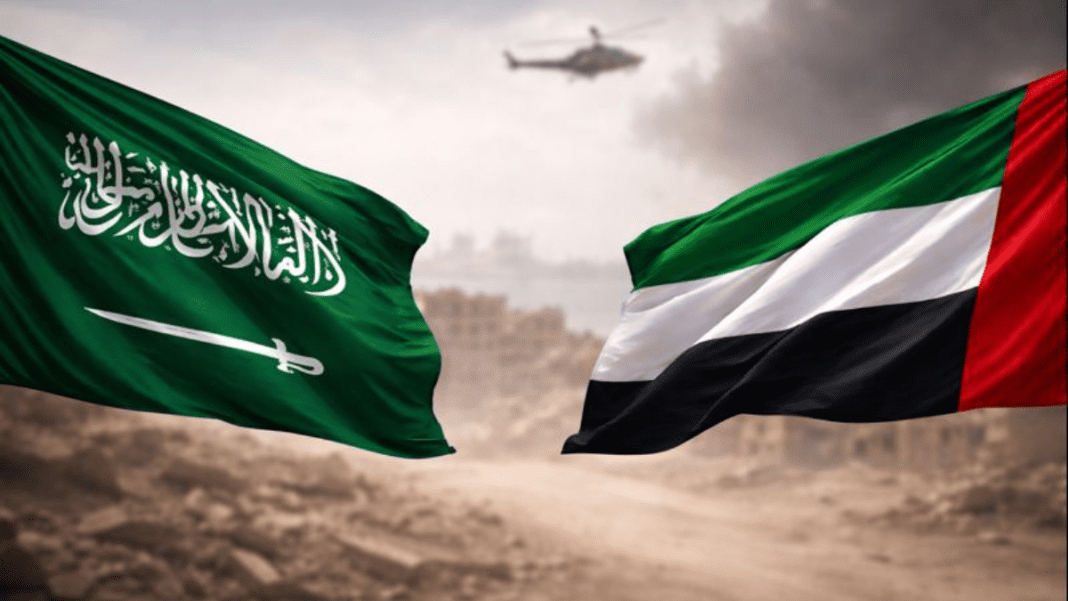

A quiet, yet significant power struggle is emerging between Saudi Arabia and the United Arab Emirates (UAE) after a key incident in Yemen exposed growing differences between the two countries. Once seen as closely aligned on Middle Eastern affairs, they continue to present a united front publicly, but recent developments have highlighted a widening gap in their strategic interests. The rift stems from differing alliances, political ambitions, and approaches to shaping the region, rather than direct military conflict.
Following events in Yemen, the visible tension has intensified. However, this rivalry has deeper roots, linked to various conflicts across Africa and the Middle East. The relationship, once defined by close coordination, now reflects shifting priorities and competing strategies, placing it under growing strain.
Different Visions Drive Regional Influence
The tension centers on two different approaches to how regional power should be exercised. Saudi Arabia has increasingly centered its foreign policy on stability, economic security, and state-based diplomacy. Its strategy focuses on strengthening recognized governments, preserving borders, and working through global frameworks such as the United Nations.
According to Kristian Coates Ulrichsen, Saudi Arabia has little interest in prolonged military involvement and instead prioritizes regional calm to support its domestic development plans. This approach aims to limit chaos near Saudi borders and reduce risks that could spill over into the kingdom.
Saudi Arabia deports over 13,000 in a week as immigration crackdown widens
The UAE, however, has adopted a more flexible and indirect strategy. As described by Andreas Krieg, Emirati influence is often built through local actors rather than central governments. This includes support networks involving armed groups, security forces, ports, trade routes, and media platforms. The goal is to gain access and leverage without relying on formal political agreements.
This method has allowed the UAE to expand its reach across Yemen, Sudan, Somalia, and other strategic areas. Supporters say this model is adaptable and efficient. Critics argue it weakens national institutions and creates long-term instability.
Yemen Incident Brings Tensions to the Surface
In late December, Saudi Arabia launched air strikes on the Yemeni port city of Mukalla, making the underlying rivalry public. Saudi officials stated that these strikes aimed to prevent what they described as a weapons shipment from the UAE to the STC, a separatist group in southern Yemen.
The UAE denied the allegation, claiming the arms were intended for its own forces. Saudi Arabia mentioned that it had issued prior warnings and considered the shipment a regional security risk. Hesham Alghannam noted that geographic factors closely tie into Saudi concerns.
Saudi Arabia bombs UAE-linked arms shipments in Yemen as southern separatist crisis intensifies
The STC operates in Hadramout province, which shares a long and sensitive border with Saudi Arabia. From Riyadh’s perspective, the presence of a separatist force in that area without Saudi alignment is unacceptable.
This marked the first direct military confrontation between Saudi Arabia and the UAE, both of which are members of the same Yemen coalition. Shortly after the incident, the UAE announced the withdrawal of its remaining troops from Yemen. While this reduced immediate friction, it did not address the deeper policy divide.
Clashing Positions Across the Middle East and Africa
The Saudi-UAE split is also evident beyond Yemen. In Sudan, Saudi Arabia has supported internationally recognized authorities and engaged in mediation efforts. The UAE, meanwhile, has faced accusations of backing the Rapid Support Forces (RSF), a powerful paramilitary group linked to widespread violence.
Differences are also clear in the Horn of Africa. When Israel recognized Somaliland as separate from Somalia, Saudi Arabia joined most Arab states in opposing the move. The UAE did not publicly object and maintains close ties with Somaliland and Israel.
Relations with Israel further highlight the divide. The UAE has normalized relations with Israel, expanding cooperation in trade and security. In contrast, Saudi Arabia has stated that it will not establish similar relations until progress is made toward Palestinian statehood.
EU freezes Israel sanctions after Trump-brokered peace deal — diplomacy reshapes Middle
East strategy
In Syria, Saudi Arabia actively supports efforts to reinforce the central government and restore national unity. Meanwhile, the UAE has faced accusations of encouraging separatist movements among certain local groups, adding another layer of disagreement.
Public reactions in both countries have grown sharper, especially on social media, where citizens openly criticize each other’s governments. While diplomatic relations remain intact, the pattern of opposing strategies is increasingly clear.