
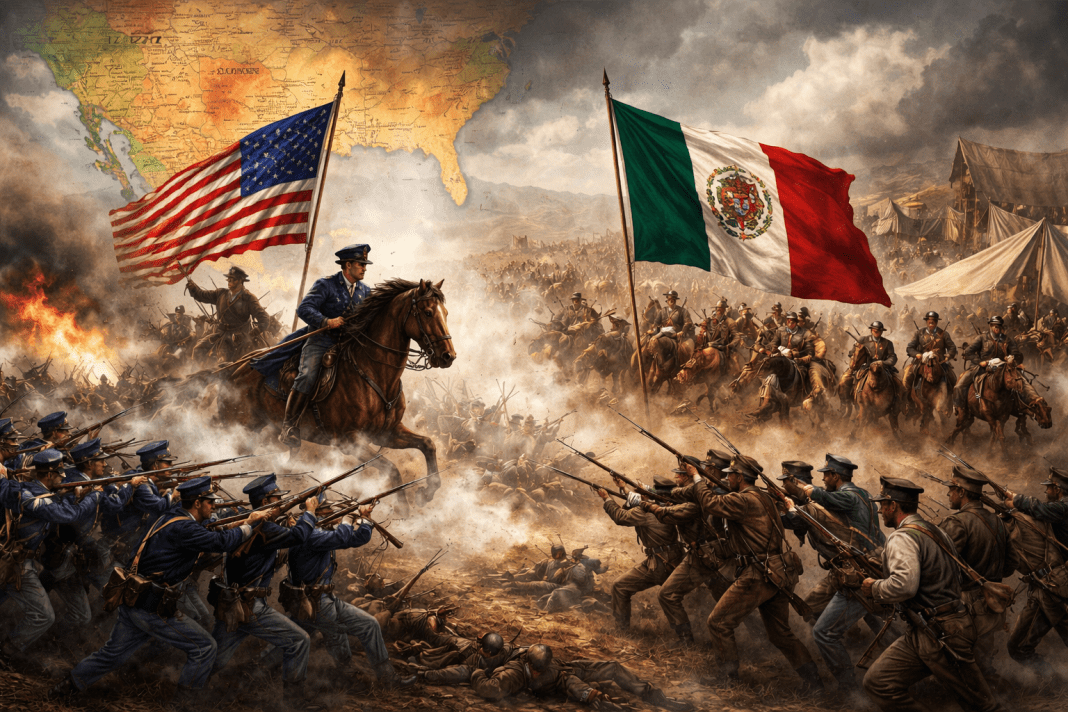

Historians, political observers, and foreign leaders are criticizing the Trump administration. The backlash followed a White House statement on the Mexican-American War. The statement sparked outrage in both Mexico and the United States. Critics say the administration is misrepresenting history. They argue it is being used to justify a tougher stance toward Latin America.
White House Statement Triggers Backlash From Historians
The controversy began when the White House released a statement marking the anniversary of the Mexican-American War of 1846–1848. It described the conflict as a “legendary victory” that secured the American Southwest and strengthened U.S. sovereignty.
The statement also linked the war to current U.S. policies toward Latin America. It claimed the conflict’s lessons guide efforts to protect the southern border, enforce the rule of law, and keep the Western Hemisphere safe.
Mexico trapped between Trump tariffs and Cuba blackout crisis as oil supplies face cutoff
Critics noted the statement did not mention the role of slavery or the suffering of Native American communities during U.S. expansion. One passage said the administration was inspired by the war to defend the country from “forces of evil, violence, and destruction.”
Historians quickly pushed back. Alexander Aviña of Arizona State University said the statement ignored the violence and human cost of the war. He called the idea that the conflict was defensive historically inaccurate and said many scholars view it as an act of U.S. imperialism.
Why the Mexican-American War Remains a Sensitive Topic
The Mexican-American War began in 1846 after years of tension over borders and territory. The United States had annexed Texas in 1845, a move Mexico did not recognize. American settlers had been moving into Mexican-controlled lands for years, increasing friction between the two countries.
At the time, slavery was a major issue. Mexico had banned slavery, while many leaders in the United States sought new territories where slavery could expand. U.S. abolitionists feared that the war was partly driven by an effort to add more slave states.
After two years of fighting and repeated U.S. military victories, the United States forced Mexico to surrender more than 525,000 square miles of territory. These lands later became parts of present-day Arizona, California, Nevada, Utah, New Mexico, Texas, and western Colorado.
Trump warns of possible Mexico strikes as US reviews options to curb cartel violence
The war reshaped North America but left deep scars. During the westward expansion known as Manifest Destiny, U.S. expansion displaced hundreds of thousands of Native Americans from their ancestral lands. Many historians argue that this period involved widespread violence, broken treaties, and cultural destruction.
Former U.S. President Ulysses S. Grant later wrote that the United States waged one of its most unjust wars against Mexico, describing it as a conflict fought by a stronger nation against a weaker one. Scholars often cite his words as a warning rather than a celebration of the war.
Because of this history, the war remains a painful subject in Mexico. It also continues to influence diplomatic relations, especially when U.S. leaders speak about military action, border enforcement, or sovereignty.
Regional Reaction and Broader Pattern of Rewriting History
Reaction to the White House statement spread rapidly on social media, with many users accusing the Trump administration of glorifying conquest while ignoring key historical facts. Critics said the language minimized the violence and human cost of the Mexican-American War.
In Mexico, President Claudia Sheinbaum responded with a mix of humor and firmness. During a news briefing, she laughed at the statement but emphasized the need to defend national sovereignty. Sheinbaum has maintained a cautious approach toward the Trump administration, often balancing cooperation with subtle sarcasm. Her remarks followed earlier tensions, including Trump’s controversial decision to rename the Gulf of Mexico as the Gulf of America, which drew widespread criticism in Mexico.
After U.S. action in Venezuela, Mexico takes urgent steps to shield borders and security
Historians say the statement reflects a broader effort by the Trump administration to reshape how U.S. history is presented. Albert Camarillo, a history professor at Stanford University, described the message as distorted and imperialist, arguing that it supports the administration’s “America First” agenda across the Americas.
Scholars also point to government actions such as revisions to Smithsonian exhibits and the removal of historical content from federal websites. Critics argue these steps erase decades of academic research and replace historical accuracy with political messaging, turning a long-settled historical debate into a modern political tool.