
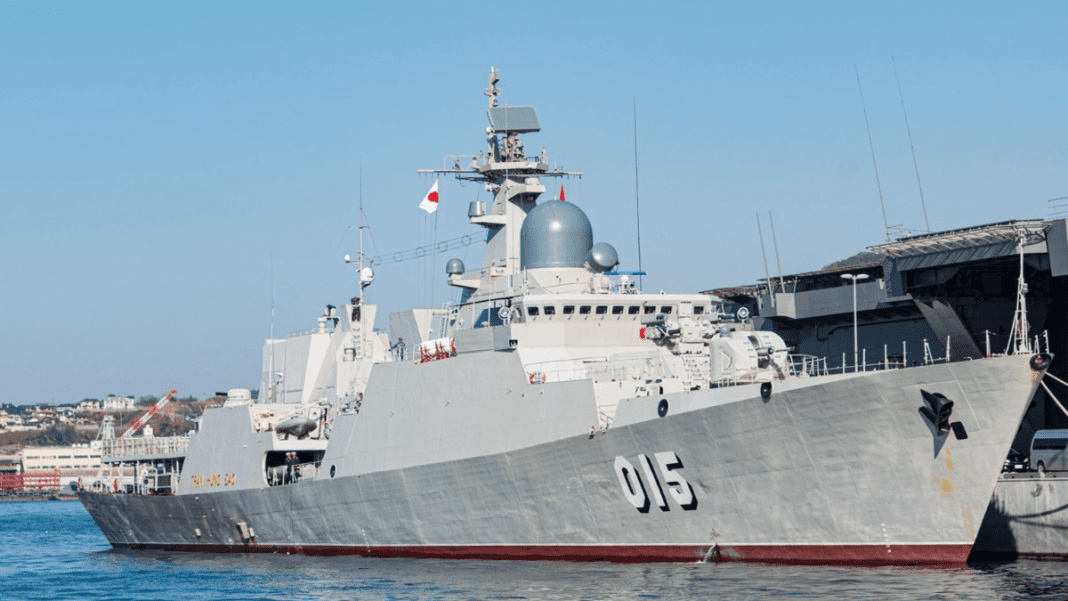

Vietnam’s modern frigate, Tran Hung Dao, has arrived at Japan’s Kure Naval Base. The visit signals a high-stakes maritime engagement in the Western Pacific. This deployment also includes stops in China and South Korea. It highlights Vietnam’s growing naval presence and its efforts to strengthen defense ties across Northeast Asia.
The arrival of Tran Hung Dao at Kure Port on December 7 marks a significant moment for both Hanoi and Tokyo. The visit demonstrates Hanoi and Tokyo’s effort to deepen the 2018 Joint Vision on defense cooperation. This agreement is designed to increase military collaboration between the two nations. Over the next few days, the Vietnamese crew will take part in ship tours, professional discussions, and informal exchanges with the Japan Maritime Self-Defense Force (JMSDF). These activities allow both sides to share operational practices and expertise.
Diplomatic and Strategic Significance of Tran Hung Dao
The Kure stopover is not just a routine port visit; it reflects Hanoi’s carefully balanced approach to regional diplomacy. Vietnam deployed Tran Hung Dao from Cam Ranh and conducted a four-day port call in Qingdao, China, before arriving in Japan. The navy plans a subsequent visit to South Korea, showing Hanoi’s strategy of maintaining friendly relations with multiple regional powers.
At Kure, Vietnamese and Japanese officers will compare procedures on crew organization, safety protocols, and standard operational practices. These exchanges are a practical demonstration of Vietnam and Japan’s upgraded Comprehensive Strategic Partnership, linking tactical cooperation with broader political ties. The visit also reinforces a pattern of Southeast Asian nations engaging in deeper maritime security cooperation with Japan, a country increasingly focused on regional stability in congested sea lanes.
Tran Hung Dao: Modern Frigate at the Center of Regional Diplomacy
Tran Hung Dao is a Gepard 3.9 frigate, one of four Russian-built Project 11661E ships in Vietnam’s fleet. It measures around 102 meters in length and weighs roughly 2,100 to 2,200 tonnes at full load. Designed for patrol, escort, and area defense in coastal waters, Tran Hung Dao can reach speeds above 28 knots and has a range of approximately 4,000 nautical miles.
The frigate carries a robust suite of weapons suitable for the busy waters of the Western Pacific. Its main gun, the AK 176M 76 mm, can quickly target both surface vessels and low-flying aircraft. Two quadruple launchers for Kh-35 Uran anti-ship missiles allow Tran Hung Dao to engage enemy vessels over 100 kilometers away.
Air defense systems, torpedo tubes, and a flight deck for a light anti-submarine helicopter provide close-in defense. The helicopter extends Tran Hung Dao’s sensor range beyond the radar horizon and enhances the ship’s situational awareness.
The frigate uses 3D air and surface search radars, a modern combat management system, and electronic warfare tools to disrupt enemy targeting. These features allow it to operate alongside other navies in multinational exercises, sharing real-time tactical information. The combination of advanced technology and operational flexibility makes the ship an effective tool for both diplomacy and maritime security.
Boosting Regional Naval Cooperation
For Japan, hosting Tran Hung Dao aligns with long-term efforts to deepen military and maritime security cooperation with Southeast Asian nations. Port visits, joint training exercises, and limited equipment sharing are part of Tokyo’s broader strategy to ensure stability in the Indo-Pacific.
🔥South China Sea Shock: Vietnam’s Secret Island Boom Stuns Rivals Amid Rising Tensions🔥
For Vietnam, sending one of its most advanced frigates on an extended diplomatic deployment highlights the growing reach of its navy. Visits like this allow Vietnam to demonstrate both political goodwill and tactical capability. Tran Hung Dao is relatively small compared to some modern warships. However, its presence in Japanese waters carries significant strategic and symbolic weight.
The stop at Kure also gives the Vietnamese navy a rare opportunity to conduct operational-level discussions aboard the frigate. These discussions link technical skills with the broader political relationship between the two nations. The combination of diplomacy, naval technology, and operational knowledge ensures that even a single ship can play a major role in regional maritime engagement.