
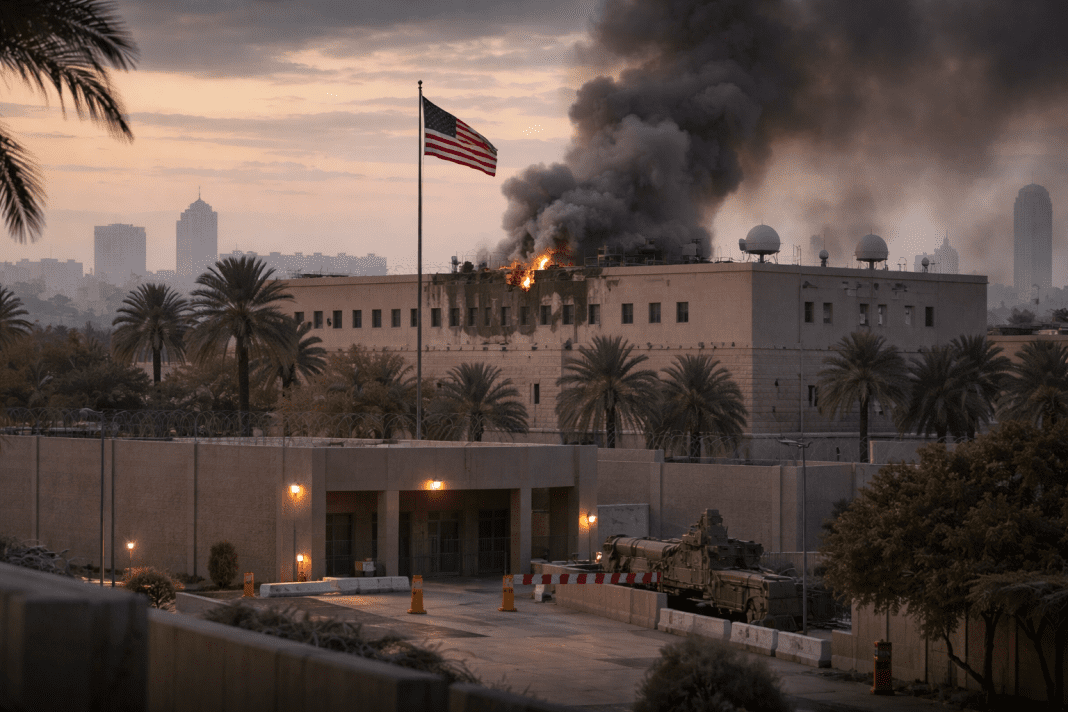

The United States has ordered non-emergency government staff and their families to leave Saudi Arabia starting March 8, 2026. The decision comes as security threats linked to the Iran conflict increase. Essential personnel will remain to manage critical operations. Routine consular services have been suspended. American citizens in the country have been advised to stay alert and follow embassy safety guidance.
Drone Strike in Saudi Arabia Raises Alarm at Diplomatic Facilities
Security concerns rose after a drone struck the United States Embassy compound in Riyadh on March 3, 2026. Initial reports said the attack caused limited damage and a small fire inside the compound. Later intelligence findings indicated that the drone hit an intelligence office located on the top floor of the embassy building, which is part of the security infrastructure operating within the diplomatic facility.
Although the strike did not cause major structural damage, it raised serious concerns about the ability of hostile groups to reach highly protected locations. Following the attack, Saudi air defense systems remained on high alert across the capital.
Pakistan holds talks with Saudi Arabia on Islamic defence cooperation amid Middle East tensions
In the days after the incident, air defense units intercepted several additional drones believed to be heading toward Riyadh. Many of these were detected near the Diplomatic Quarter, one of the most secure districts in the city, which houses multiple embassies and government buildings. Authorities have since increased monitoring and defensive measures around sensitive sites.
Mandatory Departure Reflects Growing Security Risks
The shift from a voluntary departure to a mandatory departure indicates that officials believe the security threat in Saudi Arabia has increased. Earlier, non-essential government staff and their families were given the choice to leave the country if they felt unsafe. Under the new order, however, those personnel and their family members are now required to depart.
This decision has also affected embassy operations. Routine consular services have been temporarily suspended. These services normally include visa processing, passport renewals, and other forms of assistance provided to the public. With fewer staff remaining, the embassy is focusing only on essential operations.
Rare public rift: Saudi Arabia claims UAE aided escape of wanted Yemeni leader
The diplomatic mission has also issued updated safety guidance for Americans who remain in Saudi Arabia. Citizens have been asked to stay alert and prepare a personal safety plan in case conditions change suddenly. They are encouraged to follow official updates and emergency instructions from the embassy.
Authorities have also urged Americans to enroll in official emergency notification programs. These systems allow the embassy to quickly send alerts and safety information if new risks arise. In addition, citizens have been advised to reconsider travel to Saudi Arabia due to the growing security concerns and ongoing regional tensions.
Regional Tensions Spread Across the Gulf
The current crisis began on February 28 after joint military strikes targeted sites linked to Iran. The strikes quickly triggered retaliatory threats and rising military activity across several countries in the Gulf region, increasing tensions and security concerns.
Since then, security officials have reported potential threats to American facilities in neighboring countries. Locations in Kuwait, Bahrain, and the United Arab Emirates have been placed on higher alert levels. Military bases, diplomatic offices, and other government installations are now operating under stricter security procedures while monitoring possible drone or missile threats.
The conflict has also disrupted travel and transportation across the Gulf. Several countries temporarily closed parts of their airspace due to security concerns. As a result, airlines have canceled or rerouted many commercial flights, creating travel disruptions across the region.
For Americans still in Saudi Arabia and nearby countries, these disruptions have made travel plans more difficult. With fewer commercial flights available, leaving the region has become more complicated. Authorities have advised travelers to monitor airline updates and stay in contact with the nearest embassy or consulate for assistance.