
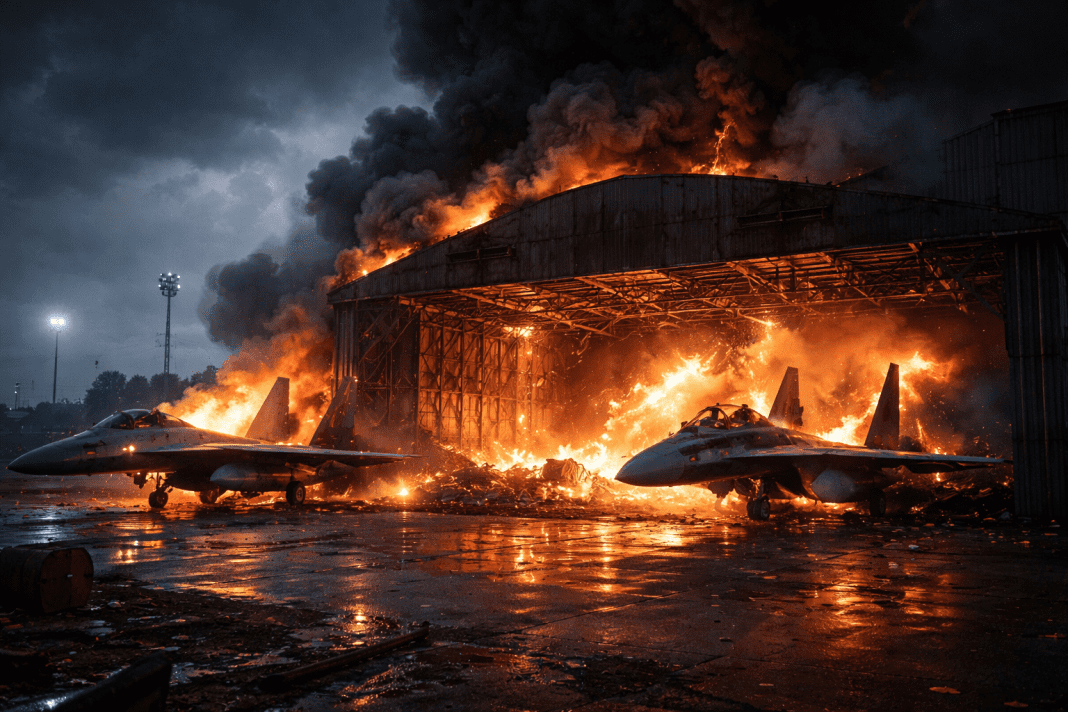

In a daring operation deep inside Russian territory, Ukrainian partisans set fire to two Russian fighter jets. The attack occurred during the late hours, at a military airfield near Lipetsk Oblast, on the night of December 21, 2025. According to Ukrainian authorities, the strike was reported by Ukrainian military intelligence, the Main Directorate of Intelligence (HUR).
As a result, the destroyed jets include a Su-30 and a Su-27. Both aircraft are considered key components of Russia’s military aviation fleet.
The targeted airfield is located roughly 340 kilometers, or about 210 miles, from the Ukrainian border. According to HUR, the operation was carried out by a representative of the Ukrainian resistance movement. The operative infiltrated the military facility under cover of darkness. The attack was executed without being detected.
Lipetsk Airfield Operation Causes Major Fire
HUR reported that the jets caught fire inside a hangar at the Russian airfield. The Su‑30 and Su‑27 were completely destroyed in the blaze, dealing a significant blow to Russian military assets. Ukrainian intelligence described the operation as carefully planned and meticulously executed.
According to HUR, the resistance operative spent two weeks studying patrol routes and guard schedules to identify the safest time to enter the airfield. This preparation allowed the operative to enter the facility, attack the jets, and leave undetected, showcasing a high level of strategic planning.
The Ukrainian agency emphasized the operation’s uniqueness and highlighted the skill and professionalism involved in carrying it out. HUR described it as part of ongoing resistance efforts to weaken Russian military capabilities even inside Russia itself.
Value and Role of the Destroyed Jets in Lipetsk
The Su‑27 is a Russian twin-engine fighter jet mainly designed for air superiority missions, while the Su‑30 is a two-seat, multirole fighter jet with advanced avionics and a longer operational range. It can carry out both air-to-air and air-to-ground missions, making it an important tool for Russia’s military operations.
HUR estimated that the combined value of the destroyed jets could reach up to $100 million, reflecting the high cost of modern military aircraft. These jets are routinely used by Russia to patrol the skies, intercept enemy aircraft, and conduct air strikes against Ukrainian positions. Their destruction reduces the operational capacity of Russian air forces in the ongoing conflict.
Part of Broader Ukrainian Efforts
This operation is one of several recent strikes carried out by Ukraine against Russian military assets. Just a day before, on December 20, Ukrainian drones reportedly targeted two Russian Su-27 fighter jets. The attack took place at the Belbek military airfield. The airfield is located in Russian-occupied Crimea.
Norway considers using its trillion-euro fund to back €100 billion Ukraine loan
Since the beginning of the full-scale invasion in February 2022, Ukrainian forces have reportedly destroyed hundreds of Russian aircraft. This information was provided by Ukraine’s General Staff. The reported losses highlight the scale of damage to Russian air power over the course of the war.
The Lipetsk operation shows how Ukraine is expanding its military efforts beyond the front lines. Ukrainian forces are increasingly operating deep inside Russian territory. These actions are aimed at disrupting key military assets. They also focus on damaging critical infrastructure used by Russian forces.
HUR stated that operations like this are designed to reduce the effectiveness of Russian forces. The goal is to target valuable military equipment and infrastructure. Such attacks are intended to limit Russia’s ability to carry out air and ground operations.
Impact on Russian Military Readiness
The raid in Lipetsk Oblast demonstrates the growing capabilities of Ukrainian partisan forces. It also shows the impact of precise and well-planned sabotage missions. According to Ukrainian intelligence, these actions affect Russia’s overall military readiness.
The Lipetsk airfield raid adds to a series of strategic strikes targeting Russian aviation and other military resources. It underscores the resourcefulness of Ukrainian forces and their resistance networks operating inside Russian territory. According to intelligence reports, such attacks continue to weaken Russian air power, creating challenges for military operations over Ukraine.
By successfully destroying high-value assets like the Su‑30 and Su‑27 fighter jets, Ukrainian forces have delivered another symbolic and strategic blow to Russia’s military operations, even deep within Russian-controlled areas. The operation also highlights how covert, well-coordinated missions are playing an increasingly significant role in the conflict between Ukraine and Russia.