
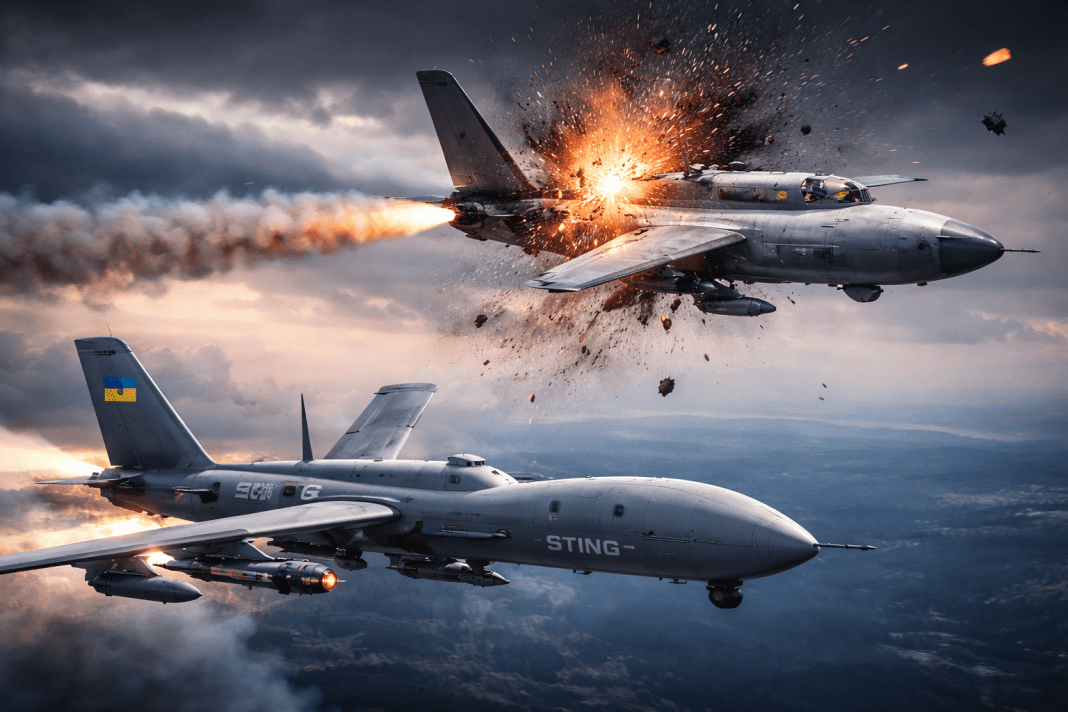

Ukrainian STING drone downs missile-armed Shahed in rare mid-air interception
Ukraine has confirmed a rare and technically significant aerial interception after a Ukrainian STING interceptor drone shot down a Russian Shahed (Geran) kamikaze drone that was equipped with an air-to-air missile. Video footage of the engagement was released by the Ukrainian defence technology group Wild Hornets, providing visual evidence of what experts describe as an escalation in drone-versus-drone warfare.
The interception was carried out by remote pilots from the 1020th Anti-Aircraft Missile and Artillery Regiment of the Ukrainian Ground Forces. According to available information, the STING drone successfully struck the Shahed while it was in flight, neutralising the threat before the missile could be launched.
This incident marks the third confirmed case of Russia deploying kamikaze drones armed with air-to-air missiles, highlighting a growing shift in how unmanned aerial vehicles are being used in the conflict.
How the STING interceptor disabled the R-60 missile threat
The Ukrainian STING interceptor drone did not simply destroy the Shahed’s airframe. According to technical details released alongside the footage, the strike hit the tail section of the R-60 missile mounted on the drone. This area houses critical components, including the turbo-generator, gas generator, and the PRD-259 sustainer motor.
Ukraine says Russia’s war losses pass 1.22 million as drone and artillery destruction surges
Damage to this section is significant. Even if the missile’s warhead did not detonate, the impact would have rendered the missile inoperable by disrupting its power supply and propulsion system. Analysts say this kind of precision hit shows a high level of remote piloting skill and targeting accuracy.
The R-60 is a Soviet-era short-range infrared-guided air-to-air missile originally designed for fighter aircraft. When mounted on a drone, it gives the operator the ability to threaten Ukrainian helicopters or low-flying aircraft. The effective launch range of the R-60 is estimated at around 7 to 8 kilometres.
Video evidence suggests the Shahed was destroyed or disabled before it could carry out its intended mission, preventing the missile from being used.
Russia’s growing use of missile-armed kamikaze drones
This interception is not an isolated case. It is the third confirmed instance of Russia using a Shahed-type drone equipped with an R-60 missile. Similar incidents were reported on December 1 and January 14. In the January 14 case, the missile recovered from a downed drone showed no visible damage, suggesting the Ukrainian strike may have hit the drone itself rather than the missile.
According to Ukraine’s Defence Intelligence, the R-60 missile is mounted on the upper part of the drone’s airframe using a standard aircraft launcher, the APU-60-1MD, adapted for unmanned use. The drone carries two cameras, one in the nose and another positioned behind the missile launcher.
Video transmission and command signals are relayed using a Chinese-made Xingkay Tech XK-F358 mesh modem. If a Ukrainian aircraft or helicopter is detected, the operator can remotely issue a command to launch the missile. After launch, the missile’s infrared seeker locks onto the target independently.
In addition to R-60 missiles, Ukrainian officials report that Russia has also begun fitting some kamikaze drones with MANPADS.
What this interception reveals about drone warfare in Ukraine
The downing of a missile-armed Shahed by a Ukrainian interceptor drone highlights how quickly drone warfare is evolving. Both sides are now using unmanned systems not only for ground attacks but also for aerial combat roles traditionally carried out by manned aircraft and air defence systems.
The Shahed involved in this incident was a Geran-2 model from the E series. Much of its internal hardware remains standard for other Shahed variants, including a 12-channel Kometa satellite navigation module designed to function under electronic warfare conditions.
The drone’s electronics reportedly include a British-made Raspberry Pi 4 single-board computer, tracking equipment, and GSM modems for telemetry. This configuration allows relatively stable control and data transmission during combat missions.
For Ukraine, the successful interception demonstrates the growing role of specialised interceptor drones like the STING. The release of verified video footage adds credibility to the claim and provides rare insight into how these engagements unfold in real time.