
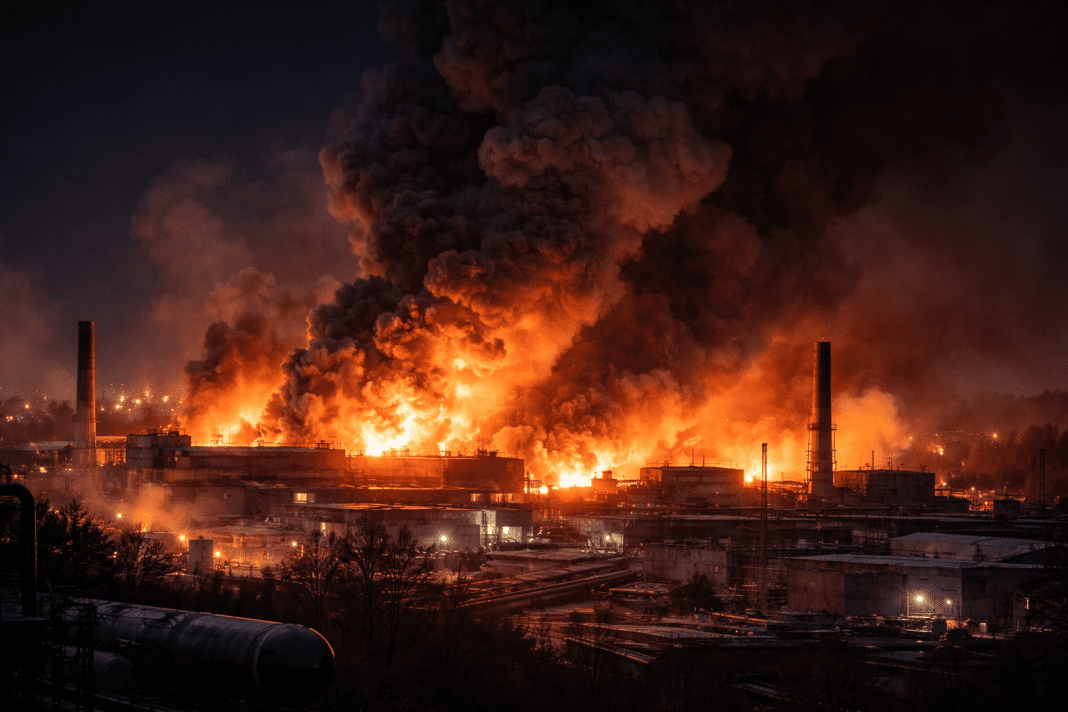

A major Russian missile manufacturing facility was reportedly hit overnight on February 21, according to independent monitoring sources and regional officials. The attack targeted the Votkinsk Machine Building Plant, a key defence site in Russia’s Udmurt Republic. The plant is known for producing some of the country’s most advanced missile systems, including tactical and intercontinental missiles.
What Happened Overnight
On the night of February 20–21, residents in Votkinsk and surrounding areas suddenly heard multiple loud explosions. Meanwhile, thick smoke was seen rising high into the sky, creating a dramatic scene that was captured in videos circulating online. Analysts who examined these clips noted that the flames and smoke appeared roughly half a kilometre from the center of the plant, indicating that the attack struck near key production areas.
Following the explosions, local authorities confirmed that a facility in the region had been targeted by drones, causing both damage and injuries. Officials did not immediately identify the plant, however, the head of the Udmurt Republic described the incident as an attack and urged the public not to spread unverified information.
Ukraine seizes 201 sq km land near Zaporizhzhia as Starlink restrictions hit Russian communications
The incident was serious enough that aviation authorities imposed temporary flight restrictions at nearby Izhevsk Airport. The restrictions were prompted by reports of drone activity over the region, raising concerns about air safety and potential threats to nearby civilian areas.
About the Votkinsk Plant and What Was Hit
The Votkinsk Machine Building Plant is one of Russia’s most significant defence production sites. Located approximately 1,400–1,500 kilometres (870–930 miles) from the Ukrainian border, the facility manufactures a variety of missiles, including:
- Iskander‑M tactical ballistic missiles, which are used by Russian forces on active battlefields.
- Oreshnik intercontinental ballistic missiles (ICBMs), capable of long-range strikes.
- Topol‑M and Yars strategic missiles, which form part of Russia’s nuclear deterrent.
In addition to complete missiles, the plant produces engines and other key components necessary for missile assembly. Eyewitness reports and videos suggest that two workshops — numbered 22 and 36 — were damaged in the attack. These workshops are central to the production and assembly of missile components, meaning the strike may have affected core operations rather than peripheral buildings.
Casualties and Weapons Involved
The regional health ministry reported that 11 people were injured in the strike. Three were hospitalized for treatment, while the remaining individuals received outpatient care. Fortunately, no fatalities were reported at the time of the announcement.
Russia’s Iskander missile production rises threefold, fueled by growing industrial ties with China
Open-source intelligence groups and Telegram monitoring channels indicated that the strike may have involved long-range “Flamingo” cruise missiles, rather than simple drones. These missiles can travel significant distances and are capable of reaching deep into Russian territory. As of now, Russian authorities have not officially confirmed the type of weapon used, leaving experts and analysts to piece together the details from available reports.
Why the Votkinsk Missile Plant Strike Matters
The Votkinsk Plant is considered a high-value strategic facility. It produces missiles that are deployed by the Russian military in various operations. The plant is also under international sanctions. These include restrictions from the United States, United Kingdom, European Union, Japan, Australia, Switzerland, and Ukraine. This makes it a sensitive target from both military and geopolitical perspectives.
Ukraine downs Su-34 bomber and Su-30 fighter, dealing costly blow to Russian air force
Residents reported seeing bright flashes in the night sky. They also heard multiple explosions. Smoke was spotted rising directly from the facility. Some nearby communities observed drones in the area before the blasts. This suggests that the attack may have been carefully planned and executed.
Several local chat groups indicated that smoke and fire came directly from areas where missiles are assembled. This highlights the possibility that the strike hit vital parts of the plant, not just surrounding buildings. Videos captured by citizens confirm the severity of the damage. The attack was visible from several parts of the city.