
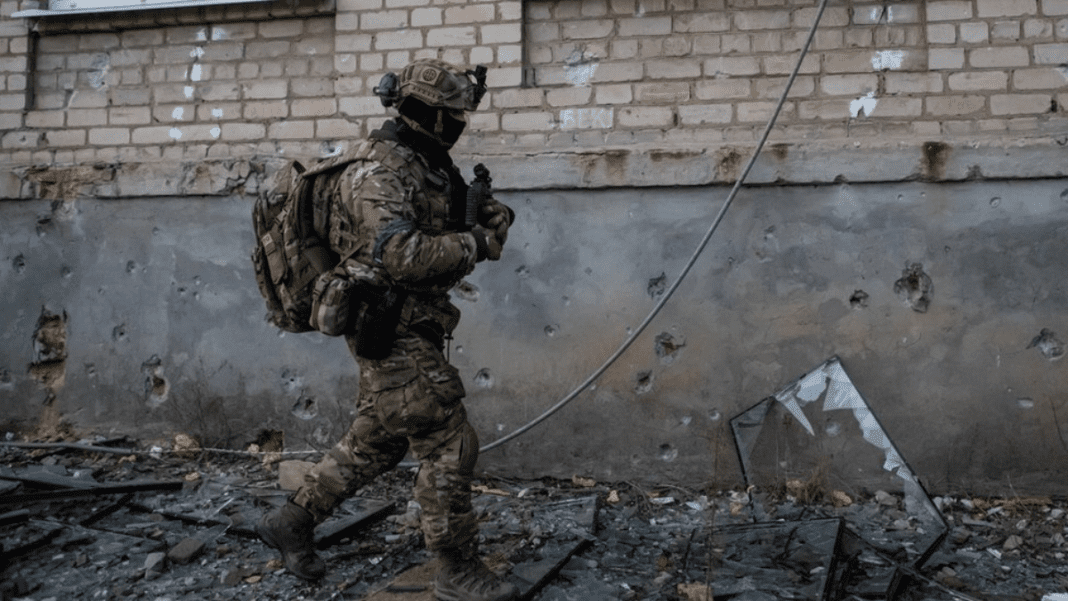

Russia claimed major victories this week, saying its troops captured Kupyansk and Pokrovsk and were advancing elsewhere. However, Ukrainian officials and independent analysts quickly labeled these as false claims, showing maps and satellite images proving the cities remain contested and Ukrainian forces still hold significant areas.
Conflicting False Claims About “Captured” Cities
Over the weekend, Russia’s top military leaders briefed President Vladimir Putin. They told him that Russian forces had fully taken Pokrovsk in the Donetsk region and Vovchansk in the Kharkiv region. They also repeated that Kupyansk had been captured.
However, Ukrainian President Volodymyr Zelenskyy quickly rejected these false claims. He said Russia had made some advances, but none were major successes.
Ukrainian OSINT platforms—groups that analyze open data like satellite photos and battlefield videos—supported Zelenskyy’s statements.
Trump shocks world after saying Russia should keep Ukrainian land ‘to stop the killing
DeepState, a well-known Ukrainian mapping site, reported that Russia holds only parts of Pokrovsk, and the rest is still being fought over. In Vovchansk, Ukrainian forces control more than half the city. In Huliaipole, another town Russia claimed to be capturing, most areas remain under Ukrainian control.
Other expert groups, including the Institute for the Study of War (ISW), also confirmed that Ukrainian troops were still resisting inside all these cities. They noted that none of the places Russia claimed to have already taken were truly under full Russian control. Analysts said these false claims are often made to create a perception of Russian progress even when little or no ground is gained.
A Repeated Pattern of Inflated Battlefield Reports
Experts say this is not the first time Russia has overstated its gains. DeepState analysts described a familiar pattern seen across multiple regions. Russian troops clear a neighborhood or a single block, quickly announce that the entire area has been “captured,” and then rotate fresh soldiers into the area. But when those units arrive, they often lose the same ground again.
This happened in Kupyansk earlier this year. Russian Chief of the General Staff Valery Gerasimov claimed Russia had taken the entire city. But independent battlefield maps still showed Ukrainian units inside multiple districts. Even weeks later, a large part of the city remained under Ukrainian defense.
Ukrainian President Zelenskyy said his troops had “cleared almost all Russian soldiers out of Kupyansk,” contradicting Russia’s false claims.
Analysts believe these false claims may be intended to impress the Kremlin leadership rather than reflect real military progress.
Ukraine imposes sanctions on 62 for stealing resources and heritage from occupied lands
The timing is also notable. Putin is preparing to meet Steve Witkoff, a U.S. special envoy who is expected to present a peace plan discussed with Ukrainian officials. Analysts say Russia might want to look stronger at the negotiating table by issuing false claims of victories.
Putin has repeatedly argued that the war will continue until Russia captures the entire region or Ukraine hands over land during negotiations. Because of this, Russia has strong political reasons to make false claims even when the front line has barely changed.
Negotiations, NATO, and False Claims Shaping the Talking Table
The fighting on the ground is closely tied to the tense negotiations happening behind the scenes. Talks are focusing on some of the most difficult issues—territory and NATO membership.
U.S. officials say their role is not to pressure Ukraine but to help both sides find a realistic path toward an agreement. However, Russia continues to demand that Ukraine withdraw from the non-occupied areas of Donbas. Ukraine says that is impossible both politically and constitutionally.
Ukraine also told American diplomats it will not change its constitution to block NATO membership, nor allow Russia to control who can or cannot join the alliance.
While security guarantees are not a major source of disagreement, territory remains the biggest sticking point of the talks. For Russia, claiming they have captured key cities boosts their argument that they hold leverage. But Ukrainian officials continue to challenge these statements, exposing them as false claims.
Zelenskyy urged the public to rely on official Ukrainian military updates instead of rumors or exaggerated reports. He explained that the front line is a “living, shifting contact line” that changes every day, and that misinformation can be dangerous during sensitive peace discussions.
In the midst of this, Ukraine carried out fresh strikes on Russian supply routes near Pokrovsk. Ukrainian aircraft targeted a critical road used by Russian infantry after Russian troops posted videos revealing their movements. This operation further proved that Russia did not have full control of the city, despite their false claims.