
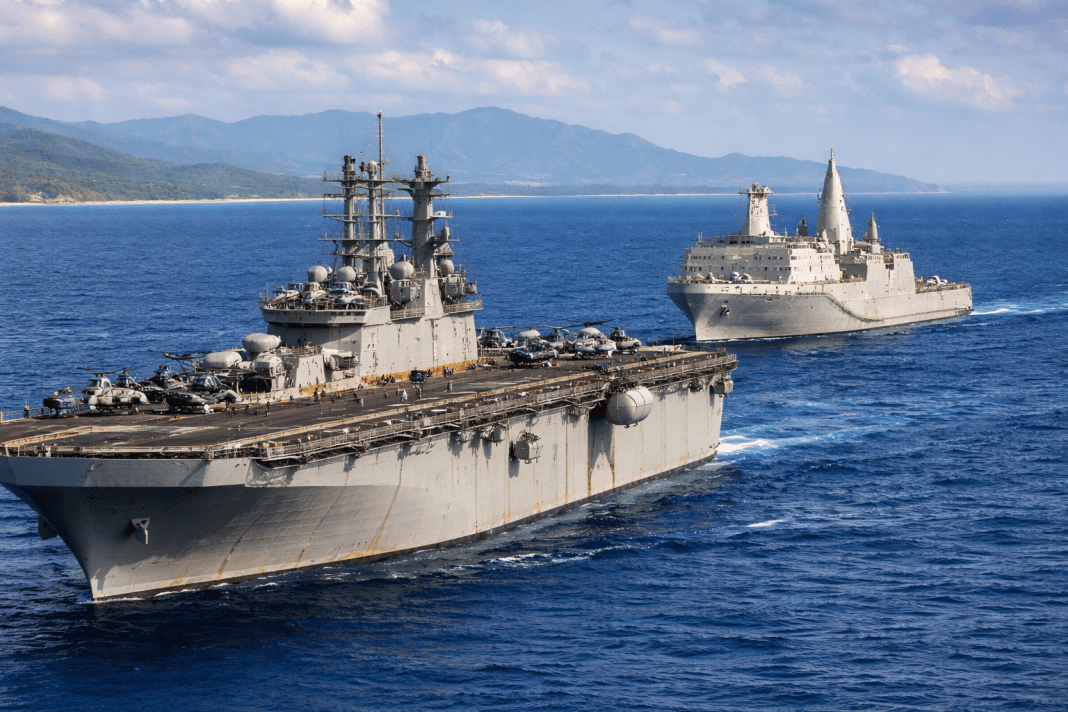

In early January 2026, the United States began shifting key warships to waters north of Cuba in the Atlantic Ocean after a big military push in the Caribbean. Two important U.S. Navy ships, the USS Iwo Jima and the USS San Antonio, were moved to this area after months of heavy activity near Venezuela. These movements mark a change in how the U.S. military is positioning its forces in the region.
US Ships Moved North of Cuba After Major Mission
The movement comes after a surprise mission on January 3, 2026, known as Operation Absolute Resolve, where U.S. forces captured the president of Venezuela. The U.S. Navy and Marines had gathered a large fleet in the Caribbean for that operation. Afterward, officials confirmed that the fleet began to thin, and the Iwo Jima and San Antonio were ordered to move north toward Cuba. At least one of these ships might soon return to its home base in Norfolk, Virginia.
Despite leaving the waters closer to Venezuela, both ships remain part of U.S. Southern Command and can go back into the Caribbean if needed for further missions.
🌩️ China Builds While Russia Waits: How Beijing Became Cuba’s Last Lifeline Amid Total Grid Collapse
These ships still play a supporting role in ongoing operations in the region. For example, on January 9, 2026, the U.S. Navy and the U.S. Coast Guard seized a Venezuelan-linked oil tanker in the Caribbean Sea. This operation was part of Operation Southern Spear — an effort by U.S. forces to stop illegal maritime activity. Officials said the presence of powerful platforms like the USS Iwo Jima and USS San Antonio gives backing for such maritime operations even if the ships are not directly nearby at all times.
Reports said U.S. forces used the USS Iwo Jima as the first secure location for the Venezuelan leader after they arrested him during the mission. From the Iwo Jima, they then flew him to New York.
What This Means
Although the two warships are north of Cuba, U.S. military operations around Cuba and the Caribbean as a whole have been active for years. The United States has long maintained a presence at Naval Station Guantanamo Bay in Cuba, which is used as a logistic hub and operations base for many military activities in the region.
For instance, U.S. forces have used Guantanamo Bay for housing and processing migrants as part of immigration enforcement operations. This use has included expanding facilities to hold hundreds of individuals under various enforcement missions.
Reports of Nicolás Maduro capture prompt Venezuelan army to mobilise entire population against US
In addition, U.S. naval units like the USS St. Louis have supported logistical efforts at Guantanamo Bay, such as helping to expand the base’s migrant operations center. These activities show that Guantanamo Bay continues to be a key location for multi-purpose U.S. operations in the Caribbean.
Even as ships like the Iwo Jima and San Antonio position farther north, the broader U.S. naval presence in the region remains ready and capable. U.S. naval leaders have emphasized that forward-deployed forces can respond quickly where needed, whether for security, enforcement of maritime laws, or other missions directed by U.S. Southern Command.
Tensions Around Cuba and Regional Reactions
The presence of U.S. military forces near Cuba and throughout the Caribbean has not been without controversy. The Cuban government has publicly expressed hostility to recent U.S. actions. Cuba reported that U.S. forces killed dozens of Cuban nationals who were serving as bodyguards during the raid in Venezuela. These claims have increased tensions between the two governments, while U.S. officials continue to emphasize their goals of security, law enforcement, and mission success.
The U.S. military has also shifted its focus by moving naval forces north of Cuba after finishing the major operation in Venezuela. News reports say that military commanders have moved many aircraft that supported the January 3 mission out of the Caribbean, showing that U.S. forces have completed the main objective of capturing the Venezuelan leader.
At the same time, U.S. forces continue to be active in capturing vessels linked to criminal activity on the seas. Recent seizures highlight ongoing enforcement operations aimed at stopping illegal oil transport and other illicit maritime actions.
From Europe to Cuba: Guantánamo Bay Set to Hold 9,000 Undocumented Migrants in Secret Transfe
Despite reduced numbers, the U.S. military remains positioned in ways that allow quick return to the Caribbean if future missions demand it. Ships and aircraft that have moved north are still part of the command structure responsible for operations in the Western Hemisphere.
Overall, the relocation of naval assets near Cuba shows a shift from active combat operations to a sustained security presence and enforcement role, ensuring U.S. interests and regional maritime security remain protected.