
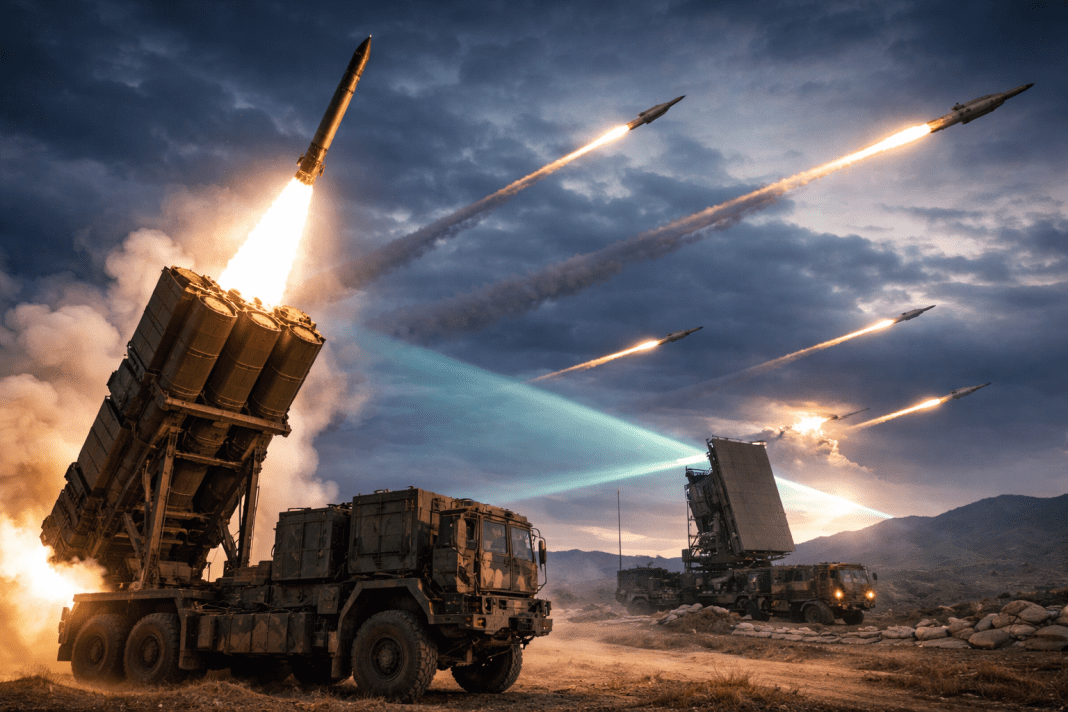

The American Patriot air defense system has long been seen as one of the most effective shields against enemy missiles. It has successfully intercepted ballistic and hypersonic threats and protected cities, bases, and key infrastructure. However, recent battlefield reports show that this system has a serious weakness. Russian forces have learned how to take advantage of a blind spot in the Patriot system, pushing the United States to work on urgent technical changes.
How the Patriot System’s Blind Spot Became a Battlefield Problem
The Patriot missile system does not launch missiles straight up like many modern air defense systems. Its launchers are angled in one direction, which means the system is most effective against threats coming from the front. Missiles approaching from behind or from unexpected angles are harder to intercept.
In simple terms, Patriot must first turn toward the incoming threat before it can fire. This takes time, and in missile defense, even a short delay can allow a fast-moving missile to break through. If an attack comes from outside the main coverage area, the system may struggle to respond quickly enough.
Ukraine’s air shield falters — Russia shifts missile tactics to confuse U.S.-made Patriot defenses
Russian Iskander-M ballistic missiles are built to be fast and difficult to track. Reports suggest they have been launched in ways that take advantage of Patriot’s limited engagement sector, approaching from angles where interception is more difficult.
There is also a missile performance issue. Older Patriot interceptors lose speed and energy when they must make sharp turns after launch. This reduces their ability to hit high-speed targets. U.S. military officials say this problem is largely related to software limitations.
The radar adds another challenge. Traditional Patriot radars focus on a single sector rather than full 360-degree coverage. Together, launcher limits, radar gaps, and missile behavior have created a weakness that adversaries appear to be exploiting.
U.S. Response with New Launchers and Over-the-Shoulder Missiles
To address this issue, the United States is working on a major upgrade to the Patriot system. The most important change involves a new type of launcher. Instead of angled launchers, the new design would use vertical launch technology.
A vertical launcher fires missiles straight up. Once airborne, the missile can quickly turn toward the target in any direction. This allows full 360-degree engagement without needing to rotate the launcher on the ground.
Along with the new launcher, the U.S. is developing new interceptor missiles. These missiles are designed to fire “over the shoulder,” meaning they can engage targets coming from behind the system. This capability would remove one of Patriot’s biggest weaknesses.
The new missiles may be linked to the Lower-Tier Future Interceptor program. This project was originally meant to replace the PAC-3 MSE missile, which is currently used by Patriot units. However, the program was paused in 2024 due to high costs.
Even though that program was halted, parts of its technology and research are still relevant. Engineers are now focusing on making interceptors that can maneuver more efficiently after launch and maintain their speed and power even when making sharp turns.
U.S. military officials have noted that older Patriot missiles struggle with backward engagement mostly because of software restrictions. Updating software alone is not enough, so new missile designs are being explored to solve this problem at the root.
Radar Upgrades and Global Comparison with Other Air Defense Systems
Fixing the launcher and missile alone is not enough, as the radar system also plays a crucial role. To intercept threats from any direction, the system must be able to detect missiles coming from all sides at the same time. This need has driven the development of the new LTAMDS radar.
Unlike older Patriot radars that focus on a limited sector, LTAMDS offers full 360-degree coverage. It can track multiple incoming threats from different directions without rotating, greatly reducing the risk of surprise attacks. Although the radar has been in development for several years, it has only recently entered limited production, marking an important step toward closing the Patriot system’s long-known blind spot.
🚨 U.S. intel: Patriot air defense crumbles as Russian missiles outmaneuver interceptors
Earlier efforts to modernize Patriot included the Medium Extended Air Defense System, or MEADS, which aimed to introduce greater mobility and vertical launch capability. However, the project was never fully adopted. Another explored option involved adapting Patriot missiles for the Navy’s Mk 41 vertical launch system, proving that Patriot interceptors can work with vertical launch technology in certain setups.
Many global air defense systems already use vertical launch designs, including the S-300, S-400, HQ-9, and SAMP/T. While these systems offer 360-degree engagement, they have not matched Patriot’s proven effectiveness against ballistic and hypersonic missile threats.