
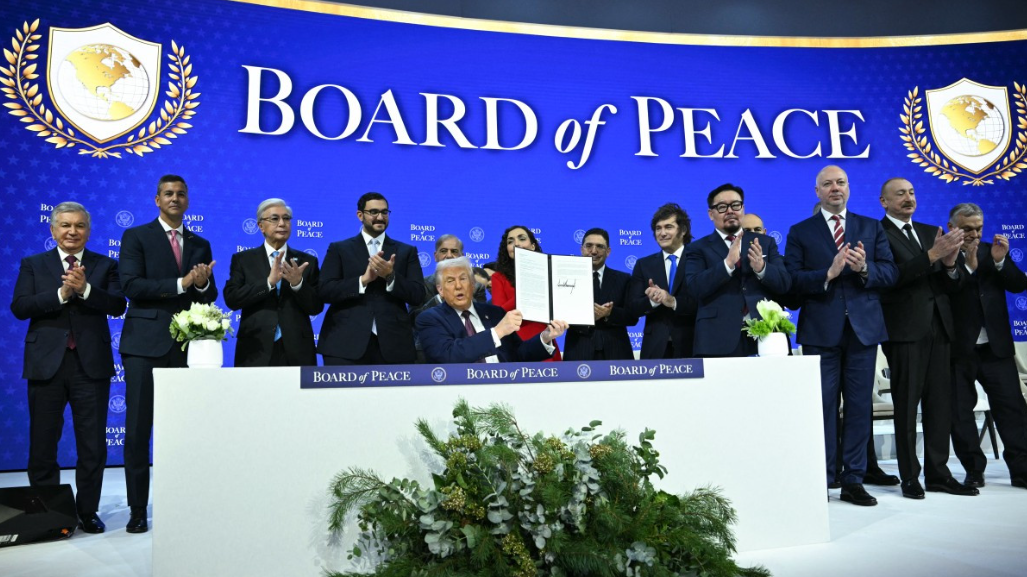

U.S. President Donald Trump on Thursday launched a new initiative called the Board of Peace. It is a global panel aimed at addressing conflicts such as the fragile Gaza ceasefire. The initiative has raised questions about its relationship with the United Nations.
The move has drawn attention from world powers. Many are watching closely as Trump positions himself at the center of international diplomacy.
Trump’s Board of Peace Aims to Expand Beyond Gaza
“Once this board is completely formed, we can do pretty much whatever we want to do,” Trump said during the launch at the World Economic Forum (WEF) in Davos. “And we’ll do it in conjunction with the United Nations,” he added, highlighting the board’s potential to work alongside the U.N., which he suggested has not been fully utilized.
Trump, who will chair the board himself, invited leaders from dozens of countries to participate. The initial focus of the board is on Gaza and its fragile ceasefire.
Beyond Gaza and Lebanon: Israel confronts a growing mental health emergency in its military
However, Trump indicated the board could eventually address other global conflicts as well. This ambitious plan has raised concerns that it might challenge the U.N.’s traditional role as the main platform for international diplomacy.
Mixed Global Reactions to Trump’s New Board
The Board of Peace has already attracted support from some regional and emerging nations. Countries such as Turkey, Egypt, Saudi Arabia, Qatar, and Indonesia have joined the initiative. However, major global powers and traditional Western allies of the United States have been more cautious.
According to reports, Russia is still reviewing the proposal. President Vladimir Putin expressed willingness to contribute $1 billion from frozen U.S. assets to support the Palestinian people, signaling tentative interest. France has declined to join, the United Kingdom has not committed, and China has yet to announce a position. Notably, Israel and the Palestinian Authority were absent from the signing ceremony, though Israel’s Prime Minister Benjamin Netanyahu has accepted an invitation to participate.
Hamas fighters open fire near Khan Younis in ceasefire breach as IDF reports risk to aid flow
The U.S. Secretary of State, Marco Rubio, described the board’s mission as focusing on ensuring the Gaza peace plan is implemented. He added that the initiative could “serve as an example of what’s possible in other parts of the world,” signaling Trump’s broader ambitions for the panel.
Few of the countries that have officially joined the board are democracies. Argentina, Hungary, and Israel, where leaders are closely aligned with Trump’s political approach, have committed to participate. Other prominent members include Jared Kushner and Steve Witkoff, U.S. negotiators involved in Gaza, as well as former British Prime Minister Tony Blair.
Addressing Gaza’s Fragile Ceasefire
The new Board of Peace was launched to stabilize the Gaza ceasefire. The ceasefire has faced repeated disruptions since an agreement in October. Clashes between Israel and Hamas have caused hundreds of Palestinian deaths. Several Israeli soldiers have also been killed. Both sides blame each other for violations.
Jared Kushner, Trump’s son-in-law and a key negotiator, said the next phase of the plan will focus on humanitarian aid. It will also include rebuilding Gaza and disarming Hamas. He said, “If Hamas doesn’t demilitarize, that would be what holds this plan back.” This points to one of the toughest challenges ahead.
Some progress has been reported. Palestinian committee leader Ali Shaath said the Rafah border crossing with Egypt, Gaza’s main entry point, will reopen next week. This move offers relief amid the ongoing humanitarian crisis.
Calm before the storm? Gaza ceasefire hangs by a thread as Hamas digs in
Trump emphasized that the board’s work will complement the U.N. The U.N. formally endorsed the initiative through a Security Council resolution linked to the Gaza plan. U.N. spokesperson Rolando Gomez clarified that the organization’s involvement is limited to this context.
The Board of Peace has sparked both interest and concern. Supporters see it as a new approach to long-standing conflicts, while critics warn it could undermine global institutions. Trump, however, expressed confidence that working with select world leaders could create “something very, very unique for the world.”