
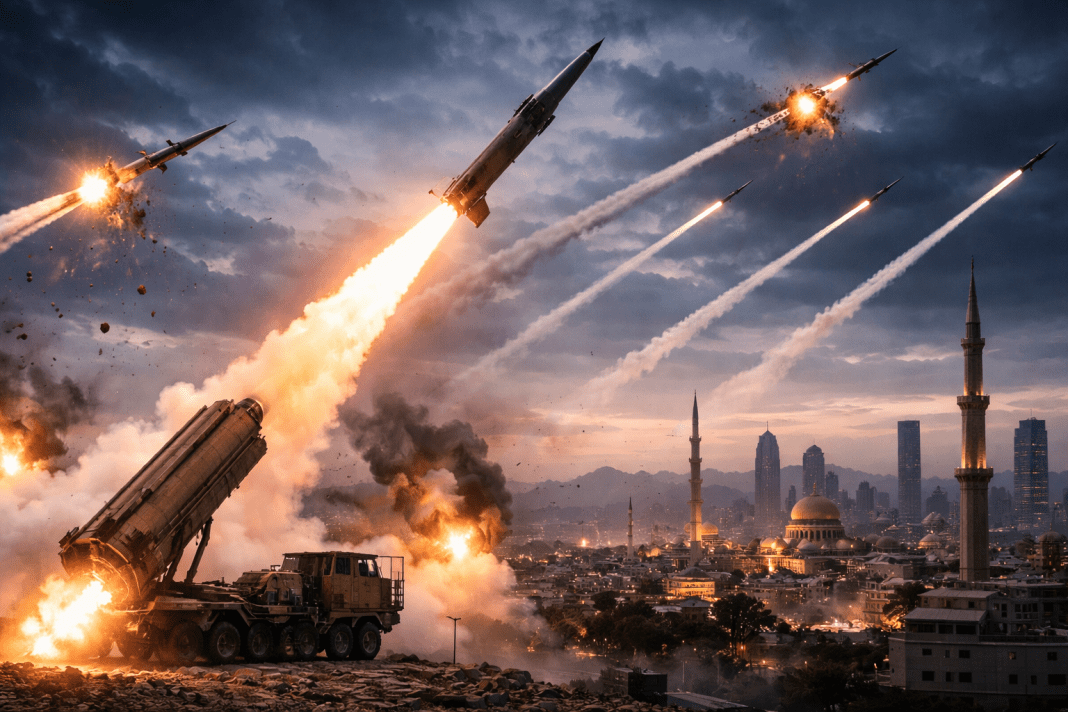

The conflict in the Middle East has rapidly transformed into a high-tech confrontation, with the skies becoming the main battlefield. Missile strikes and defence systems now dominate the situation, replacing traditional ground combat. Iran’s ballistic missiles and advanced systems like THAAD drive this critical contest, highlighting how modern warfare relies on speed, precision, and cutting-edge technology.
A conflict that moved to the skies
The ongoing conflict in the Middle East has evolved into a high-stakes battle in the sky. What began on February 28 with coordinated strikes by the United States and Israel on Iranian targets has now stretched into its 32nd day. Iran’s swift retaliation with missile attacks has sharply increased tensions across the region.
This is no longer just a ground war. It is a technology-driven conflict where missiles and defence systems play a decisive role. Iran’s use of ballistic missiles has become a central factor, while the United States has deployed advanced systems like THAAD to intercept them.
United States reviews missile defense after Iran reportedly destroys THAAD radar in Jordan
Ballistic missiles are powerful weapons designed to travel long distances at high speeds. They are classified by range, from short- to intercontinental. After launch, they follow a curved path through space before descending toward targets. Iran has mainly used short- and medium-range missiles, putting constant pressure on defence systems across the region.
How THAAD defends against incoming threats
The ongoing conflict in the Middle East has turned into a high-stakes battle in the sky. What began on February 28 with coordinated strikes by the United States and Israel on Iranian targets has now entered its 32nd day. Iran’s swift retaliation with missile attacks has sharply escalated tensions, creating a dangerous and unpredictable situation across the region.
This is no longer just a ground-based conflict. It has become a technology-driven confrontation where advanced weapons systems play a decisive role. Iran’s use of ballistic missiles has emerged as a key factor, while the United States has deployed sophisticated defence systems like THAAD to intercept these incoming threats.
Damaged radar systems impact Israel’s defense as Iran missile strikes bypass sensors
Ballistic missiles are among the most powerful weapons in modern warfare. They are built to travel long distances at extremely high speeds, making them difficult to stop. These missiles are classified by their range, from short-range to intercontinental systems.
After launch, ballistic missiles are powered briefly before following a curved path high into the sky. They then descend toward their targets at high speed. In this conflict, Iran has primarily relied on short- and medium-range missiles, keeping constant pressure on defence systems and intensifying the aerial dimension of the war.
THAAD vs ballistic missiles: A high-speed battle
The current conflict has become a real-time test of how effective THAAD is against Iran’s missile arsenal. During ongoing operations, the United States has deployed THAAD alongside other defence systems, including Patriot missiles, to intercept incoming threats and protect key locations.
Together, these systems have reportedly achieved interception rates of over 90 percent in certain areas, particularly in the United Arab Emirates. This shows that they have successfully neutralised most incoming missiles and drones before they could reach their targets, demonstrating the strength of modern missile defence networks.
However, the situation is not entirely one-sided. Iran has claimed that it has managed to strike and damage some THAAD installations. If these claims are accurate, it could reduce the effectiveness of the defence shield and increase the likelihood of successful missile attacks.
Another growing concern is the high rate of interceptor usage. Each interception reduces the available stockpile, and with continuous missile attacks, there are fears that supplies could run low. Replacing these interceptors requires time, coordination, and significant resources.
The battle between THAAD and ballistic missiles is often described as a race against time. Detection systems must act quickly, and interceptors must respond within seconds. This highlights how modern warfare is increasingly shaped by speed, precision, and advanced technology in the skies.