
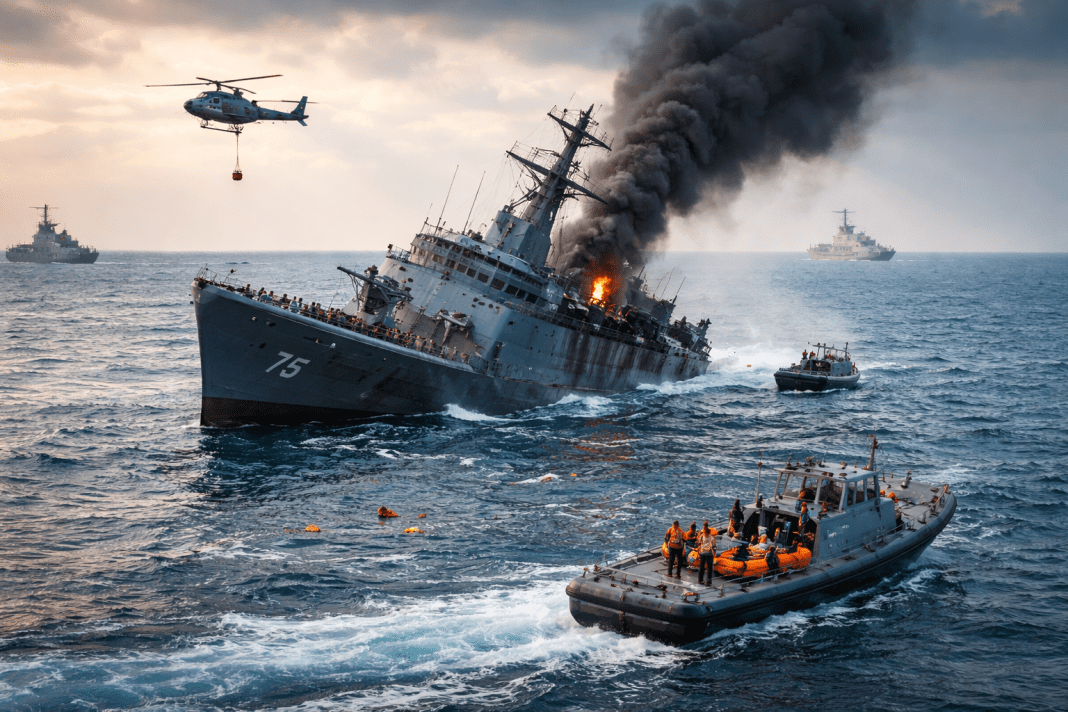

In a dramatic turn of events early Wednesday, Sri Lanka launched a large-scale rescue operation. An Iranian naval frigate had begun sinking just outside the island’s territorial waters in the Indian Ocean. The vessel sent out a distress call at dawn. Sri Lankan authorities received the call and acted quickly. The country’s navy and air force moved into action. They successfully rescued at least 30 sailors from the sinking ship.
Swift Rescue Operation by Sri Lankan Forces in the Indian Ocean
The emergency began early Wednesday. Sri Lanka received a distress call from the Iranian frigate Iris Dena. The ship was in serious trouble in the seas south of the island in the Indian Ocean. Reports indicated that the frigate was sinking about 40 nautical miles off Galle. Galle is a city on Sri Lanka’s southern coast along the Indian Ocean.
The Sri Lankan Navy acted quickly, sending two naval vessels to reach the vessel. A military aircraft was also deployed to locate the sailors and coordinate the rescue. The Sri Lanka Air Force joined the operation, scanning the Indian Ocean to ensure no crew member was missed.
B-1B Lancer bombers strike deep inside Iran in long-range missile operation
By mid-morning, rescue teams had evacuated 30 sailors, many injured, and transported them to Karapitiya Hospital in Galle, where doctors were on standby. Officials described the operation as challenging due to rough seas in the Indian Ocean, but swift action by the armed forces saved lives.
Sri Lanka’s foreign minister briefed parliament on the operation, praising the navy and air force for their quick response and readiness during emergencies at sea in the Indian Ocean.
What We Know About the Frigate and Its Crew
The Iranian frigate involved in the incident, Iris Dena, is an active vessel in Iran’s naval fleet. The ship reportedly had a crew of around 180 sailors, highlighting the scale of the rescue operation. While 30 sailors have been safely rescued, the fate of the remaining crew remains unknown. Authorities confirmed that efforts were concentrated on saving as many sailors as possible from the Indian Ocean.
At this time, the exact reason for the frigate’s distress is still unclear. Officials have not confirmed whether the vessel faced a mechanical failure, rough weather, or some form of damage. The lack of concrete information has created uncertainty about what caused the ship to sink in the busy waters of the Indian Ocean.
The incident comes amid rising tensions in the Middle East. Recent escalations in the Gulf have prompted speculation about whether the frigate could have been affected by regional conflicts. Authorities have so far avoided linking the sinking directly to ongoing military actions, keeping the situation under observation.
During discussions in parliament, a lawmaker asked whether the frigate might have been attacked as part of the wider regional unrest. The government has not responded to these questions, leaving the cause of the incident open to speculation. Meanwhile, rescue operations continue to focus on those still unaccounted for in the Indian Ocean.
Sri Lanka’s Role and Maritime Obligations
Sri Lanka emphasized that the rescue operation was carried out under international maritime rescue obligations. These rules require countries to respond promptly to distress calls from ships in the Indian Ocean, regardless of nationality, as long as the incident occurs within their designated search and rescue area in the ocean.
A spokesperson for the Sri Lankan Navy confirmed that helping the sailors was part of the country’s humanitarian duty. “Our forces acted quickly because saving lives at sea in the Indian Ocean is a responsibility that goes beyond borders,” the spokesperson said.
Hospitals along the southern coast, particularly in Galle, were put on alert to receive the rescued sailors. The city, located about 115 kilometers (70 miles) south of Colombo, became the central hub for emergency medical care and coordination. Local authorities coordinated with naval teams to ensure the smooth transfer of injured personnel and provide immediate support.
The operation underscored Sri Lanka’s readiness to respond to maritime emergencies in the Indian Ocean and highlighted the importance of international cooperation in such crises. Even though the reason behind the frigate’s sinking remains unknown, the rapid response ensured that dozens of sailors were saved from a potentially fatal situation.