
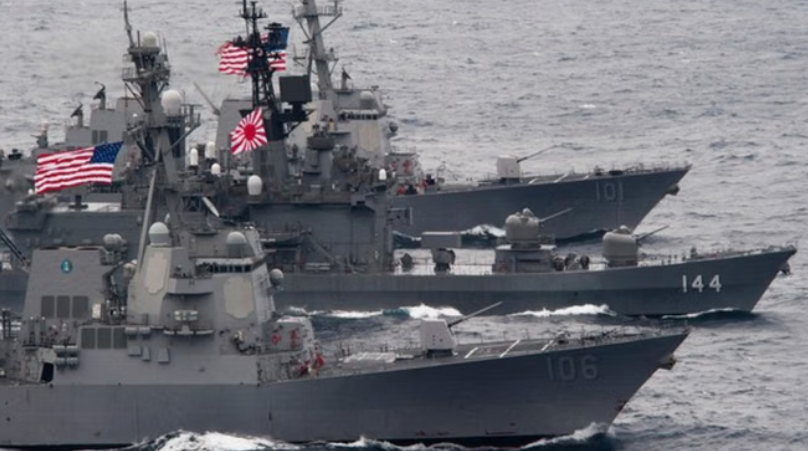

Two U.S. Navy ships, including the guided-missile destroyer USS Truxtun, collided in the Caribbean Sea on Wednesday, leaving two sailors with minor injuries, the U.S. Southern Command reported. The incident occurred during a routine at-sea supply operation, a standard procedure where Navy vessels transfer fuel, food, and other essential supplies while sailing side by side.
Unexpected Sea Accident During Routine Supply Operation
The ships involved were the guided-missile destroyer USS Truxtun and the fast supply ship USNS Supply. During the operation, the vessels sailed very close to each other, often just a few hundred feet apart, while supplies and fuel were moved using specialized hoses and cables. At one point, the ships accidentally bumped into each other, causing the collision.
Military officials confirmed that two sailors sustained minor injuries. Both received medical attention on board and were reported to be in stable condition. After the collision, both ships continued to sail safely, ensuring that naval operations in the region were not disrupted.
U.S. Navy turns to F/A-XX fighter as Iran’s air defenses challenge Super Hornets
Although collisions during supply operations are rare, they can occur even under routine conditions. These maneuvers require precise coordination, careful timing, and steady navigation. A small miscalculation in speed, steering, or communication can lead to a bump or crash when vessels operate in such close proximity.
Collision Involving USS Truxtun and Other Navy Ship
The USS Truxtun had recently departed from Norfolk, Virginia, earlier this month to join a larger U.S. naval force in the Caribbean. The destroyer briefly returned to port for an emergency equipment repair before setting sail again on February 6.
The USNS Supply is a fast supply ship that provides fuel, ammunition, and other critical materials to U.S. Navy warships while at sea. Replenishment-at-sea operations like this are routine for the Navy, but they require extreme focus and precision, making this kind of collision unusual.
The military has not yet disclosed the exact cause of the accident. However, officials confirmed that a formal investigation is underway to gather facts about the collision. Investigations after naval accidents are standard practice and help prevent similar incidents in the future.
For context, the Navy’s last major ship collision occurred in February 2025, when the aircraft carrier USS Harry S. Truman collided with a merchant vessel near the Suez Canal. That incident caused minor damage but no injuries. An investigation later found that the carrier was traveling at an unsafe speed and that the officer navigating the ship did not take sufficient action to avoid the collision.
Large U.S. Naval Force Operating in the Caribbean
At the time of the collision, the U.S. Navy maintained a significant presence in the Caribbean, with about 12 ships deployed in the region. This included the aircraft carrier USS Gerald R. Ford and multiple amphibious assault ships carrying thousands of Marines. The force represents one of the largest U.S. naval presences in the Caribbean in recent decades and is responsible for patrols, support operations, and other missions that require careful coordination.
Officials emphasized that the collision caused no major damage and that the situation remained under control. Both the USS Truxtun and USNS Supply continued their missions without further incident, demonstrating the Navy’s ability to manage accidents safely while maintaining operational readiness.
U.S. Navy recasts Zumwalt destroyer as hypersonic strike asset amid rising China tensions
The U.S. Navy has a long history of at-sea operations that involve careful planning and strict procedures. Despite this, accidents can occur due to the complex nature of naval maneuvers, especially when ships operate in close quarters.
Military leaders are reviewing the incident thoroughly to determine exactly what caused the collision. Their main priority is ensuring the safety of sailors and maintaining the effectiveness of naval operations in the Caribbean.
Both ships are currently operational and have resumed normal activities. The minor injuries sustained by the two sailors are being treated, and officials continue to monitor their recovery.