
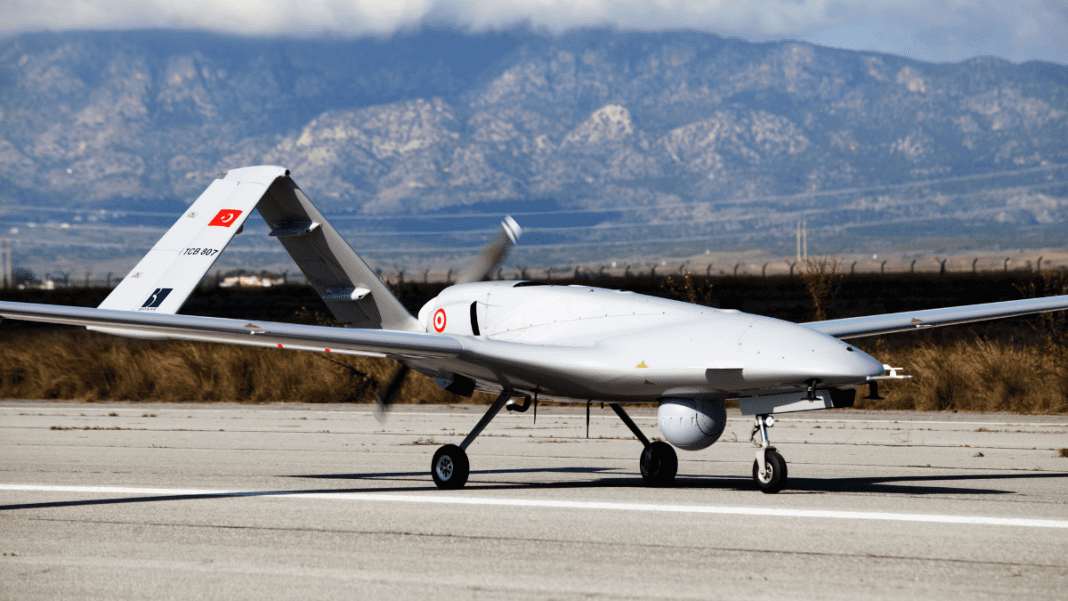

In a stunning demonstration of military technology, Turkey’s Baykar defense company has achieved a global first. Its advanced Bayraktar Kızılelma drone successfully shot down a fighter jet using an air-to-air missile in a controlled test. This achievement marks a historic milestone in the development of unmanned aerial vehicles (UAVs) and their combat capabilities.
The Bayraktar Kızılelma is a jet-powered, supersonic drone that can carry heavy payloads and operate from aircraft carriers. In the recent trial, the drone struck an F-16 fighter jet in a beyond-visual-range engagement, showing its ability to detect, track, and neutralize highly maneuverable targets at a distance.
The Test That Shocked the Aviation World
During the exercise, two Turkish F-16 fighter jets participated. One F-16 flew alongside the Bayraktar Kızılelma, while the other acted as the target. The drone detected the target jet from 30 miles away using its advanced radar system. Once it locked onto the target, the drone launched a radar-guided missile, successfully hitting the fighter in the simulation.
The test was not just about firing a missile. It demonstrated several critical capabilities:
- The drone’s integration with the Turkish Gökdogan beyond-visual-range air-to-air missile (BVRAAM).
- The ability to work seamlessly with the Turkish AESA MURAD radar, enabling detection, tracking, and locking onto targets even in complex conditions.
The successful engagement is being hailed as a groundbreaking moment in aviation history. For the first time, a drone has independently launched a radar-guided air-to-air missile and achieved a direct hit on a fighter jet. This confirms the potential of unmanned drones to perform advanced combat operations that were previously limited to crewed aircraft.
What Makes Bayraktar Kızılelma Special
The Bayraktar Kızılelma stands out for several reasons. It is a supersonic drone capable of reaching speeds faster than the sound barrier, making it extremely agile in the sky. With a maximum take-off weight exceeding 5.5 tonnes, it can carry more than 1,500 kilograms of payload, including weapons and surveillance equipment.
Another key feature is its stealth and low-observable design, which allows the drone to operate in hostile environments while minimizing the chance of being detected. The integration of advanced radars and missile systems enables the drone to act independently in combat, identifying and engaging targets without direct human control.
Turkey Seeks Sanctions Waiver to Maintain Critical Gas Payments to Russia
In addition to the missile test, the Bayraktar Kızılelma recently completed a mid-altitude identification system trial with a Ukrainian engine. This shows the UAV’s ability to operate effectively across different flight levels, further proving its versatility in modern aerial warfare.
Turkey has also unveiled an upgraded version of its well-known Bayraktar TB2 drone, now equipped with artificial intelligence. This new model can autonomously identify targets, make real-time decisions, and perform missions without direct guidance from operators. The combination of AI-powered systems and advanced missile technology in Turkish drones represents a significant step forward in unmanned combat aviation.
Global Implications of the Achievement
This test positions Turkey as a pioneer in the field of unmanned fighter jets. The Bayraktar Kızılelma has demonstrated capabilities that were once thought to be exclusive to crewed aircraft. It highlights how drones are increasingly capable of performing complex combat roles, including air-to-air engagements at long ranges.
Russia’s S-400 turns into Turkey’s headache—airpower crisis mounts as F-35 ban persists
By integrating radar-guided missiles and autonomous operational systems, the Bayraktar Kızılelma represents a new era in military aviation. While fighter jets have long dominated the skies, the successful drone test shows that UAVs can now complement or even match certain combat roles traditionally reserved for crewed aircraft.
The historic flight also underlines the rapid pace of innovation in drone technology. With supersonic speeds, heavy payload capacity, low observability, and advanced targeting systems, drones like Bayraktar Kızılelma are no longer just surveillance tools. They are becoming fully capable combat aircraft, capable of reshaping the future of aerial warfare.