
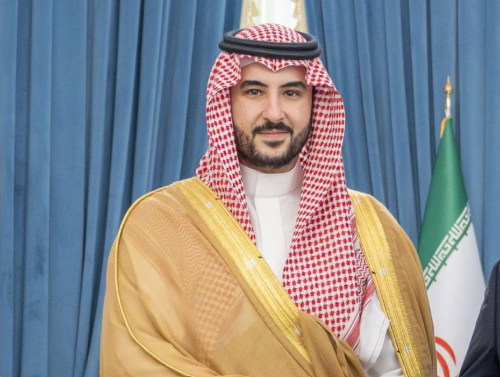

In a private meeting held last night in Washington, Saudi Defense Minister Khalid bin Salman delivered a strong warning about Iran. According to Axios, which cited four people who attended the meeting, bin Salman told U.S. officials that if President Donald Trump does not act on his threats to strike Iran, the Iranian regime “will only grow stronger.”
Bin Salman Urges Caution on Iran Strike
The closed-door meeting lasted about an hour and included nearly 15 Middle East experts along with representatives from five Jewish organizations. During the discussion, Saudi Defense Minister Khalid bin Salman shared his concerns about the rising tensions with Iran.
Bin Salman said that after President Donald Trump’s repeated warnings, the United States may eventually be forced to take military action. At the same time, he stressed the importance of limiting the risk of a wider regional conflict.
He also delivered similar messages during White House meetings a day earlier with senior U.S. officials. Despite his strong warning, bin Salman said he does not know the Trump administration’s current strategy or specific plans regarding Iran.
Meetings with U.S. Officials Focus on Iran Strike
During his White House visit, bin Salman met with key American leaders, including Secretary of State Marco Rubio, Defense Secretary Pete Hegseth, Trump’s special envoy Steve Witkoff, and Chairman of the Joint Chiefs of Staff, Gen. Dan Caine. A source familiar with the discussions said the main focus was exploring whether a U.S. strike against Iran was possible and what it could entail.
Earlier this week, Saudi Crown Prince Mohammed bin Salman had a direct conversation with Iranian President Masoud Pezeshkian. During the call, he made it clear that Saudi Arabia would not allow its territory, airspace, or land to be used for any attack on Iran. The United Arab Emirates had issued a similar statement a couple of days earlier. These moves indicate that key Gulf states are drawing a line when it comes to involvement in any potential military action.
Meanwhile, Iranian leaders have responded with strong warnings. President Pezeshkian urged the government to “listen to peaceful protesters” but accused external actors of trying to exploit unrest to weaken the country. Iranian Foreign Minister Abbas Araghchi added that there is currently “no serious basis for negotiations” with the U.S. He stressed that the atmosphere of threats and pressure must end first and warned that any attack on Iran would trigger a “harsh and very powerful” response.
Signals of an Imminent Strike
Amid rising tensions, some Western sources say a U.S. strike against Iran could happen soon. Iran International, an outlet linked to the Iranian opposition, reported that American and Israeli officials are closely watching developments. According to the report, discussions have moved beyond whether a strike will occur to when it might take place.
A source familiar with the talks said the current approach is different from past U.S.-Israel actions. This time, the aim is not to push Iran back to negotiations but to seriously weaken the Iranian regime, possibly to the point of collapse. The source described the planned action as unprecedented in scale and intensity.
In earlier confrontations, including a brief “12-day war,” the U.S. and Israel avoided taking major risks. However, the source said officials now see the situation as a rare opportunity and are more willing to accept greater risks. If Israel joins the operation, planners could broaden and intensify the attack, and officials are already discussing detailed plans.
On Friday, President Donald Trump said Iran still wants a deal and added that he hopes both sides can reach an agreement. At the same time, he warned that if no deal happens, the situation could change quickly.
These developments reflect growing concern over Iran’s influence, as Saudi Arabia and Iran exchange strong warnings amid mounting regional pressure.