


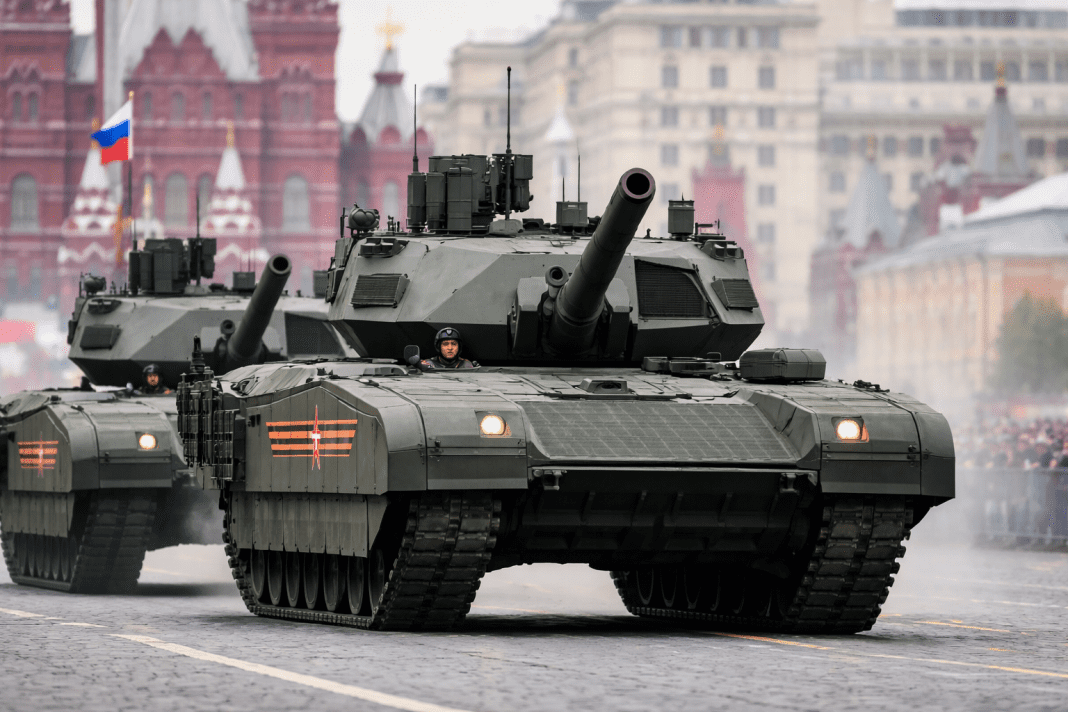


British defense analysts are surprised that Russia has never sent its T-14 Armata tank to the battlefield. The tank is highly advanced. Nearly four years have passed since Russia launched its full-scale invasion of Ukraine. The T-14 Armata is considered one of Russia’s most prestigious military vehicles. Despite this, it mostly appears in parades rather than in combat.
British Analysts Express Surprise at Russia’s Decision
Reports indicate that Russia decided early in 2024 not to send the T-14 Armata tank into combat. Officials said the main reason was cost. Each tank is extremely expensive, with estimates ranging from $5 million to $9 million. For that price, Russia could instead buy several T-90 tanks, which are cheaper, already proven in battle, and easier to produce in larger numbers.
British analysts say this decision is surprising because the Armata is one of Russia’s most advanced tanks. It has modern armor, a high-tech turret, and other cutting-edge features that make it stand out from older models. Many expected it to play a major role on the battlefield, but it has remained in storage and appeared only in parades and ceremonial events.
Russia’s modern tank fleet in crisis — Kremlin resurrects 50-year-old T-72s for Ukraine war
Experts also note a missed opportunity for Ukraine and its allies. Had even one T-14 fallen into Ukrainian hands, Western military specialists could have studied it in detail. This would have provided a rare chance to examine Russia’s latest armored technology up close and learn more about how the tank works in real-world conditions.
Armata Remains a Parade Vehicle, Not a War Machine
The T-14 Armata was unveiled to the world with great fanfare and presented as the next generation of Russia’s main battle tanks. It is equipped with modern armor, advanced electronics, and a remotely operated turret that makes it very different from older tanks. Yet, despite these features, Russia’s own statements show the tank was never intended for full-scale war.
Cargo ship carrying banned Russian steel seized amid probe into Baltic telecom cable damage
The head of Rostec, the state-owned company behind the Armata, publicly confirmed that the tank’s cost makes mass production unrealistic. He explained that while the T-14 surpasses older tanks in performance, it would be more practical to invest in multiple units of other existing vehicles. The admission clarifies why these highly advanced machines have not appeared on the front lines.
For years, Western media speculated that Russia might be afraid of sending the Armata into combat. Concerns included reputational risks if the tank failed under real battle conditions. The fear of failure seemed to outweigh the potential strategic advantages of using the vehicle. As a result, the tank continues to appear primarily during ceremonial events, such as the famous Red Square parades in Moscow.
Cost and Practicality Over Prestige
The decision to keep the Armata out of combat appears to be driven largely by financial and practical reasons. A single T-14 tank costs millions of dollars. Because of this, Russia finds it more effective to focus on tanks that are cheaper, reliable, and battle-tested. The T-90, for example, is much less expensive and already widely used. This allows Russia to keep large numbers of tanks on the battlefield. It also avoids the risk of sending a small number of very costly machines.
Silent Tension in the Channel — British Navy Closely Tracks Russian Submarine in NATO Waters
This decision has sparked discussions in defense circles. Experts talk about the balance between prestige and practicality in modern warfare. The T-14 Armata was meant to showcase Russia’s technological skill. Yet its absence from Ukraine has surprised many abroad. British analysts note the oddity: despite being one of Russia’s top military machines, the tank has never been tested in combat.
Today, the Armata is still a symbol of advanced engineering and national pride. However, it is not a war-tested weapon. The choice shows the challenges nations face when weighing the cost of cutting-edge military gear against the needs of real battle.