
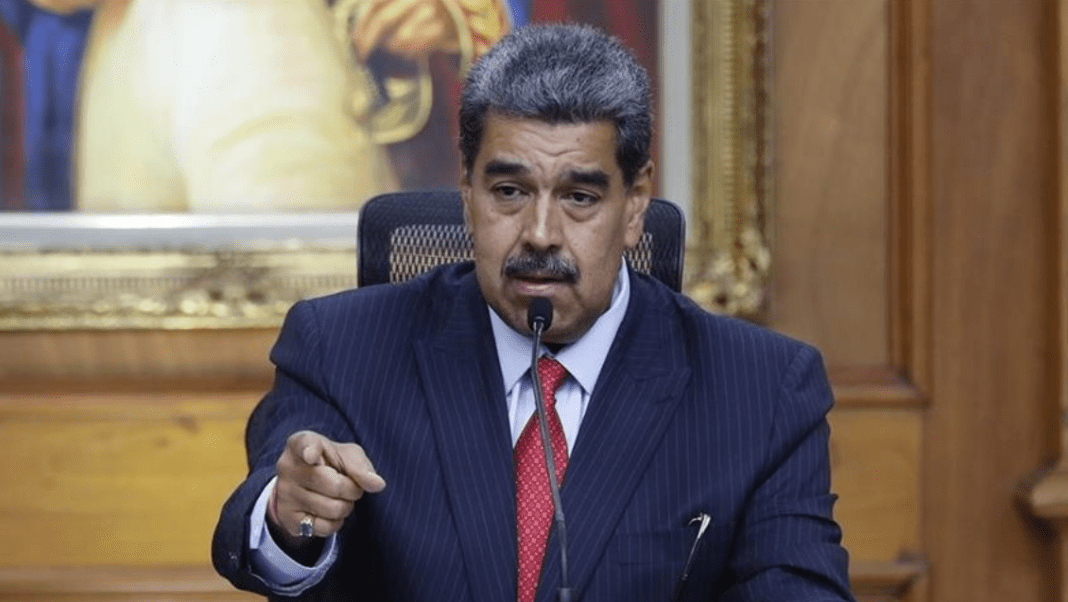

Reports suggesting Venezuelan President Nicolás Maduro was captured have sparked an unprecedented response from his government. After explosions rocked Caracas and US President Donald Trump claimed Maduro’s capture, authorities quickly issued a nationwide order for the entire population to mobilise. Consequently, the government framed the situation as an act of war by the United States, prompting emergency measures, civilian deployment, and rising regional tensions.
Nationwide call to the streets after explosions in Caracas
Shortly after explosions shook Caracas, the Venezuelan government issued an urgent statement calling on citizens to take to the streets. Reports cited by the Economic Times said officials ordered “the entire country” to mobilise immediately, urging all social and political groups to unite against what they called “imperialist aggression.”
The order went beyond a military alert, directly addressing workers, students, and community groups. The government presented the slogan “People to the streets” as a call for unity, saying that everyone had a role in defending the nation.
The mobilisation followed claims by Donald Trump that Nicolás Maduro had captured. While Maduro’s status remained unclear, authorities treated the statement as evidence of a foreign attack. Security forces and civilians filled public areas, as the government emphasised national unity in the face of the alleged external threat.
Emergency decree places entire country under extraordinary powers
To formally legalise the mass mobilisation, the government signed a decree declaring a “State of External Disturbance,” also called “External Commotion,” across Venezuela. This decree grants the state extraordinary powers, allowing it to control resources, transportation, and manpower in the name of national defence.
Under this measure, authorities can rapidly deploy forces and involve civilians directly in security activities. The decree effectively places the entire country under conditions similar to martial law. Officials said the goal was to protect sovereignty and respond quickly to foreign aggression.
Along with the decree, the government announced the activation of “comprehensive national defence command bodies” in every state and municipality. These local command units are designed to coordinate actions between civilians and the military. According to official statements, this structure aims to turn neighbourhoods and communities into organised resistance units.
Defence Minister Vladimir Padrino López addressed the nation in a video message, stating that the armed forces would resist the presence of foreign troops “at any cost.” He described the reported US blockade and strikes as an “open act of aggression” and said they violated international law, including the United Nations Charter.
Authorities emphasised that this was not just an army mobilisation. It was described as a “civil-military” deployment, where civilians and soldiers work side by side in public spaces, infrastructure protection, and local defence roles.
Maduro capture narrative, militias activated, and regional alarm
To build public support, the Venezuelan government has described the crisis as a “war for oil” rather than a move against Nicolás Maduro personally. Meanwhile, Foreign Minister Yvan Gil accused the United States of trying to seize Venezuela’s strategic resources, especially oil and minerals. He said foreign forces were targeting the population not for freedom, but rather to take control of the country’s national wealth.
Furthermore, the government has repeated this message across state television and official platforms. It told citizens that they must resist foreign intervention to protect Venezuela’s independence and resources. The government also argued that it uses claims about Maduro’s capture to justify a wider foreign intervention.
In addition, the mobilisation relies heavily on the Bolivarian Militia, a paramilitary force made up of loyalist civilians. Defence Minister Vladimir Padrino López reaffirmed their role, urging militia members to support society and defend the constitution against what he called “interventionism.” Authorities confirmed that these armed civilians would operate alongside regular military forces.
As a result, the scale of the mobilisation has alarmed neighbouring countries. Colombia activated a unified command post along its border, citing fears of violence spreading and a possible refugee crisis. Meanwhile, Cuba and other allies condemned the reported US actions as “state terrorism” and called for an international response.